we are old

Brigden’s on Richmond St Toronto in 1925

Toronto In 1925, when this photograph was taken, photography was less than a century  old. Fredrick Brigden and his wife had emigrated here in the 1870s from England. He was an engraver by trade and established a small engraving firm here in 1874. The firm became the well respected Toronto Engraving Company in 1877. The photo shown here is an interior shot of Brigden’s Limited (1912-1955).

The Toronto Engraving Company became a family business in 1888, and merged with the Rous and Mann Press nearly century later in 1979. Many companies grew in Toronto catering to the publishing trade.

My title above for this post  is a riff off When We Are Old, a European song sung by Asaf Avidan. I first heard the lyrics on a car commercial.

This photograph is from a better resolution one contained in the archives of the Toronto Public Library (TPL).  My thanks to George Dunbar for discovering this bit of our city’s history and the evolution of photography here.

Posted in history, Uncategorized | Tagged , , | Comments Off on we are old

my dad’s camera

Kodak Junior SIX-20
1935-1937 Model

Toronto. When my father went west to Saskatchewan to help with the harvest as a youth, he took with him a box camera that he used to record life on the prairies. On the way home, the little camera was lost – dad thought it was left on the train at some point.  In the late 1930s when I struggled into this strange world, dad felt a need once again to photograph family events. He bought a Kodak folder called the Kodak Junior Six-20.

After each use, the camera was always returned to its box and carefully placed in the top drawer of the buffet in the living room. This version of the SIX-20 was only made from 1935-1937 according to McKeown’s. The first picture I saw from it was a picture of me a few months old sitting on my grandmother’s lap.

This camera was a big step up for dad. It had a fancier Doublet lens with apertures from f/11 to f/32, (no click stops) and a No. 0 KODON shutter with settings T, B, 1/25th, 1/50th, and 1/100th of a second. A big jump from the box camera’s fixed aperture and “T” and “I” shutter (about 1/25th in”I” for instantaneous setting).

In spite of this new flexibility, the slow films of the day precluded the camera’s use beyond outdoors  during bright days unless special steps were taken to increase the lighting indoors. The camera has an unused 1/4 inch tripod thread and an unused cable release screw. I can still see my dad standing over his camera squinting in the viewfinder and carefully squeezing off the shutter to add to our family history. Film and prints were relatively expensive in the 1930s – 1950s so the camera still looks like new today.

While the plate affixed to it’s bed says “Made in Canada” it was more likely  “assembled” in Canada from parts made in Rochester and sent across the lake to Kodak Heights just north of the city (mid-city today) in Mount Denis. Customs duties of the day were less if assembly was completed here. The little instruction booklet includes a catalogue and a note pasted on page one stating  “prices on some articles do not apply in Canada“.

Posted in camera | Tagged , , | Comments Off on my dad’s camera

photographs indoors

1930s Kodak Brochure

Toronto. Can you imagine a media so insensitive and cameras so slow that a special technique was needed to show amateurs how they could take photos indoors at night. And worse, the resulting negatives and prints were black and white exposures!

In the mid 1930s Kodak published this free brochure to show amateurs how they could take indoor night time photos with any (Kodak) camera having a ‘time’ (T) shutter setting and at least an f/6.3 lens. All they needed were Mazda photoflood lights, or Mazda flash bulbs, and a Kodak reflector and Kodak “SS” Panchromatic film.

Kodak, like many photographic industry giants, earned their money from film and paper purchases more than from hardware. Cameras and accessories were offered so you would buy more Kodak film, paper, and chemistry. As the daytime amateur market reached capacity, new sources of revenue were investigated. One promising new revenue was from the promotion of indoor night time photographs.

“High speed” film, and flood lights let you hand hold the camera, or with a hand held flash bulb holder and reflector, the camera could be placed on a nearby table, set to ‘T’ on the shutter, and the flash bulb triggered at just the right moment. The camera shutter was clicked to set it open, and then after the flash was triggered, clicked again to close. Easy-peasy in the years before smartphones!

Posted in history | Tagged , , , , , , , | Comments Off on photographs indoors

instruction booklets

Using the Kodak Six-20 c1936

Toronto.  In about 1936, my dad bought a Kodak Six-20 folder, a big step up from the box camera he took west with him a few years earlier. Kodak made the folder in this first version from  1935-1937. The rather simple camera was a step up from the box camera he first used, but it came with a 34 page booklet telling the new owner just how to perform various functions and how to take photographs. Imagine – a detailed instruction booklet necessary so the uninitiated amateur had at least a chance to make a Kodak Moment!

Ironically, different makers and different models worked in sometimes non intuitive ways making such booklets essential to the uninitiated so they could at least have a chance of success. There were no standards back then. One had to learn how to use each camera. Some cocked the shutter, then set the speed, others worked in reverse. In some cameras the wrong sequence could actually cause damage, in others the result was an incorrect exposure. My Exakta was intended for left handed operation.

Often for common or inexpensive cameras, the instruction booklets and original packaging  were more valuable than the camera itself. The late John Craig made a business from providing instruction booklets and other ephemera. Initially the booklets were originals, but over time many became reproductions or even pdf files.

One member of the PHSC donated his large collection of very old cameras to a museum in Ottawa. On a visit, he was dismayed that the staff showing his treasures seemed completely flummoxed by how the cameras worked, how to load film, how to make intelligent settings, etc. Worse, after making some 75 short videos to teach how each type of camera functioned, no one passed them on to those in need of such enlightenment!

By the way, our fairs, like the spring fair next month, are a great source of film cameras, films, and instruction booklets. Don’t sleep in and miss out!

Posted in book | Tagged , , , , | Comments Off on instruction booklets

PHSC News April 2019

Toronto. Sonja has whipped up another tasty treat for aficionados of her PHSC News. Like each April issue,  this one has a mixture of articles blending fake and real situations and facts… fun to read and fun to figure out which article/fact is real and which one is fabricated.

Page one has the Timeless Tech story of a novel alarm clock. Check out the camera! Look at the video too (on the linked page).

Page 2 covers our speaker this month and her topic – remember to bring your photos for a look-see and suggestions for conservation. Chloé Lucas speaks on Preventative Conservation for Photographs.

Tired of all the political delays to public transportation in the city while demand escalates? Then you will enjoy Sonja’s ideas in an article marked “News Exclusive”.  Fair poster, “Equipment Review”, “Time Travel 101” and “WebLinks” are just some of the other interesting articles in this issue.

Click here to read and print our April 2019 newsletter (number 18-10)


Posted in newsletter | Tagged , , , , , , | Comments Off on PHSC News April 2019

preventative conservation for photographs

Ms Chloé Lucas

NEXT MEETING: Wed April 17th, 2019
Preventative Conservation for Photographs – Chloé Lucas Chloé holds degrees from the Sorbonne  and the Institut National du Patrimoine. She has studied conservation and interned at the National Gallery of Canada,  Libraries and Archives Canada, and the Canadian Conservation Institute, amongst other facilities.

Chloé operates her own conservation company in Ottawa catering to large institutions. Audience members are invited to bring some photographs for examination and discussion.

Come on out and share an interesting evening with Chloé. The public is welcome.  Go to our Programs page for times and directions.

Posted in program | Tagged , , , | Comments Off on preventative conservation for photographs

photo engraving

Ad for Photo Engraving 1891

Toronto. Have you ever wondered how photographs ended up in magazines and newspapers, or why it took so long, or why colour was so sparse? The short answer is expense and technology.

The earliest books used actual prints tipped in. Wood cut or steel cut engravings from photographs allowed images like our wet plate man to be in print as an accurate and detailed drawing. Black and white drawings could be placed on a page with text, or  placed on a single sided, full page size plate facing another page. These plates carried colour drawings too on occasion.

In January 1891, The Canadian Architect and Builder magazine carried an illustrated advertisement on page 12 from the Toronto firm of Moore & Alexander for Photo-Engraving, Half-Tone, Cuts. and Reproductions made by their company The Canadian Photo Engraving Bureau, 203 Yonge Street,  Toronto. (Just around the corner from Massey Hall, between  Shuter and Queen.)

Thanks to PHSC member George Dunbar for emailing me this piece of Toronto photographic history.

Posted in history | Tagged , , , | Comments Off on photo engraving

analog (film) delights

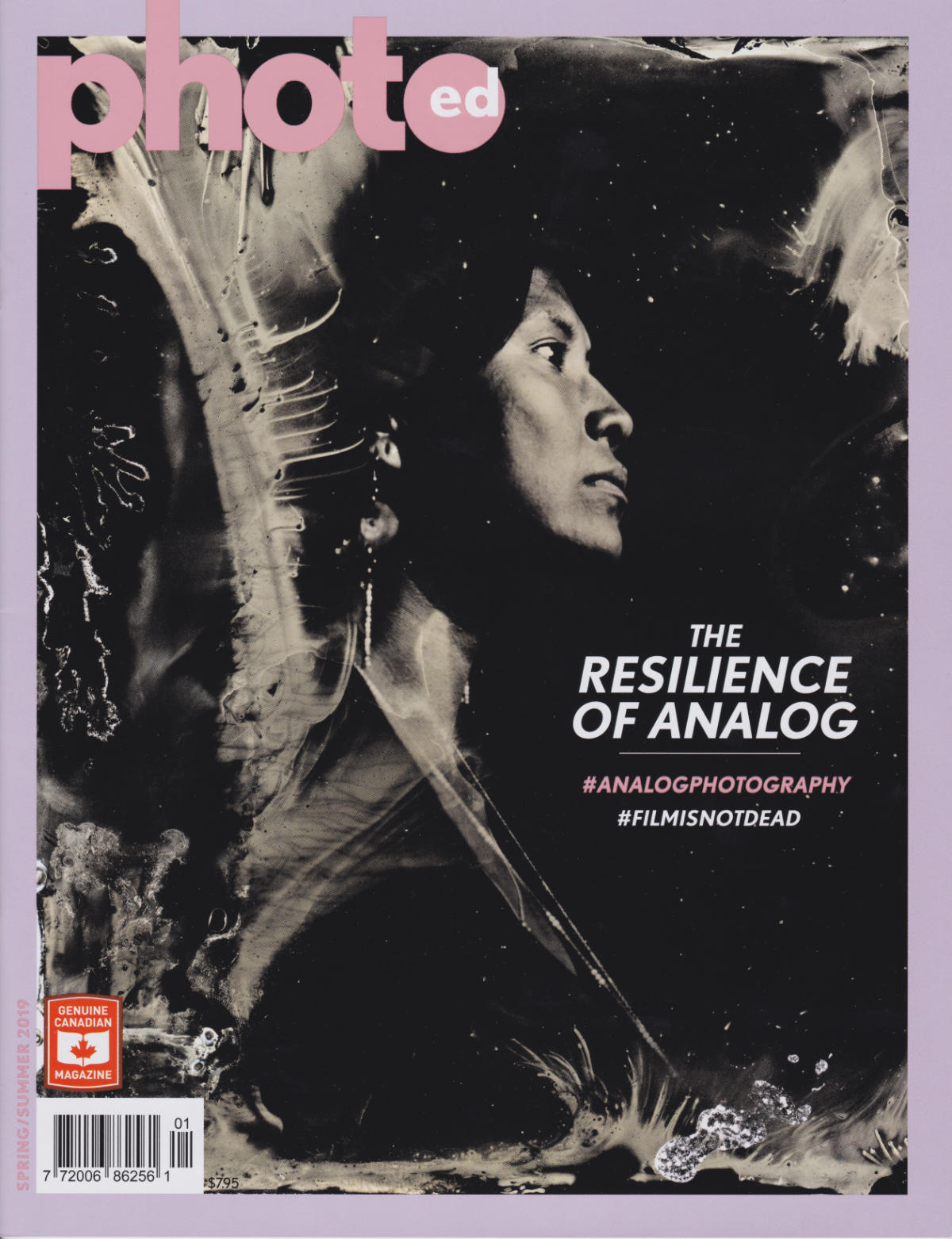
PhotoEd Magazine Spring/Summer 2019

Toronto. PhotoEd magazine has just issued a paper version of its Spring/Summer 2019 issue. This issue uses film as a theme “the resilience of analog” If you want even more of the theme topic, editor/publisher Rita Godlevskis has also produced an online version for free – with a twist. The online version is not the electronic version of the paper magazine, but it is an extension of the magazine with additional editorial content to complement the content in the for-pay paper magazine.

And the colourful ads (including ours) are included in the online version with yet another thrilling twist! If you hover over an ad and see a hand symbol, a click on the ad takes you to their web site – WOW! A big tip of the hat to Rita and her crew at PhotoEd. Thrilling ideas in this era of digital turmoil.

Posted in magazine | Tagged , , , , , , | Comments Off on analog (film) delights

Light Painting Photography

Another use for TV – George Dunbar c1952

Toronto. Light Painting Photography has a long history. The relative insensitivity of glass plates and film readily lent them to this form of art. It was not unusual for professional photographers to “paint” a scene with a series of flash exposures using an open shutter. The result (if done right) was a correctly exposed scene.

Over the years we have all set a shutter open and used a light source to “draw” an image on the exposed film or plate. The image above left can be enlarged with a simple click to see a larger size view of the efforts of a very young George Dunbar to paint his B&W TV set when he lost interest in the wrestling event on screen!

Posted in history | Tagged , , , , | Comments Off on Light Painting Photography

words, words, words

Words, Words, Words

Toronto. I put our first website online over two decades ago on April, 1996. A few years ago, in 2006 or 7, I began an investigation of means to simplify maintenance and updates to our web site so it would be an easier task to transfer responsibilities to a new person. I began looking at various public domain content management systems (CMS) that would allow posts and pages to be written and automatically search them and sort them in chronological order.

While many CMSs were tried out, I settled on WordPress since it had a large following and was easy to use unlike some others that were comprehensible only if you had deep computer knowledge. And in August 2008 I moved us over to WordPress. I created the heading image in Photoshop and I used a WordPress template with a right side bar as a standard. Since WordPress was written in a scripting language, it was also easy to fine tune its look without deep diving into the language. Continue reading

Posted in history, Uncategorized | Tagged , , , | Comments Off on words, words, words