so what is a camera …really?

c1544 drawing of a camera obscura showing an eclipse

Toronto. At left is a c1544 drawing of a camera obscura showing a solar eclipse. In the image, the  left wall has a pin-hole to let in the light. The right wall acts as a screen to allow the image of the sun to be  projected and viewed. The construction between the two is a light tight box (one wall is removed in the drawing to show how it works). The image shown is courtesy of the Gernsheims’ book “The History of Photography“, long out of print (mine is the 1969 Thames and Hudson edition).

The most basic description of a camera is essentially the same: a light-tight box with the sensitive media at one end (instead of the wall) and a lens (instead of a pin-hole) and shutter mechanism at the other with the distance between them suitable to sharply focus a subject (about 10 feet away from the box) on the sensitive media.

In the days when media were crushingly slow, a hat, hand, lens cap, etc over the lens served as a shutter. Exposing the lens for a few seconds (or longer) allowed enough light to hit the sensitive media to record a latent image suitable for development.

Improvements at the media end of the light-tight box permitted rapid exchange of plates and later film without further unintended exposure to light.

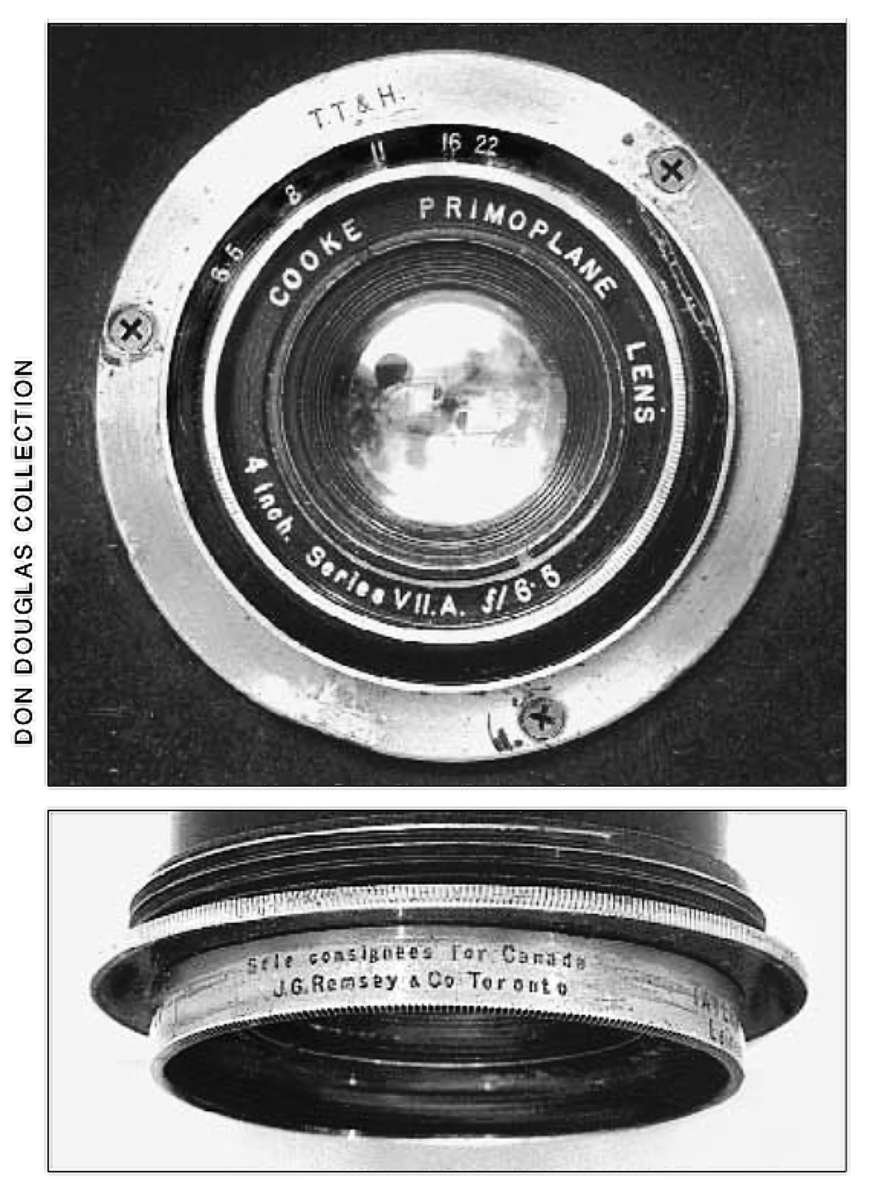
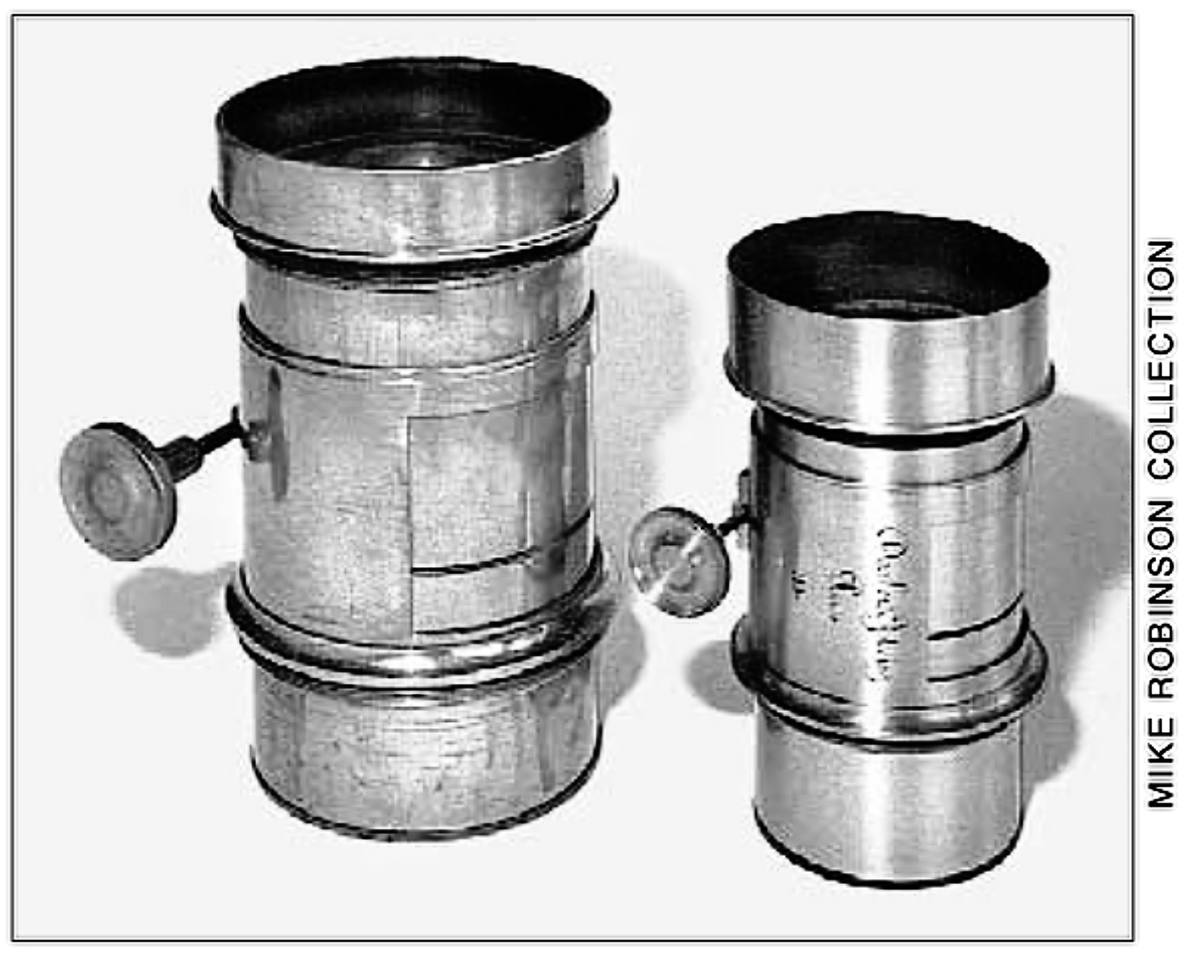
Improvements at the lens end of the box were often more complex including a means to focus on a subject closer than 10 feet, a reduced ‘aperture’ to increase the amount of the foreground and background in focus (faster lenses used Waterhouse stops or variable aperture leaves to reduce or ‘stop down’ a lens and improve the depth of focus).  Different combinations of elements were used to flatten the image projected on the media and correct various imperfections. Some worked; some didn’t.

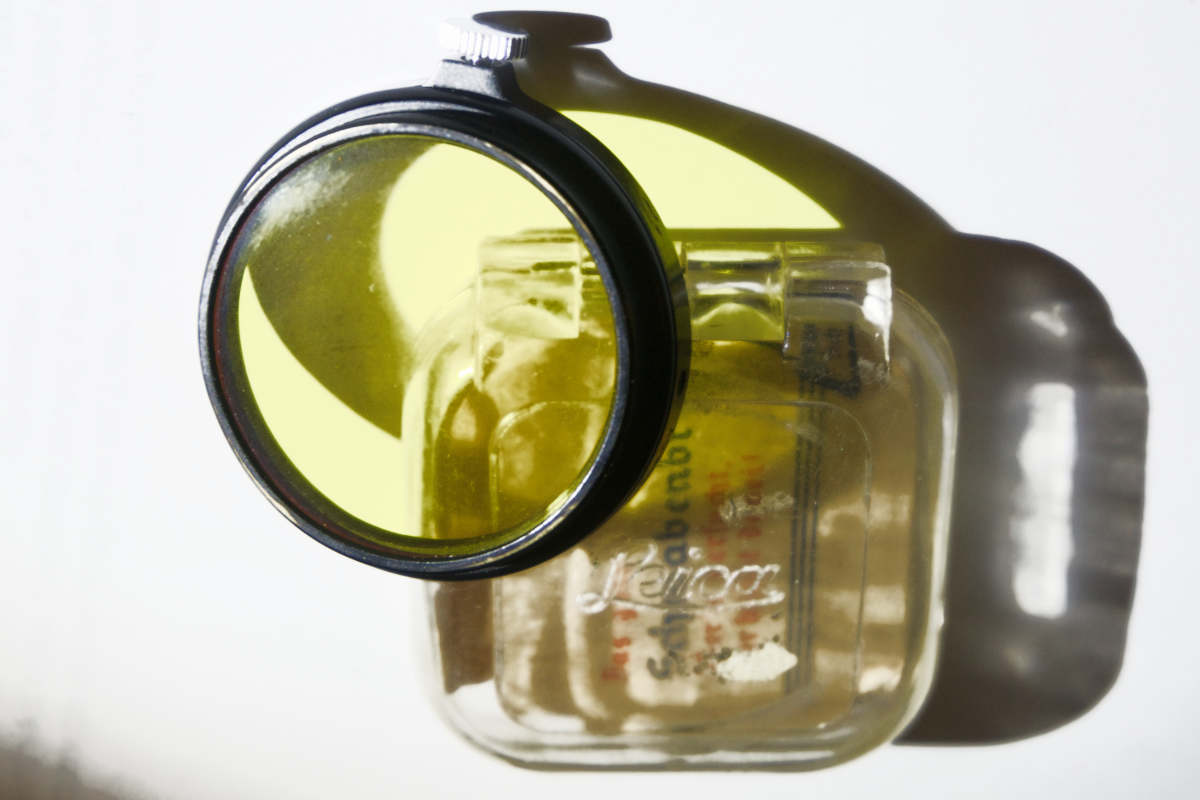
While today many cameras use variable focal length (zoom) lenses to vary focal length (and angle of view) others use interchangeable prime lenses or at least their front elements. Many zooms are also interchangeable to expand the focal length covered, or allow the use of prime lenses with special attributes.

Traditionally, lens elements were spherical (convex or concave) or plane and made of glasses with differing densities. Post WW2 special element coatings became common reducing inter-element reflections and improving contrast. A few decades later we began to see aspheric elements too. The goal was always to improve resolution, expand coverage, flatten the plane of focus and reduce or eliminate distortion – geometric, astigmatic, colour etc.

Digital technology brought with it a whole new science of photography. Quickly sensors had ISO ratings that began where the fastest film left off. Sophisticated computer chips reduced noise, sharpen images, changed saturation, auto focussed the camera, etc. Once shot, results could be displayed almost instantly. Thousands of shots could be taken on a sensor. No need to buy more film!

And lenses changed too. The smaller the size of the media (sensor), the shorter the focal length of the lens for the same angle of view. With smart phones, the sensor is so tiny a focal length of 2 or 3 mm has the same angle of view as a 35mm camera with a 35mm lens. With the strides in technology, some modern digital cameras can be bought with sensors of over 60mp allowing the use of electronic ‘zoom’ to create an image as if a zoom or longer focal length lens was used – just crop the 60mp size down!

So what is a camera … really! Visit our 2025 events to add to your collection – Next in line is our fall fair on October 19th. Details are in issue 25-7 of our PHSC News.

Posted in history | Tagged , , , , | Comments Off on so what is a camera …really?

a quest for collectibles

Sample images included in the MLAntiques fall auction lots

Toronto. Periodically I receive an email from USA based Michael Lehr Antiques (MLAntiques). The latest email announces their old photography images auction on September 6th. Details and offered lots are on their web site (see link here).

A great opportunity for photo collectors to check if  any offerings would complement their collection.

For 2025 we have at least two more events in October and November. Next we have our famous fall fair on October 19th, over a month after the MLAuction event. Drop by and see what can be added to your collection. Details will be posted here. Meantime, they appear in our PHSC News issue 25-7.

Posted in activities-other | Tagged , , | Comments Off on a quest for collectibles

wagon ho!

Mathew Brady, Civil War photographer, upon his return from the First Battle of Bull Run, wearing a saber given to him for defense by New York Fire Zouaves.

Toronto. Many old photo collectors have a ‘war’ category. One well known NYC photographer anticipated a demand  and decided he would photograph the American civil war. Sadly, interest in these war photos died with the end of the American civil war and the photographer died in poverty.

At the time of the war, the prevailing photographic process was the wet plate. It demanded the glass plates be sensitized, exposed, and developed before the emulsion dried. Worse, the process was too slow for action photos, only still shots would be sharp.

The photographer’s solution? Put all the darkroom gear, etc. in a wagon that could be pulled to each battle and the results recorded.

Well you may not spot one of Brady’s photographs at our 2025 events, you will have fun and perhaps spot items for your collection. Our next 2025 event will be the famous fall fair on October 19th. See PHSC News 25-7 for details.

NB. The title is a riff on the movie, “Westward Ho the Wagons!” produced in 1956 by Walt Disney.

Posted in history | Tagged , , | Comments Off on wagon ho!

remembering john vanderpant

John Vanderpant – courtesy the Vanderpant collection, Vancouver BC

Toronto. In issue 25-2, editor Bob Lansdale published Sheryl Salloum’s copyright 1999 article on the famous Vancouver based John Vanderpant titled, “John Vanderpant’s Vibrating “Voice” and Vision”.

Ms Salloum’s article begins with this prècis. “From 1919 to 1939, the Dutch-Canadian photographer John Vanderpant was a “voice… crying in the wilderness” of Canadian art.

“Isolated geographically from the larger metropolitan areas of Canada, he believed that western artists were too often forgotten, ignored, or misunderstood by both the local populace and the rest of the country. He urged BC’s artists to have ‘strong voices [and to] cry and cry and cry again.’

For this Dutch émigré, the desire to contribute to Canadian art by interpreting and recording the country’s beauty and spirit was paramount. A spiritual man, he also wanted to portray the cosmic energy that he believed united all things. An energetic and highly motivated individual with interests in mysticism, poetry, music, and art, Vanderpant became a significant influence on Canadian photography during the 1920s and 1930s.

“Through his ‘strong voice’ he also became a catalyst to Vancouver’s arts community; the painter Jock Macdonald called Vanderpant ‘the only “living” being’ in Vancouver.”

Her entire article, illustrated with Vanderpant’s photographs, can be viewed in the issue 25-2 pdf file on the free members-only DVD/memory stick. To join, follow the Membership instructions above (cheques), or at right (credit cards or PayPal). Any membership questions may be sent to Lilianne at member@phsc.ca.

You may spot a Vanderpant photo or other item of interest at one of our 2025 events. The next event is our famous fall fair this October 19th. See PHSC News 25-7 for fair details. As we get closer to the date, the poster and details will be pinned this website.

Posted in history | Tagged , , , | Comments Off on remembering john vanderpant

of mouse traps and man

Talbot – Daguerreotype by Claudet c1844

Toronto. Have you ever thought about how photography came about? In early January of 1839, Daguerre felt he had perfected his process enough to have it noted in the French newspapers of the day. Some more modern articles consider the process the ‘Polaroid’ of its time – a one-off monochrome image while you wait.

Most of the world were thrilled at the news. One Englishman was definitely not. William Henry Fox Talbot felt he had invented the photographic process (i.e. scenes captured by the sun and processed for permanence). He used his process personally but saw no reason to rush it to public announcement.

After Talbot saw Daguerre’s news, he presented his process, sample prints, negatives, etc.  to the Royal Institute and shortly thereafter to the Royal Society. With hindsight we see that Daguerre recognized the concept of the latent image while Talbot developed  the concept of the negative/positive process.

Both processes used silver halides  but differed – the end result was the same: an image captured by the effect of a sunlit scene on sensitive material. Daguerre offered a higher resolution one-off positive while Talbot offered a lower resolution negative that was contact printed to create as many positives as desired. The fibres of his paper causing the lower resolution.

To conduct his experiments, he chose to use small boxes  with a cork up front to check progress of the exposure. His wife dubbed these small devices “mouse traps“.  Her home was cluttered with these boxes as Talbot pursued his experiments (exposures being very long at the time).

NB. The post title is a riff on the book “Of Mice and Men” by John Steinbeck, a favourite author of mine years ago.

Posted in history | Tagged , , | Comments Off on of mouse traps and man

yikes! we missed the anniversary yesterday

Early Paris Street Scene taken by Louis Daguerre with his process in c1838

Toronto. Serious photography historians and collectors know what is meant by a Daguerreotype. In early January 1839, French newspapers published the electrifying news that Louise Daguerre had discovered a way to capture a scene by sunlight and make the image permanent.

But the papers carried no information on how to make and process such an image. That is, until 19 August, 1839 when Daguerre’s “idea was then effectively sold to the French Academy of Sciences, which subsequently gifted the process to the world on 19 August 1839.” Daguerre received a “generous income” for this act. However, people in England were obliged to pay a fee to use the process. Jabez Hogg promoted the idea of photographing through a microscope … until he saw the demand for a fee (I have a few editions of Mr Hogg’s book on the microscope).

When the idea came to celebrate photography by naming a day, it was decided to celebrate each 19 August as the beginning of photography.  My thanks to  Digital Camera World for reminding me within article posted on the 19th: “World Photography Day: what is it, and why is it today?“.

Posted in history | Tagged , , | Comments Off on yikes! we missed the anniversary yesterday

collecting Notman photos

Hunter (studio recreation) by Notman

Toronto. One popular focus by old photo collectors is to collect photos produced by a major studio or photographer. An example is collecting Notman photographs. Identifying the subject/cut line for Notman photos is made easier by the studio’s detailed record keeping now held for the most part by the McCord museum in Montreal.

To celebrate our 25th Anniversary, editor Bob Lansdale reproduced an illustrated article titled “William Notman’s …hunting photographs, 1866” which originally appeared in The Archivist, No. 118, the magazine of the National Archives of Canada. It is reproduced with the permission of the National Archives of Canada.

The author, Dr Joan M. Schwartz, of Queens University has been both a member and a speaker at the PHSC. On January 2009 her topic, “Photographic Sleuthing: Archival Stories and Academic Tales” provided a huge amount of information about professor Schwartz and her research.

For the Notman article, she begins, “In 1866, Montreal photographer William Notman produced a series of hunting and trapping scenes in a second floor “operating room” of his Bleury Street studio. Best known are the Cariboo [sic] Hunting and Moose Hunting series, parts of which were also published as Sports, Pastimes, and Pursuits of Canada Photographed from Nature.

Hailed as wonderfully realistic and admirably effected, these commercially-produced images by Canada’s foremost professional photographer won awards at international exhibitions and attracted widespread attention. One image titled Chance Shot showing hunter and guide crouched in the snow, rifle at the ready, circulated to an international audience when it was published as a mounted photograph on the frontispiece of the May 1866 issue of The Philadelphia Photographer, North America’s premier photographic journal.

“Others, such as The Breakfast and The Death, found their way into the personal photograph albums compiled by individuals as souvenirs of colonial postings or military service. Notman’s suggestion that these hunting scenes were “photographed from Nature,” juxtaposed with the great lengths to which he went to recreate the outdoors in his studio, has tended to focus critical analysis of the Cariboo Hunting and Moose Hunting series on the question of realism and art.

“However, an archival exploration of historical circumstances, functional origins and documentary contexts reveals that these overtly manipulated, but naturalistically intended, studio photographs of hunting actively participated in shaping notions of place and identity in early modern Canada.” …

Members viewed the entirety of the article in the pdf version of issue 25-2 on the free members-only DVD/thumb drive. Joining the PHSC is inexpensive and easy. See “Membership” above (cheque) or at right (PayPal or plastic). Drop a line to Lilianne at member@phsc.ca if you have a membership question.

And come to our next 2025 event on October 19th – our famous fall fair. Details/poster are listed in PHSC News 25-7.

Posted in history | Tagged , | Comments Off on collecting Notman photos

another antique photograph source

Ambrotype of Guitar player (note support too) – courtesy of the Greg French ad by the Daguerreian Society

Toronto. Old photograph collectors browse our offerings at PHSC Events. Next in line is our fabulous fall fair on October 19th. Check out issue 25-7 of the PHSC News for details.

Some of our exchange members invite relevant advertisements such as The Daguerreian Society ad for “GREG FRENCH EARLY PHOTOGRAPHY“,  Mr French, based in Massachusetts,  specializes in 19th century photographs. The Ambrotype at left is from his advertisement. Two things caught my eye: the subject is unique (at least to me) and you can see the cast iron support behind the guitarist to let him lean back and steady himself as the likeness is taken.

Have a browse at Mr French’s website  to see what he has that fits your collection. Meantime drop in at our fair as well to perhaps add even more goodies to your collection!

Posted in history | Tagged , | Comments Off on another antique photograph source

an exciting century anniversary

Construction underway at Kodak Heights, 1914 with
steam shovel and horse drawn wagons

Toronto. 1999 was an exciting time in photography. Digital technology was underway and taking on the mantle once proudly worn by film.

That year, however, Kodak Canada was stilll in Kodak Heights and a major presence in Canadian photography. CKC was part of the all pervasive Eastman Kodak organization, the major photographic corporation world-wide. In fact, for  many people, any camera was simply called ‘a Kodak’.

In the late 1800s, the parent company in Rochester was busy expanding its business world wide. In 1899, it established a strong foothold in Canada. The photograph at left shows the work underway at Kodak Heights in Weston, Ontario (now part of Toronto).

Sadly, today the grand old company is but a shadow of what it once was. The remaining building in Kodak Heights has been repurposed as a subway station on the new line now (at last) nearing completion. Buildings on the original campus in Rochester have been nearly  totally demolished.

The celebration of the 100th anniversary in Canada is commemorated by an illustrated article in our journal issue 25-2. The author of the article goes unnamed (likely editor Bob Lansdale). The article begins, “While we prepare to ring in the new millennium, Kodak Canada has a special reason to celebrate in 1999. The company is marking the 100th anniversary of its founding in Canada.

“Its 1,400 employees along with its customers, suppliers and business partners celebrate this milestone with yesterday’s memories preserved and plans for the future in place.

“In the mid-1890s the Eastman Kodak Company of Rochester was in an expansive mood, buying up various camera and photo materials companies, then incorporating their talented staff and products into the ever-expanding Kodak empire.

“The Brown and Palmer Photographic Paper Co. which had been founded in 1886, dissolved in 1897 – at which time John G. Palmer entered into a new partnership with artist George Hanmer Croughton Jr. Two years later, on April 1, 1899 they were taken over by the Eastman Kodak Company; Croughton stayed to run the plant under the Eastman banner while Palmer was dispatched to Toronto to assess the potential of the Canadian marketplace.” …

Members viewed the entire exciting story of Kodak Canada in the pdf file for issue 25-2 on the free members-only DVD. See above or at right (Membership) to join. Email Lilianne at member@phsc.ca if you have a question.

Posted in history | Tagged , , , | Comments Off on an exciting century anniversary

sober second thoughts

the tiny camera with the huge sensor

Toronto. I often suggested the smartphone – always in your pocket – is the best camera option these days. However a review of the Sony RX1-r111 with a 35mm f/2 Zeiss lens gave me serious pause to re-consider.

The camera is tiny compared to others. And the sensor is MASSIVE at 61mp. Further, with such a sensor, the lens can be changed electronically to a 50mm zoom, 70mm zoom and a macro lens to shoot insects and blossoms.

The features pro and con are discussed at length in this article in Digital Camera World by James Artaius. Raw specs of course are on the Sony Canada site here.

We (me) are used to using a zoom lens to physically adjust focal length but this little guy with a huge sensor uses an electronic zoom on a prime (fixed focal length) lens. The big sensor and accurate focus means even with electronic zoom the longest focal length of the tiny camera gives a relatively crisp 15mp image (I find my iPod Touch at only 8mp and 35mm-equivalent lens great for quick shots although focussing is a headache at times).

By the way, our next 2025 event is the famous fall fair on October 19th. While you may not see this camera there, you will see lots to add to your collection and user gear. Download PHSC News 25-7 for details right away. Later next month as the fair date comes closer, I will post details about the fair to this site and pin them to the front page.

Posted in camera | Tagged , , | Comments Off on sober second thoughts