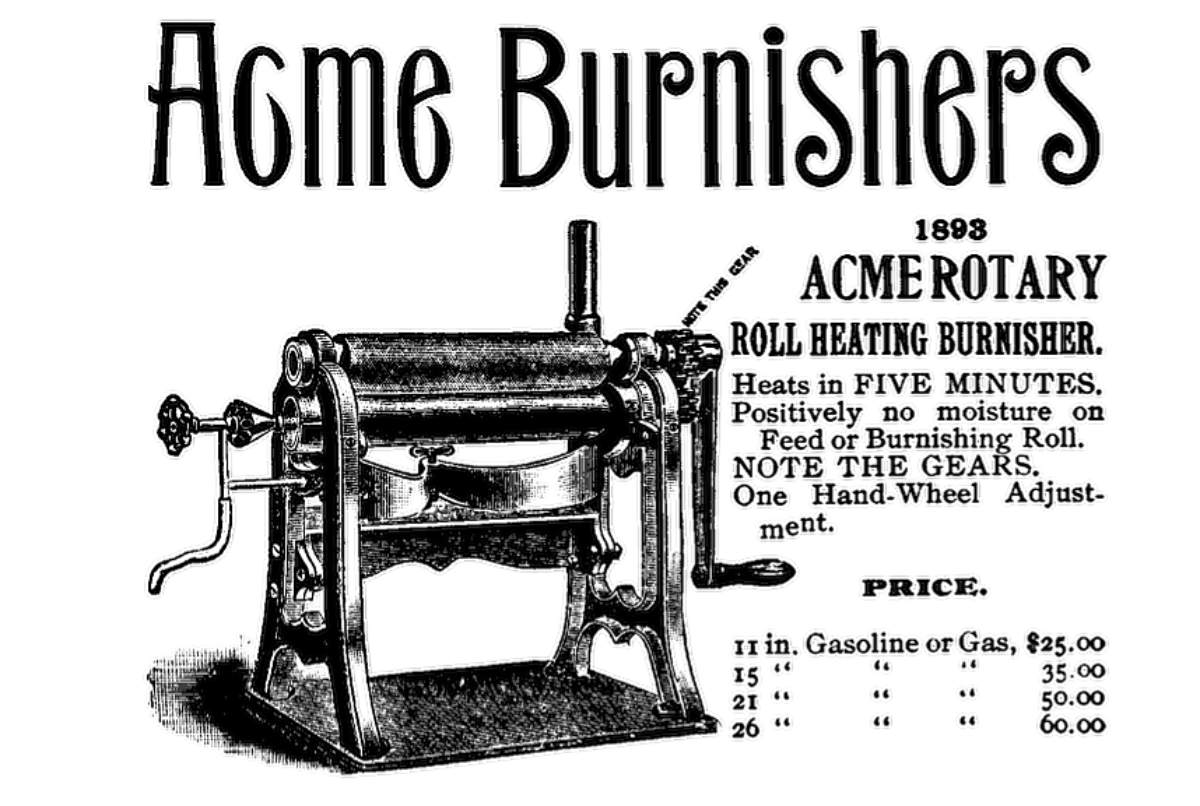
1894 ad for an Acme Burnisher
Toronto. last century, after prints were developed, a special chrome sheet and heated press was used to add a glossy finish to the print. Without this process, paper-based prints would have a matt finish and somewhat lower contrast.
Late in the 19th century when Albumen CDVs and other size cards became common, a special device (looking like part of a washing machine) called a burnisher flattened the print and card while giving the front surface of the albumen print a glossy finish.
In issue 25-2, editor Bob Lansdale writes a lengthy article about the various burnishers of albumen prints. He begins, “I haven’t heard anyone mention they were a proud owner of such a piece of equipment so this article is presented with the hope that some member may recognize a Burnisher and reclaim it for photographic history.
“Looking much like a clothes mangle with a pair of metal rollers to squeeze unknown objects or materials, collectors may have unknowingly passed these machines by as being non-photographic.
“With the arrival of the albumen photograph mounted to card there arose a need to roll the final carte-de-visite and cabinet card to achieve a flattened and finished state. Albumen paper normally came with an egg-shell finish but as styles advanced, a preference for glossy (enamelled) surfaces required that the face of the print be pressed (while in motion) to the hardsteel surface of a heated roller in order to give a sheen to the surface. It also gave crisper blacks.
“Heat was introduced by a burner set below the rollers. Improvements saw a chimney-like flue added to spread the heated air to the length of the roller. External heating was liable to cause problems by leaving moisture on the surface of the roller, causing sticking.
“An alternative solution was to introduce a burning gas jet into the interior of the vital roller. This machine was the precursor of more modern equipment, the Pako Rotary Dryer, where wet prints were fed to the surface of a large chromium plated drum, heated from within.
“Adhering to the shiny surface for one revolution of the drum allowed the inside heater to dry the print with a gloss. The introduction of present day resin-coated plastic papers made such machines redundant as some of these papers have a built-in high-gloss surface.”
All of Bob’s fully illustrated article on these old darkroom devices can be viewed in the issue 25-2 pdf file on the free members-only DVD/thumb drive. See Membership above or at right to join. Any questions on membership? Just write Mme Lilianne at member@phsc.ca.
Visit our 2025 events to add to your collection -you may even spot an old burnisher … The next event is our famous fall fair on October 19th 2025. See PHSC News 25-7 for details. A post will go up on this site later this month.