
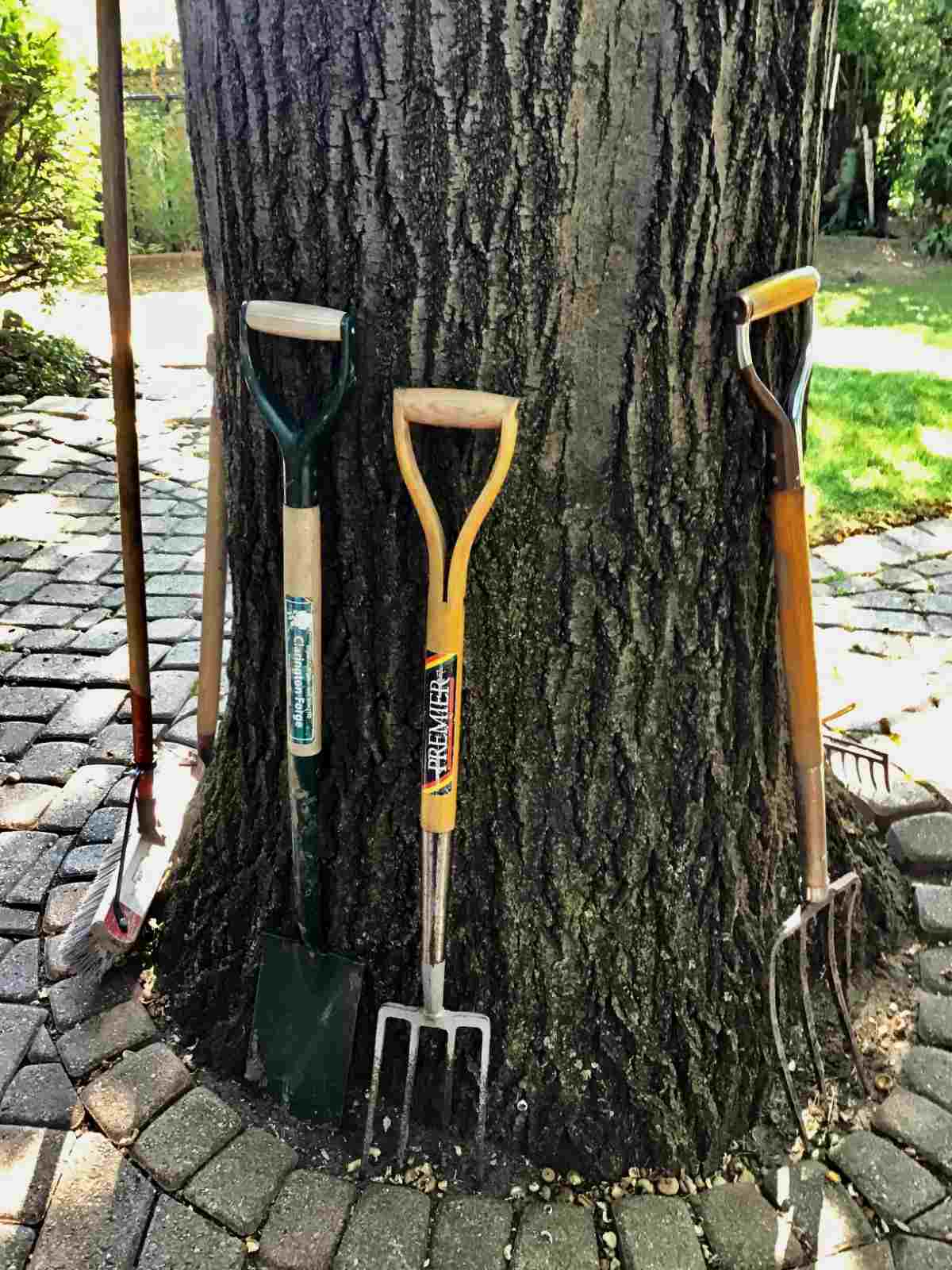
Some garden tools around a red oak ready to use
Toronto. I have posted previously on film vs. digital and its consequences. Since photography was created in 1839 until digital technology went main stream, family ‘snap-shooters’ and amateur family historians could save photographs in an album or shoe box to be pulled out whenever a visitor was to be shown ‘the relatives, old purchases, etc.’. These artifacts could be viewed by eye – no accessories needed (except perhaps, reading glasses).
The down side was the time it took to finish a roll of film, get it processed, have prints made, and see for the first time if the ‘pictures took’. If the photos were out of focus, subjects blurry, over or under exposed, etc., chances are the subjects were long gone or the reason for taking the photograph now forgotten.
Film, paper, processing, even a fancy camera, was too costly for the average family guy to buy or shoot off ‘spare’ shots. For most of the plate/film era, photos were B&W only. The early post war colour prints had poor resolution partly solved by a pattern on the paper’s surface. And colour was often prone to rather rapid fading due to the choice of dyes.
Most families had an amateur photographer; but few had a darkroom or access to one. This sharply reduced the number of prints promoted to the family album or shoebox. Cameras for the most part were very simple – box cameras, simple folders, etc.
When digital reached mainstream, almost everyone had a camera (buy a smartphone and you also had a camera for free). Literally dozens of shots could be taken with very little or no added cost; results were assessed in seconds; images were in full colour. The auto everything cameras and smartphones meant only focus, lighting and framing decisions were left to the photographer. And the best photos could be sent anywhere in the world in seconds via the internet.
Sadly, the down side for digital is far more serious – long term retention. File formats change over time, storage media change, as do special equipment and software essential for viewing. For example, in a short few decades we have seen floppy disks, mechanical hard drives, CDs, DVDs, thumb drives, solid state hard drives, streaming, cloud services, etc., come and go. Equipment, software, file formats, – they all seem to change. Astute photographers are left hopping just to move their precious digital photos from one thing to the next.
Sadly, as this article (WILL TODAY’S DIGITAL MOVIES EXIST IN 100 YEARS?) in the IEEE journal discusses, even movies are affected. Perhaps my good friend , George Dunbar, who suggested this post, has the best solution: take your photos digitally for convenience, then PRINT the best of them for posterity and simple viewing – nothing needed but possibly those eye-glasses… Thank you George for the article link and the idea of printing digital photos.


