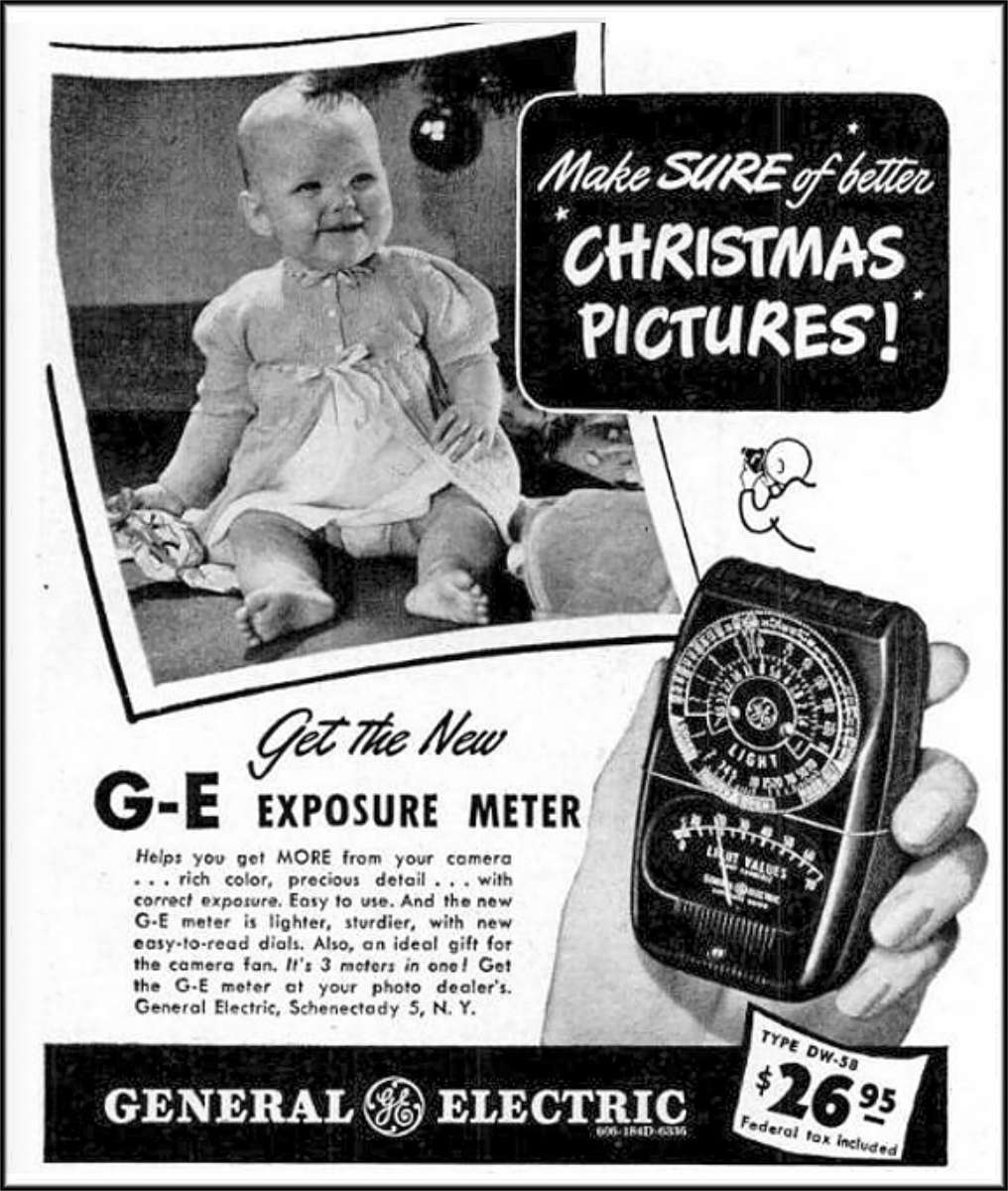
1946 ad for a GE exposure meter
Toronto. Many camera collectors also collect exposure meters and calculators. My own collection includes a handful of both. The ad shown here is from the December, 1946 LIFE magazine. George Dunbar, who generously shared it with us, found it while searching the magazines for all ads relevant to photography.
In the late 1950s I bought my first light meter. Before that I resorted to the sheets Kodak inserted in each box of film to help me choose the camera settings based on the light. It was a toss up between GE and Weston for a meter. I ended up buying the Weston Master III. This was rather early in the days of handheld meters and all were based on selenium cells which created a voltage under exposure to light.
Sadly just when you needed the reading (dim outdoor sunlight, indoor lights) selenium meters created almost no voltage. Years later meters based on the far more sensitive cadmium sulfide (CdS) cells appeared on the market. CdS resistance varied with light exposure and required a battery to reflect values on a meter. Under steady light, the resistance varied so the CdS cell was blocked from the light or any voltage until a reading was needed.
Many makers took advantage of a characteristic of mercury cells – constant voltage until end of life. This meant a simple series circuit worked (meter, battery/cell, and CdS). The apple cart was upset when government decreed that all mercury uses polluted the landscape and mercury cell manufacture stopped. Some workarounds were available to replace the cells with mercury-free hearing aid or watch cells. Or you could buy a similar sized alkaline cell and put up with a need to recalibrate from time to time as the voltage slowly fell.
In the late 1800s various calculators came to market to assist the photographer. Before the dry plate era the exposed plate was developed immediately giving nearly instant feedback to the photographer. The media were so slow a sub-second shutter was unnecessary.