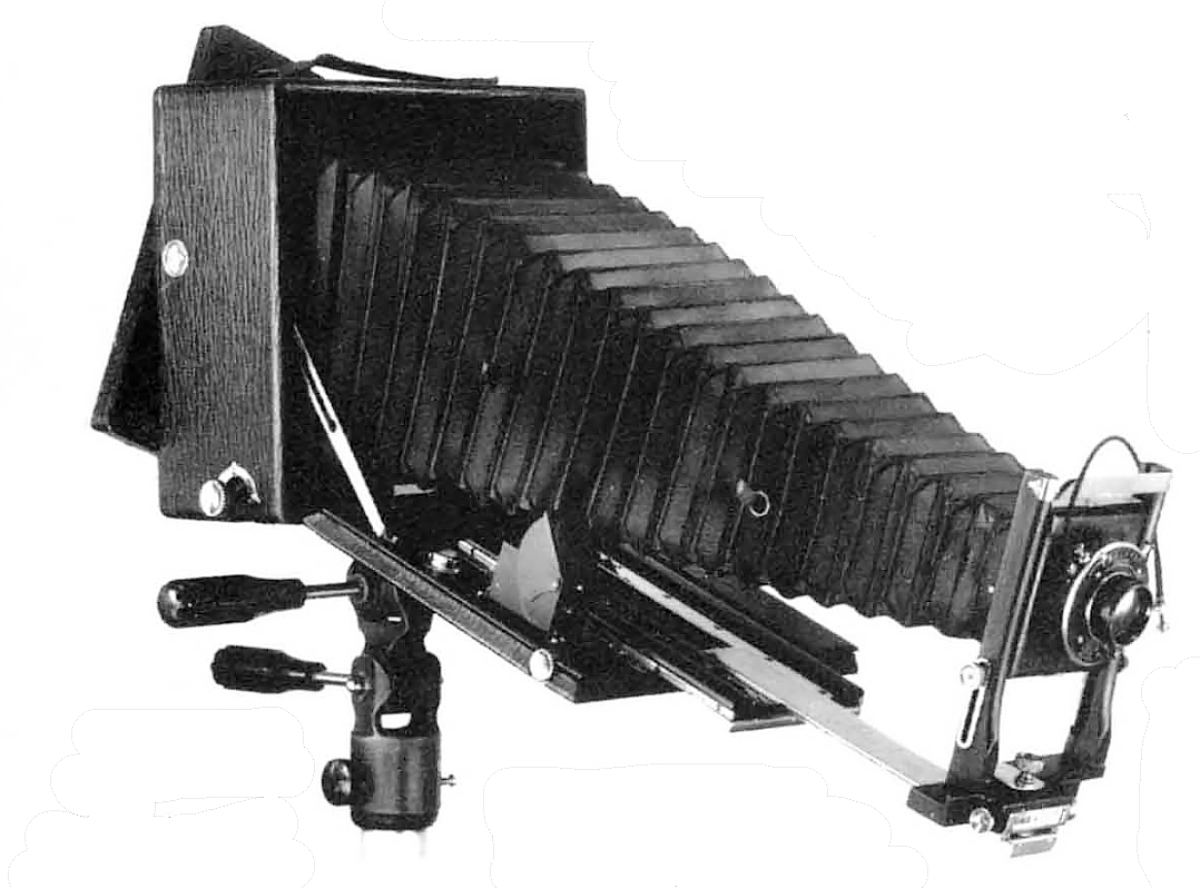
SENECA No.9 5×7 plate camera with reversing back, double extension, drop bed and front standard rise and shift.
Toronto. … and not a print in sight. Shades of smartphones. Last century, when film was in its prime, people argued which camera maker or model was the best and who made the best lenses. As Don Douglas put it for a sober second thought,”the best camera; the best lens, are the ones in your hand as you see something to photograph.”
For me today, that is the tiny 8 mpx camera module on my iPod Touch. Today’s smartphone owners do not care who made their phone’s camera module but rather that there is one ready to go on demand!
In issue 22-5 (spring, 1997) Stan White wrote a captivating article titled, “An Amateur Camera of the Early 20th Century” that shows a typical camera many amateurs chose to use. The article begins, “Once the dry plate arrived in the 1880s the last hurdle to practical photography for the amateur was cleared. It only remained for the standard of living to improve for photography to be affordable to the middle classes and eventually to the working classes.
“As a result there was a mass of photographic equipment marketed from 1890 to 1920, specifically for the amateur.
“Cameras differed wildly in sophistication and price but were different from professional equipment in a number of ways: many were not sufficiently rugged to stand up to the rigours of day-to-day use; designs often fell short of minimum professional requirements, and since they were made for a price, lenses and shutters were often of modest standard.
“Roll film was still expensive and plates (50 cents a dozen 4x5) were cheap, flat and could be large; advantages, in an era of questionable lens definition and grainy emulsions, so it is logical that the drop–bed folding plate camera became a favourite. In North America, Folmer & Schwing were making a camera of this design that was not greatly dissimilar to the Speed Graphics a half a century later and many other companies were marketing amateur versions including, Rochester Camera & Supply, Rochester Optical, Manhattan Optical Co., Robt. H. Ingersoll & Bro., Montgomery Ward & Co., Scoville & Adams Co., Ray Cameras Co., E. H. & T. Anthony, G. Gennert, Gundlach Optical Co., and of course, the Eastman Kodak Co.” …
Members can read the rest of this and other articles in the issue 22-5 pdf file on the free members-only DVD (thumb drive as of April, 2025). To join, see the information under ‘MEMBERSHIP’ (top) or ‘Membership – Join or Renew!’ (right). Questions? Email Lilianne at member@phsc.ca.