
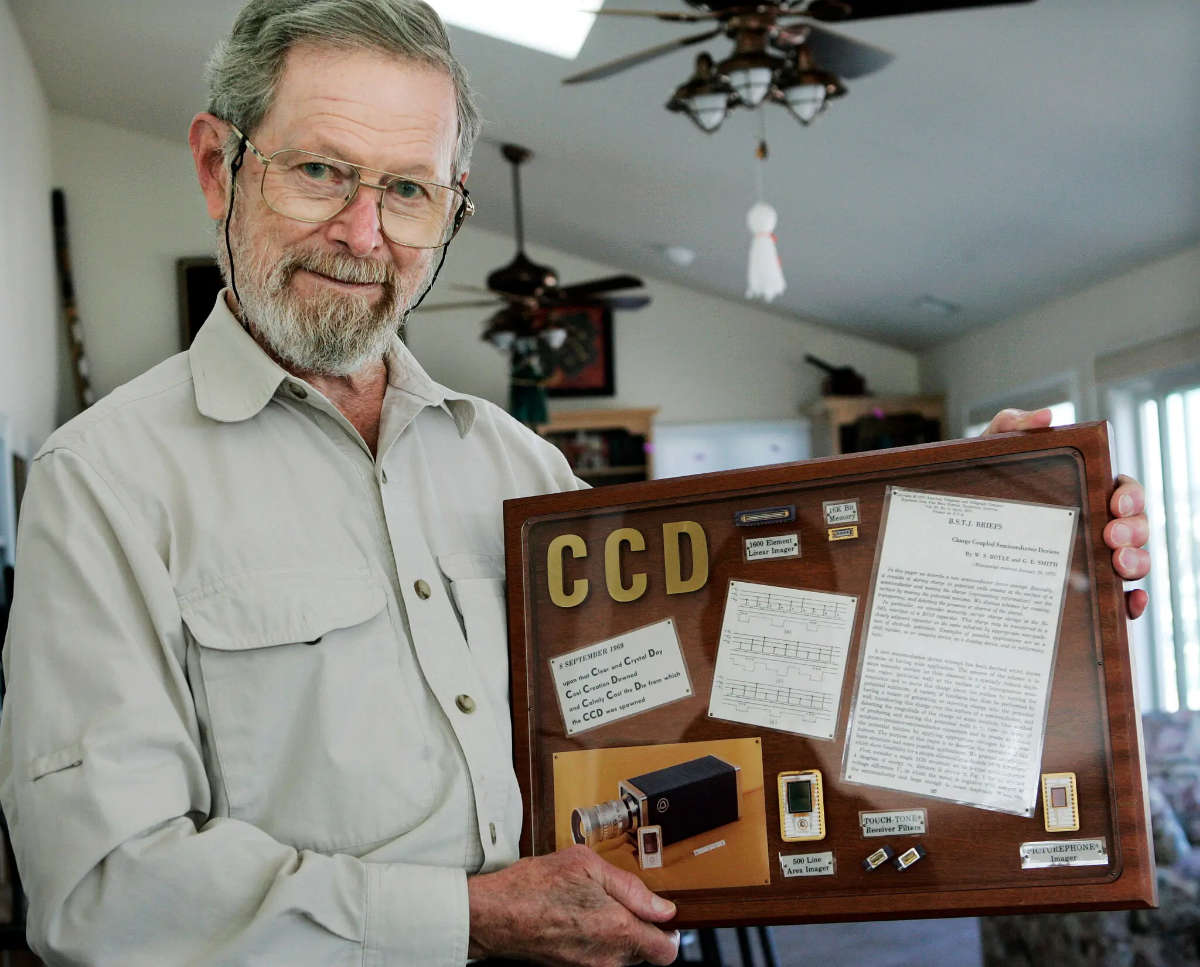
George E Smith and the famous CCD created by him and Willard S Boyle in the early 1970s
Toronto. We all know about the contributions of Daguerre, Fox Talbot, Scott Archer, Dick Maddox, and George Eastman to photography. Most were eccentric, sometimes well-to-do individuals whose ideas have become sign posts along the way in photographic history.
By the time photography entered the digital era, development of technology had shifted to scientists working in institutions and commercial laboratories. For example, last century (c1947), the transistor was developed by a trio of scientists at Bell Labs in New Jersey starting the digital revolution.
About a decade later,Texas Instruments (and Fairchild Semiconductor) manufactured integrated circuits (ICs), to save space and manufacturing steps. I still have a darkroom timer I built around a then popular IC by Signetics, some switches, tantalum condensers, and a few other bits and pieces.
In the case of digital technology, Bell Labs scientists (again) came up with the basis for sensors – the means to create electronic files based on photons bounced off the subject. Dr George E Smith and his associate, Dr Willard S Boyle, came up with the idea, of a charge couple device (CCD) as they called it, in 1969 and registered it 5 years later.
So if you use a digital camera of any sort (and who doesn’t these days) the device works thanks to a sensor based on the Nobel prize winning idea of the CCD.
My thanks to my good friend and fellow PHSC member, 90+ year old George Dunbar, who took the time to send me the NYT article on the late George E Smith.


