
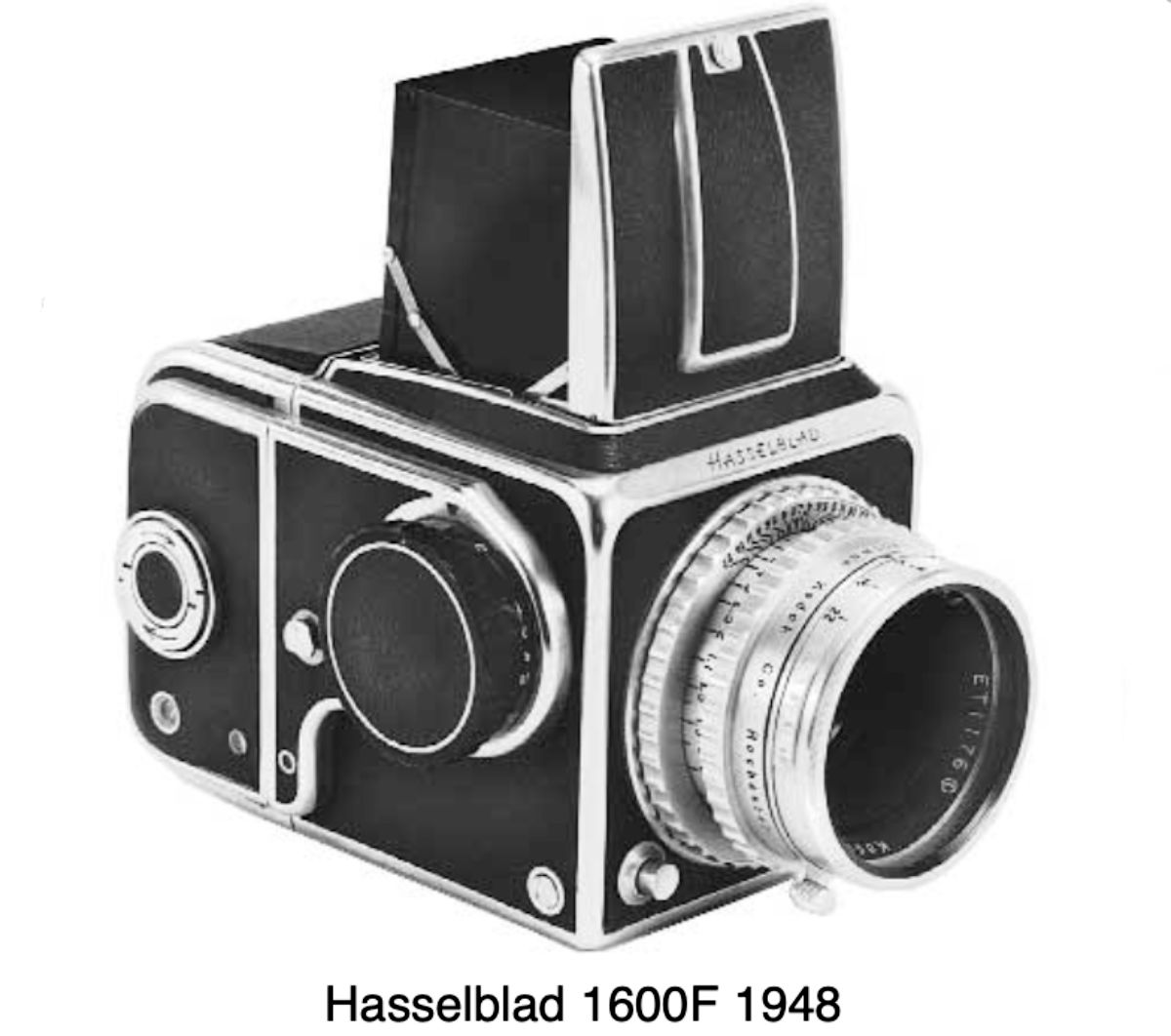
the famous first model – 1600F Hasselblad
Toronto. Victor learned his hobby before ww2 and post ww2 he designed what he felt was an ideal ‘birder’ camera, and built it in his own factory. It was a 2-1/4 SLR using a Kodak lens.
The initial commercial model was unveiled in NYC and became an instant success. A later model was used on the moon! While a Kodak lens seems an odd choice, Victor’s company was the agent for Kodak in Sweden. A few years later, Victor switched to the widely renown lenses by Zeiss.
His camera models became the darlings of studios all over and late last century became desirable collectors items. Today, most people with some photograph experience recognize the Hasselblad camera and its quality.
In issue 24-1 an article by Robert Lansdale celebrates the 50th anniversary of the Hasselblad cameras including many photos courtesy of the company, Victor Hasselblad AB. The article gives a brief history of the famous marque and begins, “The Hasselblad company of Sweden can point to a number of important dates throughout its long history, but this year [1998] is the 50th anniversary of the introduction of the Hasselblad camera system.
“In 1948, Victor Hasselblad chose New York City for a launching ceremony which revealed to the world the first medium format single lens reflex camera with interchangeable –lenses, –film magazines and –viewfinders. This was the Hasselblad 1600F, equipped with focal plane shutter and Kodak Ektar lenses.
“But the history of the company dates back to May 15, 1841 with the birth of the F.W. Hasselblad & Co. which dealt mainly in the wholesaling and retailing of knives, scissors, needles, buttons, pens, toys, and soap. First import shipment through the Göteborg Customs Office was 25 pounds of liquid scent, and being progressive in their search for new-fangled goods they were the first to introduce accordions and flush toilets to Sweden.
“An 1870 inventory lists from France – “lanternes magiques”, photographies and stereoscopic pictures. As photography flourished the company in the early 1890s began to import more photographic materials and contributed to the first photographic catalogue in Sweden.
“That catalogue illustrates both the Kodak No. 1 camera (for round images) and the Kodak No. 5 Folding camera. Interestingly, it also contains a camera named the Hasselblad Swedish Express (9×12 cm) which was marketed between 1895 and 1910.
“Expansion made it necessary to form a new company, Hasselblad Fotografiska AB which became general agent for the Eastman Kodak Company, a deal that was sealed by a handshake and lasted until 1966. The company assigned photographers to tour the country recording churches and other impressive buildings which then became another business activity to produce picture postcards and mounted albums.
“Much of this photographic interest was awakened when the founder’s son, Viktor, purchased a camera on his honeymoon in 1885. But the main thrust into the photographic industry would come from the next generation by Fritz Victor Hasselblad, born March 8, 1906.
“As a self-taught ornithologist and bird photographer, he travelled widely in pursuit of his hobby and was a pioneer in the field, publishing in 1933 a classic book on migratory birds, Flyttfågelstråk which has become a collector’s item.
“When Victor, in 1925, returned from a study period at Kodak in Rochester, he brought with him a Graflex reflex camera (3 1/4 x 4 1/4 in) to continue his study of the remaining stork settlements in his native country, Lapland, Holland and France. Although the best possible camera at the time for that task with proven superiority of the reflex viewing system, it was heavy and unwieldy.
“A Leica, equipped with a reflex attachment next became his favoured tool in documenting the autumn migration of west coast birds; this became a new book in 1935: Highways of Migratory Birds. But the desire for more flexible and easy-to-handle equipment persisted.” …
PHSC members can easily read this and all articles in issue 24-1 by opening the relevant pdf on the free members-only DVD/thumb drive. To join, see above or to the right. Questions? Email Lilianne at member@phsc.ca.
Visit our 2025 events – you may just find a Hasselblad, or other gem for your collection! Next up is our Trunk Sale on July 13th (see the poster here for details).


