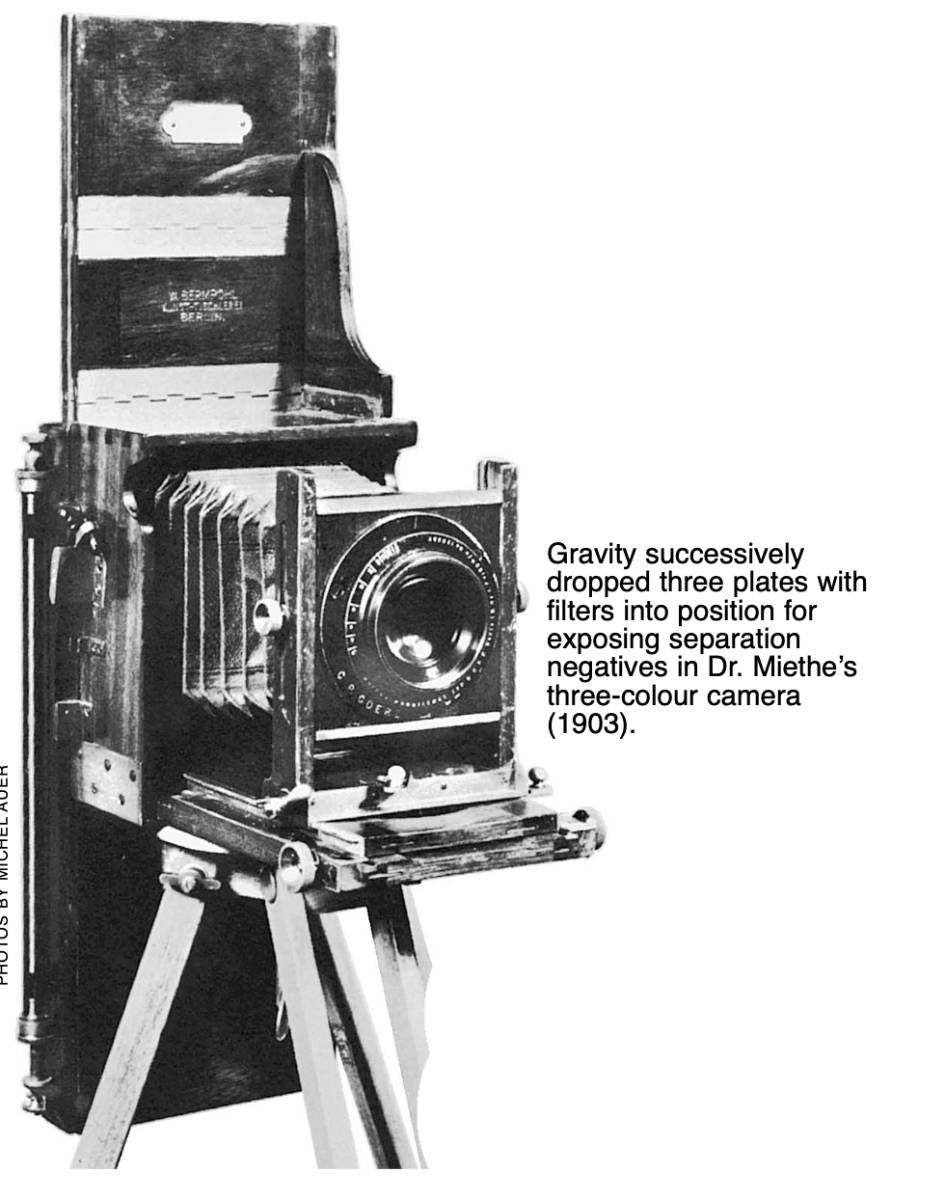
an early 1900s colour camera using gravity for changing plates/filters
Toronto. Our late editor, Robert Lansdale, had a soft spot for early colour processes and cameras. In issue 28-2, Bob wrote a lengthy article on the topic titled, “COLOUR PHOTOGRAPHY IN THE EARLY 1900s”.
Bob begins the article, “From the earliest days of photography, man’s desire for coloured images was achieved by hand, applying dry transparent colours to daguerreotypes through, to include, cartes-de visite.
“Crystoleum and oil colouring peaked about 1907 while 1920 saw the ubiquitous Velox watercolours marketed by Kodak.
“The earliest discovery of colour produced from the action of light on silver was by Ritter. Johann Seebeck in Jena repeated the experiment in 1810 with a long exposure on damp silver chloride using the spectrum produced by a prism. Herschel repeated it in 1840.
“Lending credence to Levi Hill’s 1851 claim of colour daguerreotypes, Daguerre himself observed red brick buildings exhibiting colour on his plates. Bequerel corroborated this observation and Niépce de St. Victor produced ‘heliochromes’ in 1850.” … The rest of Bob’s illustrated story is on the free members-only DVD/Thumb drive.
You may spot an early colour camera, or print at one of our events. We are on a summer break and will resume the 2026 events this fall.