a day to remember

5×7 Press Graflex at Spring Fair – Photo by Bob Lansdale

Toronto. This past Sunday was a warm, sunny, and cheerful day. It was also our annual spring fair and for the first time in a long time I missed it (my wife is recovering from surgery). Fortunately, my good friend, photographer, photo historian,  and journal editor, Bob Lansdale, was there with his camera and generously offered me his images.

If you missed this show too, you can catch up with our Trunk show this summer on July 14th at the same place, but outdoors come rain or shine (the odds for shine in July are excellent in this city).

Meantime, here are just a few of the photos by Bob Lansdale:


Posted in fair | Tagged , , | Comments Off on a day to remember

be wise, digitize

Old Minolta Digital Camera

Toronto. No need for such a slogan today – EVERYBODY went digital (there are still some niche players that insist on  the beauty of the old film technique). In the film era every photo was carefully framed and shot. A roll of 36 exposures lasted a few days or weeks and would offer up one or two decent shots, if any.

Using digital, it is  easy to knock off a hundred or more shots in an outing and get instant feed back on every one rather than taking a night or weeks with film. Riding the subway today, everybody seems to have a smartphone and every smartphone has a built-in camera! IF you want to try your hand at the old film technology, our fairs, shows and auctions are full of old film gear for you. Not a niche person? Nowadays even digital gear is offered!

Posted in camera | Tagged , , | Comments Off on be wise, digitize

Voigtlander, my Voigtlander

Voigtlander ad in LIFE magazine March 12, 1956

Toronto. 1956 was a land mark year for many. In the case of the oldest photography company in the world, It was its 200th anniversary – born years before photography itself!

One of its remarkable offerings was the Vito B 35mm camera featuring a Voigtlander lens. This advertisement in the March 12, 1956  issue of LIFE magazine celebrates both the anniversary of Voigtlander and its model VITO B camera,  a 35mm camera featuring many of the popular bells and whistles of the day – except interchangeable lenses and rangefinder focus.

The resulting cheap price was intended to attract the less sophisticated amateur using a more primitive folder or box camera. Or introduce photography to the new budding amateur with some money in his (her) pocket.

The camera was marked as made in Western Germany since the post-war country was split with half to the West and half to the East (Russian). Since Berlin was in the Eastern block, the city too was divided with the infamous Berlin Wall to keep the East Germans and Soviets out of Western Berlin.


Posted in camera | Tagged , , | Comments Off on Voigtlander, my Voigtlander

belly-button school of photography

A waist level shot of me by my dad in c1942 using a Kodak Folder

Toronto. Camera makers tried to categorize their products as having a better way to make photos. Using a waist level finder was one way – introducing the “belly-button school of photography” – a term of which I had never heard until Don Douglas and I embarked on a talk and slide show circuit for the PHSC. I talked about processes while Don used his Ansco camera collection to talk hardware. Some of his cameras were held at waist level to frame and focus, hence his expression for that kind of photo.

I realize now that my dad used this technique with his Kodak Brownie folder. He held the camera at waist level and shielded the little bright line finder from sunlight with his hand. The early SLRs like the Exakta used waist level viewers too. What was perhaps the best known version of waist level camera was the twin lens reflex cameras like the Rolleiflex.

Posted in camera | Tagged , , , , | Comments Off on belly-button school of photography

shine a light on me 2

    M2 PowerMite flash bulb ad in LIFE magazine

Toronto. In the 1950s one big opportunity was assisting amateurs to make night or indoor shots. General Electric (GE) was well respected at the time for manufacturing light bulbs. They saw two problems to be resolved to stand out in the flash bulb business: making each bulb smaller; and making each bulb brighter with a wider light dispersion.

This 1956 ad in the March 19 issue of LIFE magazine shows how GE succeeded with its PowerMite M2 flash bulb. With electronic flash and LEDs the whole concept of flash guns and flash bulbs has faded into history – and collections.

Another great find by my good friend George Dunbar of how we solved photographic issues over a half century ago.

Posted in photos | Tagged , , , , | Comments Off on shine a light on me 2

they’re coming, they’re coming

Ad for the 1956 Ricohflex camera – dirt cheap compared to the Rollei

Toronto. Not the Russians like the old movie title, but the Japanese camera makers. Until after the Korean War in the early 1950s, the Japanese industry made little inroads in the west. This changed when Americans discovered the Nikon F while in Korea. Even in the late 1950s it was common to believe Japanese cameras, while well made, were just imitators of German design.

This was typified by the Ricohflex which looked vaguely like a Rolleicord  – the cheaper version of the Rolleiflex. To gain its foothold in the west, Ricoh bought expensive ads in popular magazines like this ad on page 20 of the April 2, 1956 issue of LIFE magazine, one of the preeminent magazines of the day.

Posted in camera | Tagged , , , , | Comments Off on they’re coming, they’re coming

happy Victoria day to you too!

Stereo of Queen Victoria at 34 years of age in 1854

Toronto. The Monday on or before May 24th has been known as Victoria day in Canada (except in Quebec whose citizens take the holiday but call it National Patriots Day instead).  The holiday is designated as an annual celebration of the present British Queen’s/King’s birthday.

In light of this year being Victoria’s 200th birthday, the Museum of London released two previously unknown stereo views of the grand old monarch taken in 1854 when she was a young lady of 34. The stereos are courtesy of the Museum of London via an article in the Smithsonian under the column SmartNews.

You may wonder why we as photographic historians would be interested. Wonder no more! It’s because Queen Victoria and her consort, Prince Arthur, “were early and eager adopters” of the new art of photography. Now when you open your cottage, or share a 2-4 with neighbours on the May long weekend, you will know why we photographers care about the holiday.

A big thanks goes to well known Torontonian, author, historian, and PHSC speaker Mike Filey for taking the time to email us.

Posted in photos | Tagged , , , | Comments Off on happy Victoria day to you too!

fly me to the moon

Darryl Dyck (via Canadian Press) captures the silhouette of a Westjet aircraft against a Gibbous moon the other night in Vancouver BC

Toronto. An event occurred during the summer a half century ago that sparked the imagination of everyone! Man first walked on the moon. I was living in Montreal at the time. My first child was born that summer. And I won two of three photographic categories.

This post’s title is from a 1954 song  popularized a decade later by old blue eyes himself. All this came to mind when I saw two things: Tuesday’s Globe in its Astronomy Column on page A7; and Galerie GADCOLLECTION’s Apollo XI exhibition ‘To the Moon and Beyond‘ which runs from May 23 to July 31  of this year (2019). If you haven’t seen the photographs from this epic event, visit the Galerie and pick up a few for your collection of historic prints.

Posted in events | Tagged , , , , , | Comments Off on fly me to the moon

in Vitessa we trust

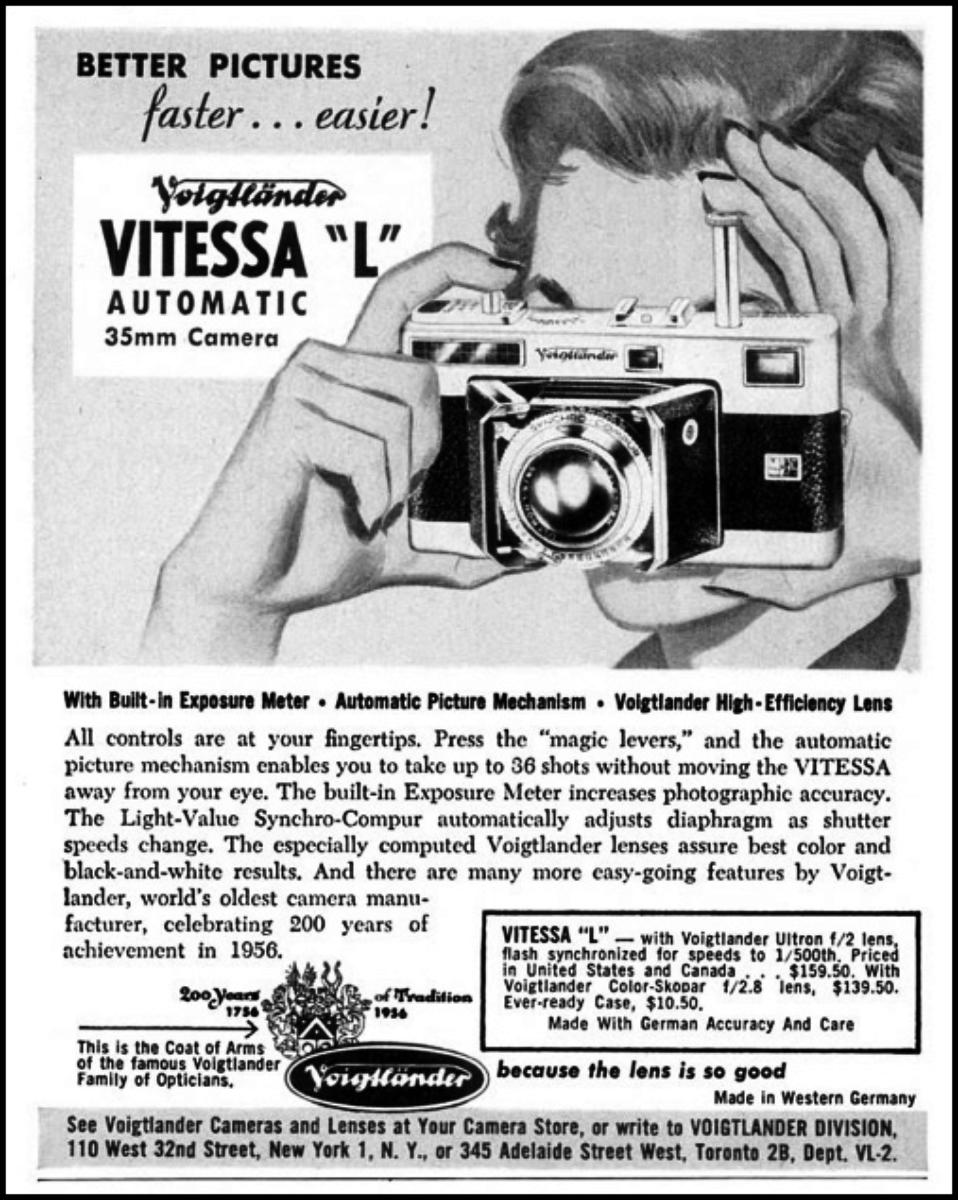
Voigtlander 1956 Ad for the Vitessa L camera

Toronto. On the eve of being absorbed by the mighty Zeiss organization, Voigtlander marketed a number of cameras featuring their lenses plus some unique operating features. The series called Vitessa from the 1950s was one such series. The earlier versions are easy to recognize with their odd long plunger to wind the film on to the next frame. Most used a bellows and a “barn door” mechanism to protect the bellows and lens when the camera was not in use.

This page 78 ad from the 1956 LIFE magazine, April 2 issue, shows the Vitessa L version of the camera. And 1956 was the 200th anniversary of the founding of the company as well.  Voigtlander billed itself as “the world’s oldest camera company”. A few years later it was bought by Zeiss and became a branch of the mighty company.


Posted in camera | Tagged , , , , , , | Comments Off on in Vitessa we trust

1840

Replica of 1840 Voigtlander cannon and Petzval lens. At Ryerson Library. Wilhelm Nassau commissioned this replica.

Toronto. One of the difficulties experienced by the earliest practitioners of the Daguerreotype process was the lack of speed, This was exacerbated by Daguerre’s use of an f/19 meniscus lens in his camera. In 1840, Josef Petzval partially solved this problem by designing the world’s first photographic lens, a 4 element f/3.7 beauty some 15x faster.

Petzval turned to a famous German optical house, Voigtlander, to manufacture the lens. They made both the lens and a special brass camera called a “cannon” sitting a top a special adjustable brass column. The lens could be focussed on the subject, then carefully lifted off the stand and taken to a darkroom where the conical focussing back was removed and a circular disk, with a round daguerreotype plate inserted, replaced the focussing cone. A brass lens cap kept light off the plate while the camera was returned to the stand.

When the customer was ready, the cap was removed and the exposure taken. With the cap back on the lens, the camera was removed from the stand and returned to the darkroom for processing. Only a few hundred original versions were ever made although Voigtlander offered serial numbered replicas over the ensuing years. Private replicas such as Willie Nassau’s are seen in museum displays.

The Voigtlander company was founded in Vienna as a scientific instrument maker in 1756. Glass optics were introduced about 1808. After the invention of photography, cameras were introduced. The company later moved to Braunschweig in Germany. And in 1956 Voigtlander merged with Zeiss and the fine old optical house disappeared. Voigtlander continued to influence Zeiss-Ikon camera design until 1972. The Voigtlander branch of Zeiss-Ikon was sold many times in the decades since 1972.

Posted in camera | Tagged , , , | Comments Off on 1840