a litter of letters for lens test

Gene Smith tests his Lenses – LIFE 1956

Toronto. In the late 1960s I was in Montreal and devised a means to test lens resolution and shutter accuracy. It was during the shutter test that I realized my Exakta had a serious problem. It turned out a brass stop was nearly chopped off and a dry axel made a curtain erratic as it moved across the exposed film frame.

For the lens tests, I used a commercial lens testing poster and moved the tripod back and forth to get most of the chart in the frame for each focal length. For the Exakta, the Steinheil 135mm f/2.8 was by far the best of the three lenses in flatness of field and resolution. The Angenieux 28mm f/3.5 was terrible and the 55mm f/1.9 Steinheil not much better. Both lenses used a retrofocus design. However; in practice, both gave a reasonably sharp result although curvature of field shows deteriorated corner resolution in my tests.

George Dunbar found the above novel lens test in LIFE magazine. The photographer, Gene Smith, was using a much larger camera and elected to photograph hand written letters and words scattered over the image frame and at various distances. Check out LIFE for  September 10, 1956 (pp16, 17).

You may wonder why we are using LIFE ads. There are a bunch of reasons: The magazine is no longer published; Google Books elected to scan and post every page of each weekly issue; LIFE was widely distributed and its name easily recognized; the magazine offers a slice of middle American life over a half century ago and by osmosis how we were in post war Canada at the time as we moved from Britain and its products to the brash outspoken America and American products.

Posted in history | Tagged , , , | Comments Off on a litter of letters for lens test

uh-oh, colour film – again

Metropolis Film

Toronto. For those of you who were born in the digital era, Colour NEGATIVE film was used before digital to make colour prints. Like black and white film, the illumination was reversed and an enlarger made the shades correct for the eye. In the case of colour negative film, colours are also reversed using complementary colours (look it up). Sometimes the film also had a filter layer – usually orange – in varying degrees of intensity.

The folks at Lomography have a passion for film and frequently announce new versions of film cameras and lenses. Some of their cameras use the Fuji film version of Polaroid packs (Instax).

They recently announced a col0ur negative film in various still-popular formats. Like Ilford’s XP-1, their film can be exposed in various ISO ratings – all incredibly slow in these days of digital sensors (ISO 100, 200, 400).

Posted in film | Tagged , , , | Comments Off on uh-oh, colour film – again

duck! …bang …finito!

speeding bullet head on

Toronto.  Years ago,  Dr Edgerton of MIT revolutionized the art of photography by using high speed flash to record mundane events in a fraction of a split second.  In the late 1950s, I bought a used Ultrablitz Reporter IIL. The speed of its light flash was more in the range of camera shutter speeds with its 1/800th and 1/400th second bursts. Before then I always thought of electronic flash as super fast.

On pp14 and 15 of the August 27th, 1956 issue of LIFE magazine, a regular column called “Speaking of Pictures” features the remarkable work of Lawrence Faeth in the New Haven Conn. labs of Winchester-Western – the rifle makers of Winchester fame. The column shows how Faeth recorded a speeding bullet head on. His photo is amazing even today, over six decades later.

N.B. Be sure to scroll through the pages of LIFE magazine above. With rare exception colour is reserved for advertisements by those with the money – most  photos in the articles are in black and white even if colour would be more suitable for them. And the products are sometimes long forgotten or viewed today in a far darker light (e.g. Marlboros are touted even though years later the poor old Marlboro Man died of lung cancer and cigarette ads have long been banned).

Posted in history | Tagged , , , , , , | Comments Off on duck! …bang …finito!

come a little bit closer…

The 1969 50mm Summicron all metal black anodized finish with a close focus of .7m

Toronto. …cried the Mexican girl in the ballad of the same name sung by Marty Robins back in the 1960s.

The standard set by Leitz in its Leica lenses was a close-up distance of 1m or 39 inches. Spider legs and various close-up devices allowed smaller items to be recorded, right down to 1:1.

This standard was continued with the Summicron 50mm lenses until the famous lens was recalculated in Midland, Ontario by the magnificent lens designer Walter Mandler to use only six elements. The close-up distance was reduced almost a foot to 28 inches or .7m. The lens was marketed in 1969. I bought mine in 1972 along with an M4 to photograph my two daughter, the youngest of whom was born that summer just before I took the plunge.

Posted in history | Tagged , , , | Comments Off on come a little bit closer…

moon walk and Hasselblads

Replica Hasselblad showing changes used in Apollo 11 mission – Cole Rise

Toronto. Riffing off yesterday’s post, the website NPR has an article called, “The Camera That Went To The Moon And Changed How We See It” written on July 13th by Scott Neuman. The article explains how NASA decided on Hasselblads for their missions and what they did to Astronaut Walter Schirra’s off the shelf camera to prepare it for the moon landing – and why Hasselblads and Zeiss lenses were abandoned on the moon.

Abandoning the cameras led to replications as explained by Cole Rise. The linked site includes this note on Cole Rise, “Cole is a photographer, designer, entrepreneur, pilot, and space camera maker. Obsessed with space and shooting Hasselblad for a over a decade, Cole spent the last two years training to became a Hasselblad technician, studying the original mission notes from NASA and obsolete Hasselblad repair manuals. He built a custom workshop for replicating NASA cameras, using many of the same tools and materials available in the 1960’s – down to replicating NASA’s temperature resistant foil stickers.”

My good friend George Dunbar sent me the second link in this post just after I wrote yesterday’s post. Thanks, George.

Posted in history | Tagged , , , , , | Comments Off on moon walk and Hasselblads

moon walk and photography

Toronto. 50 years ago this month man finallly escaped gravity and landed on the moon. Neil Armstrong was the first human to walk on our moon, He photographed his associate Buzz Aldrin, the second man to walk on the moon. The cameras were Hasselblads with heavy modifications using special Kodak colour film. Other movie and TV cameras were also used.

Apollo_11 was the mission that saw these men land on the moon. The third man in the team, Mike Collins stayed back to control the ship orbiting the moon and did a walk (fourth person on the moon) on the heavenly surface during a later mission.

Just think! If not for photography we would have to rely on the written word. The original moon walk made history, but photography recorded that history. NB. Michael Jackson made the moon walk dance famous over dozen years later in 1983. Have a look at the dance moves of this talented young performer.


Posted in history | Tagged , , , , , , , | Comments Off on moon walk and photography

even educated fleas do it

Nikon’s version of a microscope camera

Toronto.   The title of this post is a line from a 1928 Cole Porter song (Let’s Do It). I first heard it in the 1950s on a Columbia LP of Noel Coward at the Desert Inn in Las Vegas.

Many camera companies evolved from optical houses and made products like microscopes. Nikon is no exception. Nippon Kogaku made many optical products before its famous F SLR was used in the Vietnam war and later introduced to the USA.

Once Leitz developed a device to connect a 35mm camera to a microscope, others jumped on the band wagon. This included Japanese optical houses. Nikon’s FX-35DX camera shown here was specifically made for scientific use such as on microscopes. No rangefinder. No viewfinder.

This version has a Nikon mount but can also come with a Leica bayonet-mount to fit the Leitz MIKAS. Many microscope makers moved from glass plates to 35mm cameras using special devices like the MIKAS to accurately focus and frame microscope images on the film.

Posted in history | Tagged , , , , , | Comments Off on even educated fleas do it

really, really, close close-ups

Leica IIIc with MIKAS and 1/3 tube on a microscope

Toronto. Like a few other camera factories, Leitz is known for its microscopes. For years the makers of microscopes also made camera like devices to mount on the microscope and record little parts highly magnified.

A few years after the Leica became a marketing success, Leitz made a micro ibso gadget that joined a Leica camera to a microscope while allowing the image to be accurately focussed via a small telescope device.

A leaf shutter in the micro ibso (just above the telescope) ensured there was no obvious shutter movement. Leica’s traditional focal plane shutter – like all such shutters – would cause an asymmetrical vibration and blur the highly magnified image.

Shown is a post war IIIc and a post war MIKAS micro ibso with a 1/3 magnification tube and lens mounted on a c1930 microscope. The focussing telescope is the larger post war version. I picked up my copy of the MIKAS and 1/3 tube in 1984. Various MIKAS devices attached to both  screw-mount and bayonet-mount Leicas as well as movie cameras via a c-mount ring.

The 1/3 tube reduced the microscope image to 1/3 size allowing most of the image to be recorded. Traditionally a glass plate at least about 3x the size of a Leica negative was used.

Posted in history | Tagged , , , | Comments Off on really, really, close close-ups

a head for photography

Helmeted Diver using a screw mount Leica (IIIa?) – Hulton-Deutsch Collection / Corbis via Getty.

Toronto. George Dunbar sent me this image of a diver using a Leica with the special release accessory operated by teeth. This is photo number 17 in the series, “Weird, Wonderful Photos from Another Era” shown in an article by Alan Taylor on June 24th, 2019 in a column called, “InFocus” on The Atlantic website.

Taylor writes, “While doing my job of researching photos for various stories, I always come across more interesting images than I need, or photos that are unrelated to the story yet still remarkable, strange, hilarious, or just great shots. I tuck the best of those into a folder without a clear plan for future use.

“Today, I offer another sampling from that folder—a grab bag of historic images depicting land-speed records, underwater photography, Italian elections, a young Princess Elizabeth, a streamlined ferry, and more—from epic achievements to small moments. There isn’t really a theme here, other than ‘I thought these were neat photos, many rarely seen, and thought you’d enjoy them as well.’ This is part of an ongoing series of collections of interesting photos from the past.”

The cut line for photo #17 in the series is, ” diver demonstrates how he took photographs of the wreck of the Royal Navy submarine HMS Thetis by strapping a Leica camera inside his helmet and holding the trigger between his teeth.”

Posted in history | Tagged , , , | Comments Off on a head for photography

the next generation?

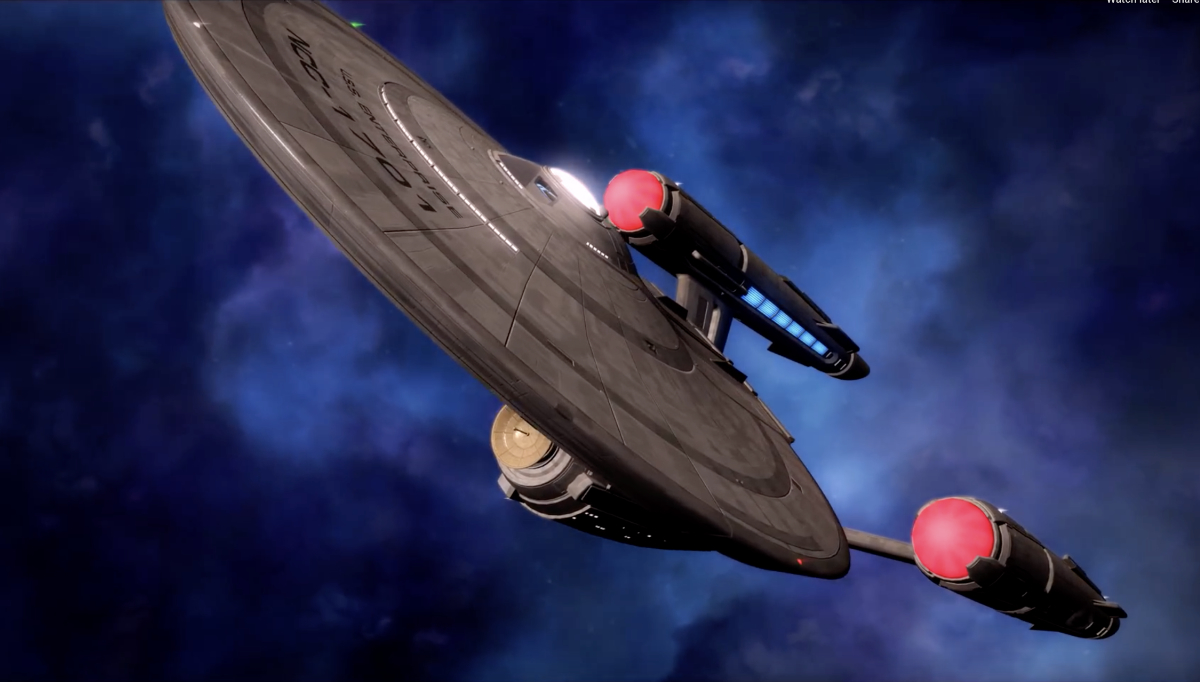
Enterprise from Star Trek

Toronto. Trekkies everywhere will recognize this famous inter-galactic spaceship.

When the art of photography was announced in January, 1839, it too was revolutionary: Two different processes were announced – one in France; one in England. Both were monochromatic,  dead slow, and very technical to use. One gave very contrasty, high resolution, one-off positive results (daguerreotype). The other was low contrast and low resolution but used a negative-positive system to make many prints from one negative (calotype or salted paper).

As time progressed, each generation tackled one issue: speed (faster lenses, faster media), motion (movies), dimensionality (stereo), colour, digital and now perhaps imagery defined by polarized light. Each generation added more converts as capturing a “good” image took less and less skill. With digital, we entered the paperless universe of the average amateur photographer retaining only a digital image using auto-everything cameras now in every smart-phone and uploading the image to social media.

My good friend (often participating at our fairs), Russ Forfar, operated Kominek’s camera repair here in the city for decades before recently fleeing to the bugs and blue skies of the Bruce peninsula. Russ sent me this fascinating article from Science Daily:

Camera brings unseen world to light

“Portable polarization-sensitive camera could be used in machine vision, autonomous vehicles, security, atmospheric chemistry and more”.

Could this be “the next generation” of photography?

Posted in history | Tagged , , | Comments Off on the next generation?