up close and personal

Scott’s fertilizer bead?

Toronto. I took this shot in October 2014 with a century old Zeiss licensed, Krauss made Tessar 35mm f/3.5 at f/22 after looking at the soil sample under a Leitz stereo microscope using 12.5x, 50x, and 100x magnification. The Tessar shot is about 25x magnification before any computer screen enlargement. According to the web, the tiny ball is either a slug or snail egg.  Scott’s (the seed and fertilizer people) say it is a slow release fertilizer bead. I tend to agree with Scott’s.

The tiny 35mm f/3.5 Tessar lens has an RMS (Royal Microscopal Society) thread (a standard once used by all microscope makers). I used a Leitz RMS to 39mm adapter, Leitz Bellows II, Visoflex housing II, Leitz M-mount to Sony E-mount adapter and my Sony NEX-6 camera to make this image.

Just as a note, in the early years of photography, Zeiss licensed other camera lens makers to use their lens designs. Licensing over-came duty penalties, scarce resources in house, and spread the name and prestige of Zeiss designs world wide.
Posted in history | Tagged , , , , , | Comments Off on up close and personal

PHSC News newsletter for May 2020

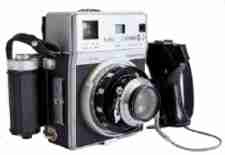
Mamiya Professional Camera

Toronto. Our latest issue of PHSC News in pdf format was released yesterday by our inspired editor Sonja Pushchak and her team in this trying time of the COVID-19 pandemic.

Page 1 offers “World Pressure”; page 2 covers  a virtual presentation on making a cereal commercial at home (since our monthly Toronto meetings are currently on hold); and in “Pandemic Follies” we see how others are not coping that well with the pandemic.

Photo Book 101 on page 4 discusses the TPL online (Toronto Public Libraries), while the Streamables on page 5 talks of the challenges faced by Franklin and Co. 1-3/4 centuries ago. David Bridge talks focus stacking with software in his Equipment Review. David follows this effort by once again helping partner Louise Freyburger with a trio of interesting web links. As a wrap, PHSC Events and the Classifieds are book ends for “Vi and Dot” who address movie fan magazines like PHOTOPLAY so popular last century.

Click here for the current issue or check out this and past issues under NEWSLETTER on the menu bar.

Posted in newsletter | Tagged , , , | Comments Off on PHSC News newsletter for May 2020

if only it was this easy …

Minolta Ad in the June 12,1964 LIFE magazine

Toronto.By 1964, a new kind of exposure meter finally made it possible to record low light settings. The CdS or Cadmium Sulfide cell resistance varied with the amount of light it was exposed to. A battery with a stable voltage level allowed a consistency over time. A meter converted the light value to the correct aperture and speed for a given media (film) sensitivity (ASA or today, ISO). The CdS cell required a voltage source whereas the selenium cell generated a voltage that varied with light intensity (unfortunately the selenium cell was nearly useless under low light conditions).

The emergence of the CdS cell made cameras far more capable of auto-exposure in low light and therefore far more idiot-proof. Camera makers like Minolta in this June 12, 1964 LIFE ad (page R12, a bit after page 112) incorporated the cell to expand or maintain their segment of the retail photographic market. A simple circuit consisting of the cell, a mercury battery, an adjustable resistor (for calibration) and a meter became common place. Unfortunately pollution from expired mercury cells resulted in this popular source of stable voltage to be banned.

My thanks to George Dunbar for mentioning the LIFE ad and its highlighting of a pivotal era in photographic history. Had the Wheatstone bridge circuitry been more common, CdS meters like the Gossen Pro could have used any button cell and not been made obsolete by environmental concerns. Later on, Zener diodes and petite silver oxide cells created more expensive alternatives to physically fit spaces designed for mercury cell buttons.

In time, digital technology made all the film cameras and accessories including light meters  obsolete to all but the film niche enthusiasts.

Posted in history | Tagged , , , | Comments Off on if only it was this easy …

the way we were …

Henry’s on Queen West in the big smoke c1945

Toronto. A popular camera chain, Henry’s, began here in Toronto over a century ago.

This May, the chain announced it would be closing a number of stores as it restructured. Then Henry’s head, Andy Stein, spoke with us back in October, 2009.

When the closures were announced, author, photographer, occasional PHSC member (and speaker), Mike Filey wrote this column in the Toronto Sun.

I spent many delightful hours in their old store just south of Queen as I changed and augmented my collection at the time. Thanks to our editor Bob Lansdale for sending on the info from member Jim Hall of Guelph. I had heard the announcement on the TV news, but forgot to put it in a post.

Posted in history | Tagged , , , , , | Comments Off on the way we were …

another auction just across the lake

Auction in Ohio. Click to see a sample lot (CDV of Tom Thumb and Wife)

Toronto. Here is another chance to augment your collection.

On the 17th of this month American Heritage Auctions in Ohio are holding a photographic auction hosted by Live Auctioneers who have the lots listed in this online catalogue.

If you want to add some Americana to your collection, here is your chance. You can bid on line.

Posted in photos | Tagged , , , , | Comments Off on another auction just across the lake

we have a winner!

PhotoEd Winner by Julie Vincent of Calgary.

Toronto. PhotoEd editor Rita Godlevskis sent me this bulletin the other day. In it she announces the winners of her “The Look West” photo challenge. First prize goes to Julie Vincent of Calgary for the portrait shown at left.

Rita says her Spring/Summer 2020 issue is now out both in hard copy and in digital (different content than the hard copy). In the digital copy (page 79) we have a full page ad that links back here. NOTE: in the spirit of new by-laws to flatten the curve of COVID-19 infections, our May 31 Fair was cancelled (hopefully the outdoor trunk sale in July and the fall fair will go ahead – I will post future details as we learn them).

Meantime, enjoy Rita’s work online and seriously consider buying a subscription to help out (and learn even more about the art too).

Posted in magazine | Tagged , , , , , , | Comments Off on we have a winner!

on the banks of the river Mara

Immortal by Kyriakos Kaziras

Toronto. I guess you won’t be visiting France any time soon. However; the Galerie GADCOLLECTION is still there and needs your support in this year of the COVID-19 pandemic. The galerie represents many photographers. Featured is the Greek photographer Kyrianos Kaziras and his series “On the Banks of the River Mara”. The river Mara is in Kenya so you can imagine the photographs he took.

The galerie writes, “Kyriakos KAZIRAS was born in Athens in 1966. He encountered photography at the early age of seven, when he received his first camera. His paternal grandfather was a painter and his maternal grandfather a photographer. This gave him the opportunity during his younger years to develop a strong affinity with art and picture composition.

“His parents moved to Geneva and the young Kyriakos KAZIRAS learnt French there. He studied French literature at the Sorbonne. At the same time, he has kept on practicing photography and he bought a second hand Praktika [Praktica], a medium-format camera. After graduating, he worked for a society specialized in staging shop windows, when photography caught him back.

“It was during a trip to Zimbabwe that Kyriakos KAZIRAS felt the urge to photograph. The African landscapes, with their vivid lights and the wild animals, acted as a catalyst for Kyriakos KAZIRAS’ photo passion, which was until that moment only a hobby. Thereafter, Kyriakos KAZIRAS went on excursions all around the world, meeting men and animals to photograph them, a personal way to report the magic beauty and the fragility of our planet.”

Posted in people | Tagged , , , , , | Comments Off on on the banks of the river Mara

who needs a mirror now anyway?

Ben shows how DSLRs and Mirrorless cameras differ.

Toronto. Digital cameras – is there any other kind these days? I often resort to my iPod Touch (I have an iPod Touch 7) since its 8 mp camera is usually in my pocket while all the other cameras are in my den. The site Cultured Kiwi has this nifty comparison chart at left between mirrorless and DSLR designs. Personally, once a decent eye-level view was added, I was sold on the design. Most professionals use the bulkier, heavier,  DSLR cameras that seem to do better at light balance and noise control.

Generally the newer the design, the higher the resolution and ISO of the camera sensor. My back-up Sony F828 is a beautiful camera but too slow and a bit low resolution these days. RAW shooting is painful with the F828 unlike my NEX-6 (now a really old mirrorless design) which is fast to use in RAW mode and has a far higher ISO.

An added benefit to mirrorless is that the shorter lens to sensor distance of the design means there is room for an adaptor between lenses and the camera making the use of many traditional lenses practical. For example, I have a basic adaptor that allows most Leica lenses and lens accessories to be connected to my Sony NEX-6.

Modern day phones have a built-in camera that usually makes jpg files easily downloaded to computers, sent to others electronically, and developed either in phone or computer. My iPod Touch uses the HEIC wrapper as a default. This “still” format wraps a short video giving the Apple look to stills which can be easily converted to jpg files for all to view.

N.B. Take a peak at Ben Kepka’s Cultured Kiwi site and enjoy your virtual visit to New Zealand.

Posted in camera | Tagged , , , | Comments Off on who needs a mirror now anyway?

just like the other one

Toronto. Well, we held our second executive meeting via ZOOM and co-ordinated by Celio (great work!). The PHSC will continue using ZOOM at least until the pandemic restrictions are lifted.

Screen Grab May 6 2020

Posted in events | Tagged , , | Comments Off on just like the other one

gizmos and gadgets

Ricoh Auto Shot ad in LIFE c 1964

Toronto, In the 1960s, camera makers fought to gain market share. A fresh idea might be swept up by the competition – or left to linger and die an orphan. Ricoh cameras were made by Riken Optical in Japan.

According to McKeown’s Price Guide to Antique and Classic Cameras (11th edition), Riken is the anglicized Japanese abbreviation for the “Institute for Physical and Chemical Research” founded in 1917. The company exists today as Ricoh. In 1937  Riken bought out Olympic Camera Works to make its own cameras. In 1963, the company became Ricoh Company Ltd and continued to manufacture many business products like copiers as well as cameras.  Seeing the way the film camera was going, Ricoh ceased camera manufacturing to put its resources elsewhere.

This advertisement from the May 15, 1964 issue of LIFE magazine (page R6 – about p 102) shows how Ricoh camera attempted to carve out its niche in photography. The idea of using the camera’s conical lens cap as a flash gun was clever, but no one else seems to have copied the idea. The spring wound shutter and film wind mechanism is reminiscent of the German Robot cameras. Ricoh does say the light meter surrounding the lens is CdS although it looks like a selenium cell as described by McKeown’s book.

Thanks again to my good friend George Dunbar who discovered this bit of history and sent it along to me. By the way, LIFE magazine ads can also show other consumer product histories in North America as well as the various ad campaigns of the last century.

Posted in history | Tagged , , , , , , , | Comments Off on gizmos and gadgets