make everybody welcome

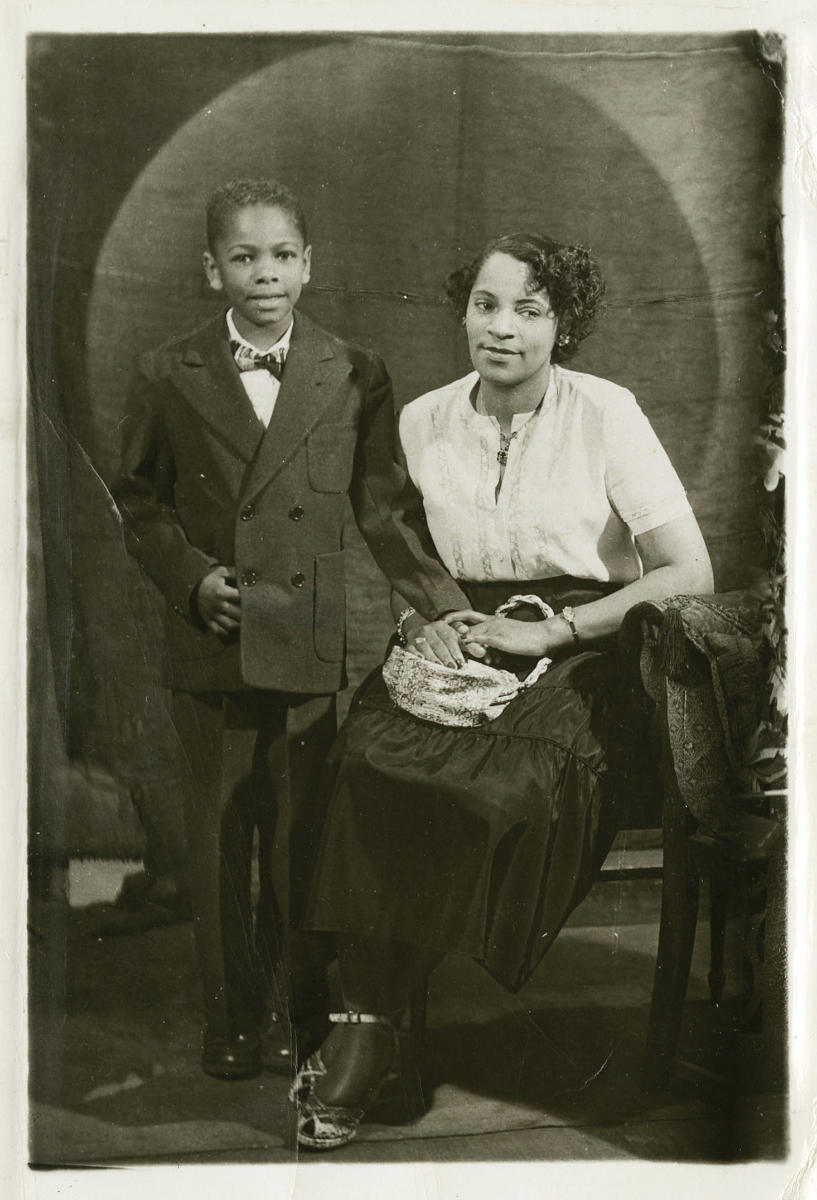
William Bell and Grandma, from the Bell-Sloman Collection of the James Gibson Library, Brock University

Toronto. I have been a member since the first year of the PHSC and in that time we have had speakers and members regardless of race, religion, or gender (the full gamut). In that time I have seen only one black photographer and a few women as members. In later years, we saw more female photographers, female speakers, and speakers of colour.

The photo at left is from the Bell-Sloman Collection  in St Catharines, Ontario. It was sourced from the talk given by Dr Julie Crooks of the AGO in February 2018.

As a society (especially in Canada), we can all be more open and embracing. On behalf of the PHSC, our VP, Ms Ashley Cook, wrote the following heart-felt message in reaction to the sad death of George Floyd south of the border and the ensuing days of discontent world wide:

“We don’t know what to say, and words may not be enough right now, but we will not stay silent.

“We acknowledge that we need to show more diversity within the photographic history of this country. This is the time to learn, build empathy, and understanding.

“BLACK LIVES MATTER”.


Posted in history | Tagged , , , | Comments Off on make everybody welcome

dyna-what?

Dynachrome 35mm slide film ad in LIFE

Toronto. In the March 27th, 1964 issue of LIFE magazine (p42), the 3M company ran this unusual ad for a colour transparency film called Dynachrome. Did you ever use it?

In 1954, the American government was hell-bent to separate any perceived trusts by large companies . In that year, Kodak was forced to separate Kodachrome manufacture and processing.

When Kodachrome patents expired, some organizations made a Kodachrome clone with built-in processing, selling for the price of Kodak’s film alone (companies too small for the trust busters). Around 1959 a clone was made by Dynacolor and called Dynachrome. Around 1963, the company was sold to 3M and the above advertisement showed up and ran for a few months in LIFE magazine. 3M used price to whittle off a bit of the burgeoning amateur photography market for itself.

You can read more detail about the history of the film and the suspected production and processing variations underneath the marketing names on the Photography Forums web site.

A big thank you to fellow PHSC member George Dunbar for spotting this bit of film history and passing it along.

Posted in history | Tagged , , , , , | Comments Off on dyna-what?

trifecta

Toronto. Our third executive meeting was held last evening (Wednesday) via ZOOM and co-ordinated by Celio (great work!). The PHSC will continue using ZOOM at least until the pandemic restrictions are lifted. The telephone symbols show two members of the executive connected via telephone only.

ZOOM screen grab when meeting was in progress

Posted in history | Tagged , , , | Comments Off on trifecta

who the heck is Hurter?

Hurter by Driffield

Toronto. Ferd Hurter and Chuck Driffield worked together in England. They were known in glass plate and film days for the H&D Curve. In 1890, the two spent their spare time as amateur photographers. They gained recognition after publishing  a way to accurately determine glass plate (film) speed and contrast based on their experiments.

Their H&D curve correlated negative exposure with glass/film density after development. Before this dynamic duo worked their magic, the speed of any photographic dry plate measurement was empirical only (a “by guess and by god” approach). They devoted their personal time to accurate sensitometry, gamma (contrast), latent image theory, etc.

Theirs was an age of photographic research, study and standardization necessary to make exposure of dry plates and film reproducible in the days when creation of sensitive materials, exposure, and development were no longer necessarily done by one experienced person in a very brief period of time during an afternoon.

Posted in history | Tagged , , , , , , | Comments Off on who the heck is Hurter?

making the grade

curve mapping exposure to various grades of paper. from Basic Photography by M J Langford 1965

Toronto. This post refers to film (black and white)  printing. Once you choose the huge number of variables for a photographic paper choice, you are left with one last factor – paper grade.

Ideally, the chart shown at left (3 grades, but some papers go to 5 or even 6 grades) shows how the negative printing exposure (exp.) maps to the paper using different grades. If it was only that simple a choice! Paper surface type, illumination type, grade, etc. all affect the final contrast on the paper. Ilford and other big manufacturers came up with double coated papers. One coating was very low contrast, the other very high contrast. Filters gave an exposure in various ratios of the two emulsions allowing one package of paper to cover a full range of paper grades from soft to hard.

The dynamic range from dark (shadow) to light (highlight) in the eye is very great. This range must be compressed in the film and crunched even further in the print. Film sensitivity and developing process affect the scene contrast. Basically the slower the film, the greater the contrast (and finer the grain). If a film is under-exposed or developed, the result is a very thin scene (flat). A contrasty paper grade may help a bit but shadow detail must exist for the print to show it. Alternatively, an over-exposed or developed film (negative) makes for a very dense scene. A softer paper grade (lower number) may help but once again detail must be in the negative or the highlights just block up on the print and show a flat tone.

Lots of books were available in the latter half of the last century to show how to properly expose and develop a film and the properly print each scene so there is some detail in both shadows and highlights and the over all contrast is from very light detail to very black (dark) detail. Not an easy task. It takes hours of study and experiment to get it right technically. Then you are stuck with the real artistic effort entailed – lighting, scene, framing, mood, etc., etc.

Posted in film | Tagged , , , , | Comments Off on making the grade

paper doll

Portrait by David Hamilton on Ilford Ilfomar A117 paper c1970

Toronto. To convert a film negative into a positive image, a second piece of the sensitive medium was usually used. Most commonly this was a photographic (light sensitive) paper. And there stood the dilemma for the average beginning photographer.

There was a mind blowing number of factors to consider: manufacturer (Kodak, Ansco, Ilford, Agfa, etc.), sensitivity (fast for enlarging, slow for contact printing, P.O.P. for temporary samples), weight (DW or double weight was thicker and easier to handle, SW or single weight was cheaper), size (8×10 inches, 11×14, 16×20, 4×5, etc. – bigger was cheaper and could be cut to smaller sizes), tone ( a toner bath could vary the print colour a bit).

And texture! Whole booklets were devoted to the wide variety of textures offered for monochrome printing. With colour, the choice was far less. At one time a geometric texture was used on commercial colour paper to mask the poor resolution inherent in 1950s colour media.

With colour, you were usually limited to one grade – your exposure and development were  spot on, or not. For monochrome, a series of grades were offered to determine the contrast of the print (or make it a high key print). Dodging and burning could adjust contrast for some parts of the print such as adding shadow or highlight detail (if this existed in the negative, of course).

The title of this post is an homage to a 1915 song, of the same name made popular during the second war by the Mills Brothers.

Posted in film | Tagged , , | Comments Off on paper doll

use da fixer

Sir John Herschel by J M Cameron. Restored by MM of A in NYC

Toronto. The first successful photographic processes used a weak salt solution as a fixer. Earlier experiments showed silver nitrate solutions reacted to light and could record scenes, BUT the silver nitrates quietly turned the whole medium dark. There was no way to turn off the silver salt (transparent) to metallic silver (opaque) process!

Shortly after the 1839 photographic processes were announced, Sir John Herschel suggested using Hyposulphite of Soda (Hypo) as a fixer.  Sir John had discovered its property two decades earlier! The actual chemical turned out to be sodium thiosulphate, but the name HYPO stuck for many, many decades. When I turned to photography in the 1950s, the terms hypo and fixer were interchangeable and in common use.

Hypo or fixer had one simple job to do: wash out the remaining silver halides in the medium so they could not slowly convert to metallic silver and destroy the image. A lengthy water wash in turn removed the fixer.

Posted in history | Tagged , , , , | Comments Off on use da fixer

as time goes by

Darkroom Timer by Kodak. Well built. Well used.

Toronto. The first T in the TNT film processing method  stands for Time. Using a darkroom tank or a daylight tank, it was necessary to use this method of processing a film.

Many companies offered a decent timer. This one (about 70 years old) was manufactured in Rochester and sold by Canadian Kodak in Toronto.

Another timer was the massive GrayLab gizmo also made in the States. If you chose to use a film by one maker and a developer by another, books like the Photo-Lab-Index helped convert the Time/Temperature data to save experimentation.

Posted in history | Tagged , , , , , | Comments Off on as time goes by

stop already!

traditional octagon shaped red top sign

Toronto. We know how to begin film or paper developing – just pour in the developer. But how do we stop the process? The sensitive media absorbs the developer so even draining it off or removing the media won’t stop development promptly.

The secret is to use a  chemical process. Development occurs only when the pH factor of the developer is slightly alkaline. Dropping it below seven by adding a bit of acid stops the process on a dime. Traditionally a diluted solution of Acetic Acid (Glacial Acetic Acid is 37 percent) is used. Never heard of the stuff? Try calling it vinegar (11 percent acetic acid in water) and don’t dilute it so much:-)

I know, I know, lazier folk just wash the medium in water.

Posted in history | Tagged , , , , , , | Comments Off on stop already!

doin’ it in the dark

dial thermometers for photography

Toronto, When light sensitive media were very slow and insensitive to the lower end of the spectrum (reds, oranges), the photographer’s eye could judge a fully developed image by subdued light or reddish illumination. About a century ago, flexible roll film made alternative means more practical. As sensitivity increased, and especially when film went panchromatic, and then colour, development HAD to be done in total darkness and another means had to be found to replace the educated eye.

This was the tried and true “Temperature and Time” method. Film began to be sold with a small bit of paper specifying the ideal time, temperature (usually 68 degrees Fahrenheit), and agitation (usually a slow spin of the spool once each minute). The trouble was, that the developers listed were only those sold by the film maker. This opened the door for books like the Photo-Lab Index which listed many formulae and the time/temperature to be used for a variety of film materials.

Under-developed film tended to be flat, lacking in contrast, and possibly with little or no shadow detail. On the other hand, over-developed film was very contrasty with the risk of little or no highlight detail. Developer too hot or too cold affected the film as did the development duration and agitation. Thermometers gave decent temperature settings, Timers (or watches with big second hands) allowed for good timing while attention to agitation kept that variable in line too.

NB. The post title is a takeoff on a Beatles songWhy Don’t We Do It in the Road“. The post photo is my two dial thermometers taken at 8mp hand held with my iPod Touch camera and cropped a bit. AirDrop transferred the image to my computer painlessly – no chemicals, no long delays, no sweat …

Posted in history | Tagged , , , , , | Comments Off on doin’ it in the dark