good money after bad

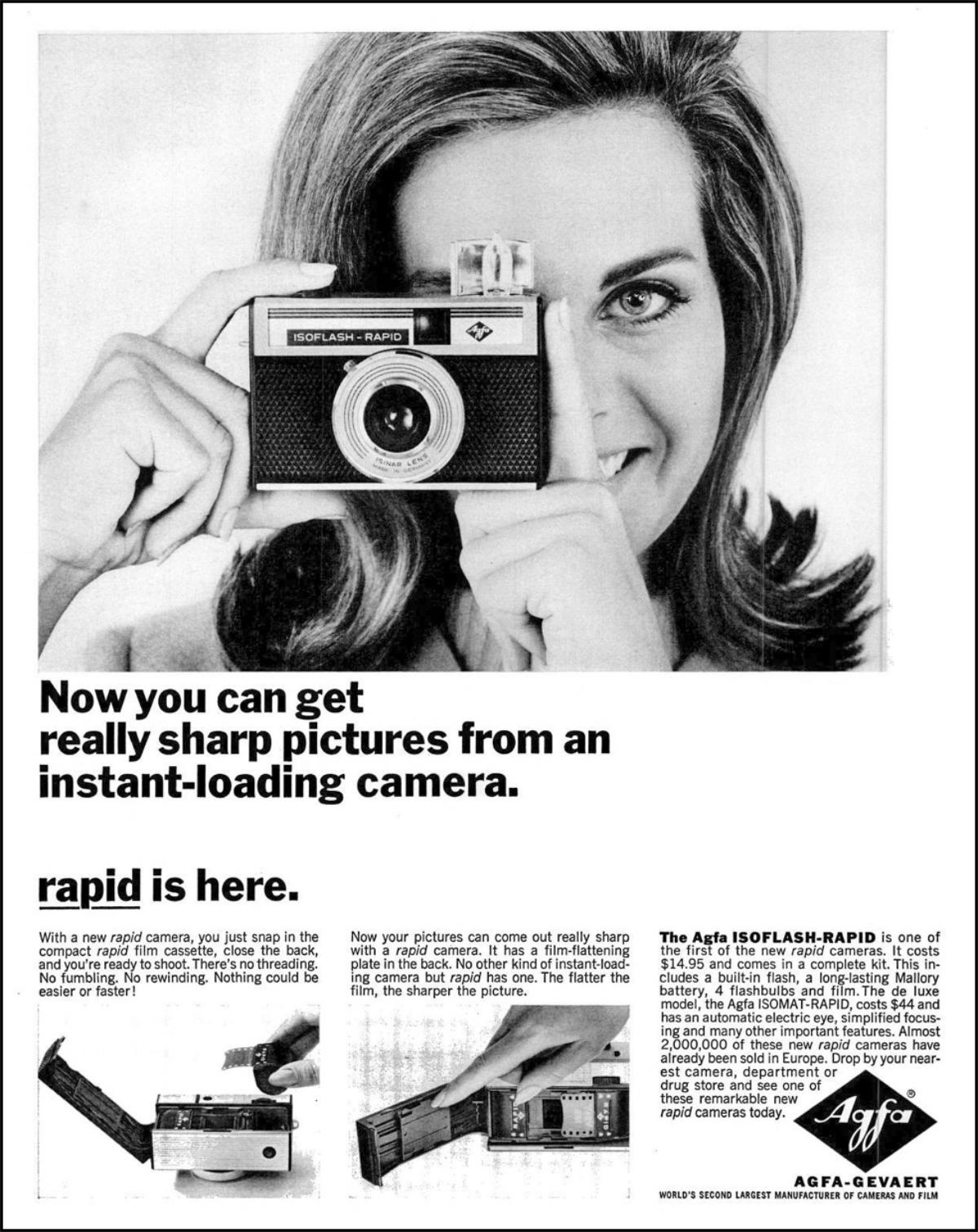
Fall 1965 American Ad for Agfa-Gevaert deal

Toronto. This is what we said when someone spent added money on a lost cause. Sometimes a better way didn’t gain traction in the marketplace and fell in the dustbin of history. This happened to Agfa-Gevaert’s rapid film system. When introduced as a competitor to Kodak’s 126  Instamatic film pack Kodapak, the rapid 35mm system was technically superior. It had a smaller cassette, no reel, and used a camera’s film plate to ensure the film was flat to the film plane.

BUT Kodak was a preeminent force in photography at the time. Both systems demanded new cameras, and were not compatible with then current models. The powerful Kodak brand was placed on many low end Instamatic cameras and the corporation slowly won over the market place.

As shown on page 20 in the September 17, 1965 ad from LIFE magazine, Agfa tossed another free 30,000 rapid cameras into the mix (limited to selected American states). The camera model it chose competed directly with the Instamatic. As a rough guess the $14.95 retail price would mean a factory cost of about $3.00 per camera or some $90,000 or more plus S&H, marketing, etc. No small sum in 1965.

It seemed nearly every home had an Instamatic. Hardly anyone had a rapid film camera. … In less than a decade the rapid system disappeared. My thanks once again to good friend George Dunbar for his diligent investigation of this tidbit of long forgotten (collectors excepted) photographic history.

Posted in history | Tagged , , , , , | Comments Off on good money after bad

that’s the spirit

The Spirit of Fact – Southworth and Hawes of Boston

Toronto.  Within a year of the January 1839 announcement of Daguerre’s process in Paris, the new way to create images was known world-wide. By the early 1840s every major city had a daguerreotype portrait studio.

Boston was no different. The works of Southworth and Hawes (S&H) were known through out America. In 1976, a high quality edition of their selected work (1943-1862) was reproduced by David R Godine of Boston and the IMP at George Eastman House (GEH) using the GEH (now known as George Eastman Museum) archive of originals from the S&H studios. Some years later a Dover reproduction was release but with half size images and less faithful reproduction to the originals.

A selection of quality images were also included in Grant Romer’s book “Young America“.

This Saturday, the Daguerreian Society feature an online lecture on S&H, “About a 1 hour conversation on Southworth and Hawes by Mike Robinson and Grant Romer drawing from the collection at The George Eastman House.

“The lecture will be on Saturday, June 27th at 1:30 PM EST. The $25 fee for the talk is fully tax deductible contribution to the Daguerreian Society.  On Saturday morning at 9am all participants will receive an email with the Zoom information including a passcode that we ask you not to share. You will receive a second reminder email at 1pm.

“We are using PayPal so please remember to check your PayPal email address or send us an email you would like to be contacted with by The Daguerreian Society.”

Posted in book | Tagged , , , , | Comments Off on that’s the spirit

colour quartet

Flower c2008 digital photo.

Toronto. The earliest photos were monochrome – unless hand coloured. By the turn of the 20th century, colour photos could be taken using three black and white films sandwiched together and interspersed with colour layers. The additive colour system created transparencies while the subtractive system created colour negatives to print on colour paper.

One of the earliest commercial successes was the c1900 Autochrome glass slides sold by the Lumière Brothers of France. While only a single glass pate was used, dyed potato grains created the colours. Colour processes faced a quartet of issues: speed, resolution, fidelity, and permanence. The light from the scene had to go through many layers resulting in very low ASA ratings. In the late 1950s, Kodachrome slide film reached ASA 10 and had to be used only in sunshine! Other slide films reached an ASA of 32, but that too was better used outdoors.

The processes like autochromes were clearly low resolution since every filter was a tiny potato grain. While the mid 20th century colour films relied on dyes and colour couplers, the absence or intensity of the dyes were determined by their respective films, so grain did enter the question. Kodachrome and the other slide films were slow speed but high resolution. Colour negatives and prints on the other hand were faster but remained rather low resolution options until the 1970s or so. Detail and colour appeared to be trade-offs.

Similarly, in that era, colour fidelity was an issue. Film types were chosen for their beautiful and realistic renderings. No one film accurately captured every colour in a scene. Kodachrome was touted for the brilliant reds while Ektachrome and the like tended to give better blues and greens. White balance was an issue solved by blue and amber coated flash bulbs, special conversion filters, or colour films intended for use outdoors (blue sunlight) or indoors under incandescent lighting (soft yellowish colour). Enlargers had a wide range of different density filters (Cyan, Magenta, Yellow, Red) to balance lighting over all in a print.

The issue of permanence in colour films or paper was never solved before film lost out to digital technology. Some processes used small dye molecules limiting the choice so chemists balanced off fidelity and permanence. Today we live in a digital world where very high ASA (now ISO) ratings are common place and white balance is usually performed automatically. Modern day digital cameras (either stand alone or in smart phones) make correct colour rendering a snap – but framing, sharpness, subject matter, etc. remain issues for amateurs.

Posted in history | Tagged , , , , | Comments Off on colour quartet

its the dye, silly

colour portrait 1970s/1980s

Toronto. In the days of colour film, it was somewhat common knowledge that colour photos faded badly and didn’t last. 60 years ago it was appropriate to get a mix of colour and B&W prints to commemorate special occasions like weddings.

When I was in Labrador in the late 1950s, I used Ansco colour slide film since, like Ektachrome, it could be processed at home. Over time these slides shifted to a purplish colour as the yellow dyes disappeared. Kodachrome slides fared much better but the processing was far too complex and demanding to do at home.

To make fading matters worse, Kodak had switched to using the notoriously poor amateur  Ektacolor paper for its professional prints. Studios were suddenly sued when their expensive wedding prints faded badly. You can read about the studies in the Wilhelm Institute’s epic book “ThePermanence and Care of Color Photographs: Traditional and Digital Color Prints, Color Negatives, Slides, and Motion Picturespublished in 1993 and long out of print. Henry Wihelm still offers a free download of this milestone 700+ page tomb.

Clicking on the small icon at top left will show the original Ansco ad in the September 3, 1965 issue of LIFE magazine on page 82. Thanks to my friend George Dunbar for this bit of photographic history last century.

Posted in history | Tagged , , , , | Comments Off on its the dye, silly

hockey and photography? really?

kids playing hockey

Toronto. Well, sports photographers and some news hounds would agree that hockey and photos definitely do mix quite well. In fact, one of our exchange members is the Hockey Hall of Fame (HHoF) here in the Big Smoke. And a few years back, we went to their satellite archives  in Long Branch for a meeting (March, 2013) one chilly evening.

Everybody in this country knows Tim Hortons (or Timmy’s) for coffee and a doughnut. But not all know of the tragic death of this famous NHL player. Brad Lombardo remedies this with a book about six NHL players who died a tragic death while still on an NHL team.

His book, “From Triumph to Tragedy In The NHL” is covered on this site, including how you can order it in hard copy or as an electronic file. The book uses Lombardo’s prose plus photographs from the HHoF archives.

NB. I snapped the above photo of one of my grandson’s (in blue) a while back (about eight years ago) using a Sony digital camera and an old Leica lens joined together with an adaptor bought online from a store in Hong Kong.

Posted in history | Tagged , , , | Comments Off on hockey and photography? really?

Managing, cataloging, storing, and digitizing your daguerreotype collection

Daugerreian Society Lectures

Toronto. The above title is quite a mouthful! As announced for today by the Daguerreian Society, it is, ” A one hour presentation with Mike Robinson on digitizing your daguerreotypes, followed by Len Walle and Phil Nathanson discussing how to manage, catalog and store your photographic collections.

“These topic are some of our most asked about subjects in the Facebook group. If you aren’t a member the group you are missing a wealth of information daily about daguerreotypes and other pre 1870s images.

“The lecture is today at 1:30 PM EST. The $25 fee for the talk is a fully tax deductible [USA taxes] contribution to the Daguerreian Society.  This morning all participants will receive an email with the Zoom information including a passcode that we ask you not to share.

Posted in activities-other | Tagged , | Comments Off on Managing, cataloging, storing, and digitizing your daguerreotype collection

more than one way …

Ivan the Terrible – click him to see the LIFE 1965 ad for the Agfa Rapid 35mm film system

Toronto. … to skin a cat, as the old saying goes. Film was no different. Kodak touted its 126 film size (35mm sans traditional sprocket holes and paper backed) Kodapak for its instamatic cameras eliminating the “klutzy” confusion of loading and rewinding a seldom used film camera.

A short time later, Agfa came along with their version of auto-loading 35mm film using a battery. The traditional camera film plate was used to flatten the film instead of the less precise Kodapak. Their Rapid system used a simple technique – the film tongue was slightly concave, not the long skinny lop-sided 35mm film leader in use for decades as an homage to the then old screw mount Leicas.

The old Leicas loaded through their base plate and a weird cam inside the base plate opened the brass film cassette Leitz sold so the film was free of any risk of scratches (retail cassettes with spools and a felt light trap could also be used).

The Rapid system eschewed the spool. The unexposed film slipped frame by frame into an empty Rapid cassette making rewinding unnecessary. Sadly, the Rapid system was overwhelmed in the market place by the instamatic Kodapak and disappeared in the early 1970s. Ironically the odd-ball APS system produced by a consortium of camera makers near the end of the days of film attempted to modernize information capture closer to the EXIF data of today and usurp the traditional 35mm system in amateur cameras, but it was just too little, too late.

My thanks to George Dunbar for reminding me of this bit of photographic history. The ad you see, when you click Ivan, originally appeared in the August 27, 1965 issue of LIFE on page 16.

Posted in film | Tagged , , , , , , , , , | Comments Off on more than one way …

coping with COVID

Wet Plate Guy – original steel cut of the PHSC Logo

Toronto. The pandemic that swept the world this year caused a seismic change in photographic historical societies. The societies reacted in various ways. Our group (PHSC) took advantage of our MailChimp account used to disseminate our newsletter “PHSC News” by adding a MEMBER tag to separate out member emails. Using the tag, we were able to send pdf copies of our journal “Photographic Canadiana” to all members with an email address on file (just over 4/5 of the members).

Since the monthly meetings were cancelled by decree, we elected to compile other material in pdf files ready to send to members IF they supplied an email address AND had a fast enough internet connection to receive the 2mb or so pdf files. A number of files are ready and will go out beginning next month (or late this month).

Others have elected to produce free short online videos (Michigan Photographic Historical Society) or even hold weekly lectures open to members (and others) who pay a modest fee (Daguerreian Society).

Posted in events | Tagged , , | Comments Off on coping with COVID

we lost Mike Mitchell at 76

Two publications of “Monsters” by the late Michael Mitchell

Toronto. I received very sad news on June 16th from our treasurer, John Morden.  John came across an AGO article written just yesterday (June 16th) announcing the death of Michael Mitchell in Hamilton on May 18, 2020.

The article was written by Maia Sutnik (retired from the AGO), another popular speaker at the PHSC. Mike gave two talks to us on his collection of Eisenmann photos, first in 1979 or the early 1980s, with a new release, new publisher (ECW),  and further details on October of 2003.

A fine mind and a fine photographer. Michael will be missed by us all.


Posted in people | Tagged , , , , | Comments Off on we lost Mike Mitchell at 76

ghosties and ghoulies …

a double exposure

Toronto. … and things that go bump in the night. An old saying to scare children silly in the days before electrical lighting. In the 19th century, few people understood exactly how photography worked. These folk often fell victim to those claiming to photograph spirits or ghosts.

In time, people discovered such things were simply double exposures either on the positive (print) or negative. In camera was easy especially when glass plates and cut film was used (or early roll film cameras). 20th  century roll film cameras touted double exposure prevention as a perk.

By under exposing the “ghost” it would appear to be more realistic. The above image was taken with a Leica which had double exposure prevention provided the photographer did not reuse a previously exposed roll of film (my bad)! In later times I tore a notch in the film or wrote on the leader to avoid such unintended results.

Posted in history | Tagged , , , | Comments Off on ghosties and ghoulies …