how to tell when a topic is HOT

Ad in Nov 1928 issue of S&I magazine

Toronto. In the roaring twenties, a century ago, movies were all the rage. As a result, “get rich quick” ads were everywhere. A typical ad was this November 1928 ad in Science and Invention magazine on page 651. The ad promised that readers could earn one hundred dollars (US) per week taking movies or stills.

This was a magnificent sum in 1928 and promised by the “N.Y. Institute of Photography” in NYC . No cost is given in their ad copy but they say they will give readers a “professional still or movie camera” plus instruction on how to get started – no previous experience needed!

This and other ads promised outrageous salaries in hot fields for untrained readers.

Thanks once again to my friend George Dunbar who was a serious professional industrial photographer in both stills and movies/videos.

Posted in history | Tagged , , , , | Comments Off on how to tell when a topic is HOT

the marvellous little Polaroid

Polaroid cameras that beep and buzz

Toronto. In 1969, the Polaroid ad in LIFE magazine touted its series of electronic and mechanical cameras with built in timers and signals to tell the user development was finished.

While Polaroid film and prints were somewhat expensive, the cameras were of an advanced design using electronics and CdS cells to ensure most snaps were technically correct saving money if the framing and pose was acceptable to the snap shooter. My friend George Dunbar found this ad from page 46 of the March 21st, 1969 issue of LIFE magazine and shared it with me.

The title of this post is a riff on Tom  Paxton’s rendering of “the marvellous toy“. I first heard this charming 1962 folk song by Tom Paxton back when it first came out. The song was sung either by him or the Chad Mitchell Trio back then. I was in university so it was likely playing when I was home.

Posted in magazine | Tagged , , , , | Comments Off on the marvellous little Polaroid

a searing legacy

Sears Roebuck typical camera pages 100+ years ago

Toronto. Well, Christmas and boxing day are over for most of us. Hope you managed to give/receive great gifts and find bargains in spite of the @#$#%^ pandemic we are all struggling with (well, most of us up here anyway).

Prior to the end of WW2, Canada was heavily oriented towards the UK and UK goods. The big deal each holiday season used to be Eaton’s catalogue. In the early years of the last century, Eaton’s also sold a wide variety of cameras and supplies. Bob Wilson generously allowed the use of his c1910 catalogue as an original for copies sent to all members along with our journal during the society’s 25th anniversary in 1999. Today, we have a pdf version of the same catalogue here under PRESS.

Eaton’s never operated in the States. Instead, in America, Sear Roebuck served the same purpose. Catalogues and mail order flourished over a century ago when most of North America was rural and not everyone could go shopping in the city. Like Eaton’s, the old Sears Roebuck catalog served its country’s population including professional and amateur photographers alike, but out of Chicago, instead of Toronto.

A typical Sears Roebuck catalog and its cameras and supplies can be seen on Archive.org in its Internet Archive section as shown with a typical spread. A thanks is due to friend and fellow PHSC member, George Dunbar for sharing this find.


Posted in history | Tagged , , , , , | Comments Off on a searing legacy

an old boxing day box camera

1930 50th Anniversary Box Camera by Kodak

Toronto. Boxing day on December 26th used to be THE day for sales. Then boxing day week, then black Friday, now COVID-19 and total lockdown over the holidays.

Still, it is fitting to celebrate boxing day with a box camera. Box cameras were the simplest of designs – fixed focus meniscus lens (about f/16), simple two blade shutter (about 1/25), simple viewer, and a box to keep out the light and hold the lens and shutter the correct distance from the roll film.

Kodak’s Brownie line saved money by using cardboard and a paper covering instead of wood and a leather covering. In 1930, to celebrate the 50th anniversary of Eastman-Kodak, Eastman badged a bunch of Brownie Hawk-Eye No 2 cameras with a round gold coloured paper circle and offered a camera free to anyone child who turned 12 that year on a first come basis (until all 550,000 or so  cameras were handed out by the retailers). A Brownie  linked site says “in North America” but the ad shown on the site says “America”. I vaguely remember a member saying the largess of Mr Eastman was limited to 12 year old American children in 1930.

Posted in camera | Tagged , , , , | Comments Off on an old boxing day box camera

merry Christmas all!

good health this season and all of 2021 – courtesy of George Dunbar, source unknown

Posted in activities | Tagged | Comments Off on merry Christmas all!

you think this post is about you

A Studio Stand holding a camera steady indoors for portraits

Toronto. I did various posts on the ubiquitous tripod so necessary so long ago. From the beginning of photography in 1839, the media and lenses were so slow that a steady stand was a necessity even outdoors. Studios used the sturdy wood and cast iron base versions like the one at left to hold the massive unwieldily cameras of the 1800s.

Little changed until the 1870s when Richard Maddox finally figured out how to make dry plates that could be used in a camera. Even then the bulky cameras had to be used outdoors in bright sunlight. The next century, roll film, flash, faster lenses,  and faster media changed all that, but …

As Carly Simon says in her song “You’re so Vain“, this post is really about membership in the PHSC.  Through the time consuming efforts of our volunteers and especially Bob Lansdale, John Morden and David Bridge, we have published added material online for members only. Journals, Exchange Newsletters, Specials of Historical Interest, etc. Not a member yet? No big deal – pull your plastic out and use the PayPal set up at the top right of this web page. Of course, we will continue to send our PHSC News to all who are on our MailChimp list – PHSC member or not.

Posted in activities | Tagged , , , | Comments Off on you think this post is about you

ya gotta light, mister

overview of a 1930s portait in studio

Toronto. For decades photographic studios were the epitome of Photographic businesses. In reality, the studios usually cranked out technically sound portraits using a tried and true combination of lighting including facial lights for modelling the features, background lights to illuminate the backdrop, and a general overall illumination.

The lighting varied – natural light (north facing preferred), incandescent lights. soft boxes, massive electronic flash, etc. Often done with a heavy tripod based camera and later a portable Hasselblad or such.

Studios with skillful photographers managed to get the true nuance of character of their subjects – like Karsh did in his famous portrait of Sir Winston Churchill.

Today, smartphone cameras are everywhere and the studio portrait seems to no long cater to modern people. If your phone can take selfies at a whim, and send them all over, then  you have no need for a fancy studio portrait anymore. At the time my uncle had his portrait taken, family cameras were very rare, usually simple devices, and few amateur photographers knew how to take a portrait let alone an outstanding one.

Like family albums and shoe boxes of prints, quality studios are disappearing into the mists of time.

Posted in history | Tagged , , , , , , | Comments Off on ya gotta light, mister

the world as seen by Inge Morath

A foggy city view – by Inge Morath

Toronto. Inge Morath was an Austrian-American photographer. At the time of her second marriage (to American playwright Arthur Miller), she emigrated to the States. Her work was featured in the TIME–LIFE Photography series in the late 1960s, early 1970s.

Inge was a member of the famous Magnum Photo organization in Paris, France. Stefan  Musil, of the Austrian Gallery “Galerie Ostlicht”, dropped me a note a couple of weeks ago that Inge’s work would be in a gallery exhibition there from December 9th, 2020 until June 2nd, 2021.

If you are in Austria anytime the exhibition is on, be sure to drop in. Meantime, those of us who are homebodies – by nature or by pandemic rules, take a browse online. You may find a print to add to your collection.

Posted in photos | Tagged , , , , | Comments Off on the world as seen by Inge Morath

what a combination!

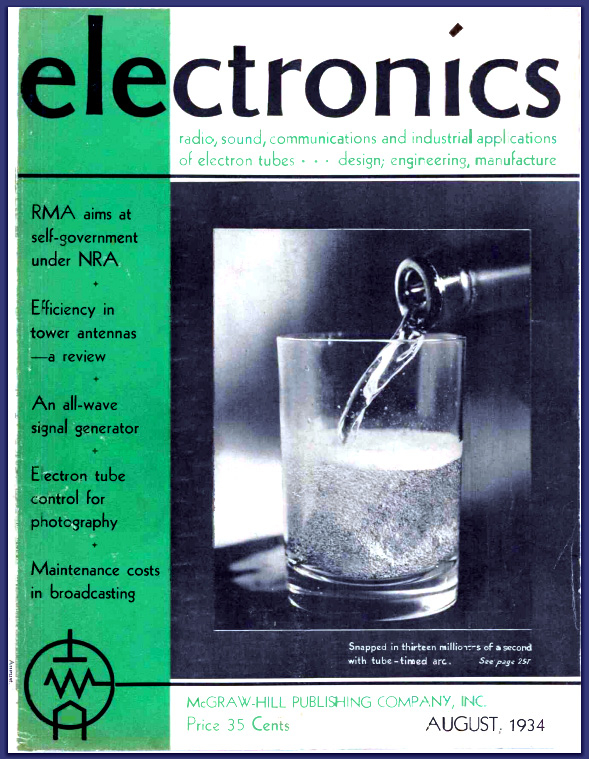
Cover – Electronics Magazine August 1934

Toronto. Movies and Electronics (not the typical science fiction variety movie) came together in the 1930s to extend human understanding. The 1930s were an exciting time (aside from the devastating depression) in photography and in electronics, The minicam revolution gained traction, German camera manufacture was at its best, radio sets and radio networks thrived, colour photography continued to evolve, the electronics industry was booming with new discoveries rampant, and Edgerton was at his best with strobes, but it took a nasty war at the end of the decade to move the world ahead.

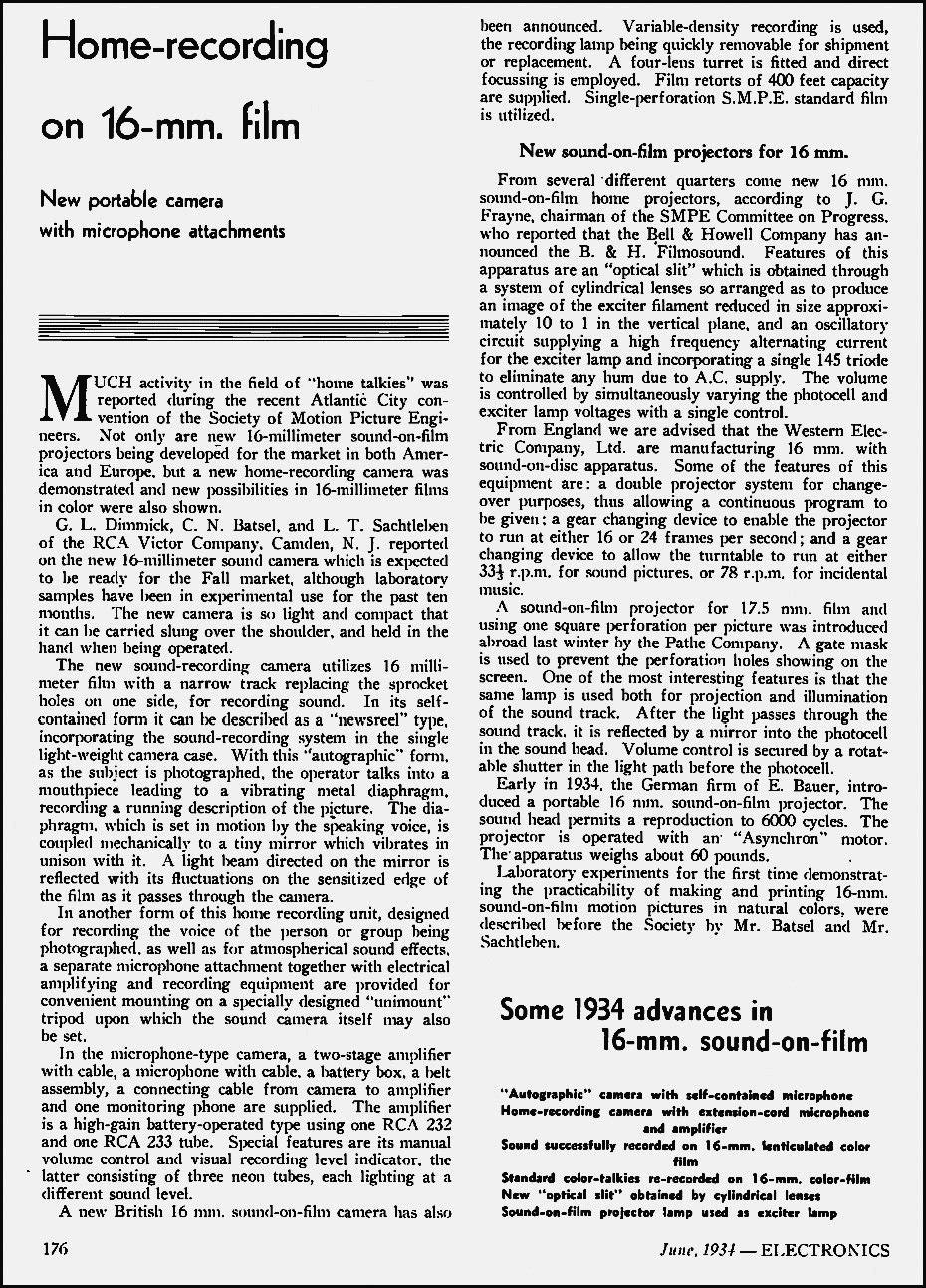
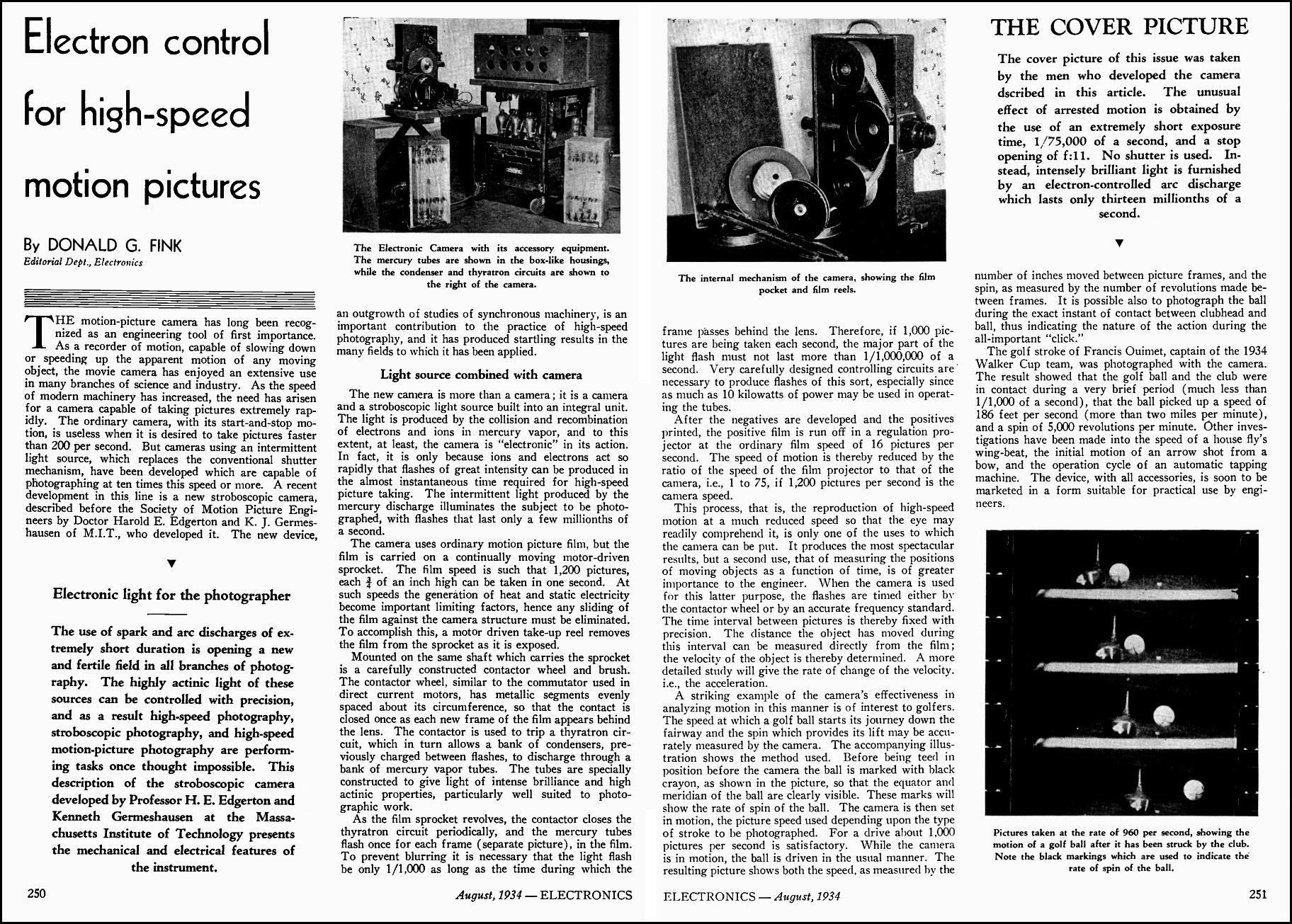
Electronics magazine for 1934  (June and August issues) reported exiting news regarding 16mm film and electronics. For home movies, it was advances in on-film sound, and colour film matching the 35mm colour film used for Hollywood extravaganzas.

The application of high speed and electronic control to industrial and scientific movies sparked a greater understanding of motions too brief for the unaided human eye to see. Electronic circuits allowed each frame to be synchronized with a strobe light flashing at  about 1 millionth of a second per frame.

Once you overcame the struggle imposed by the depression, it was an exciting time indeed according to my late father. Thanks are due to good friend and fellow photographic historian George Dunbar for sharing this find with me.

NB. the lower left of the magazine cover shows the schematic symbol for a triode vacuum tube. Current flows between the plate (upside down capital T which is positive) and the filament *upside down V which is negative). A low voltage high current battery between the sides of the V make the filament glow bright red and boils off electrons. The squiggly horizontal line is the grid. A very low current and voltage between grid and filament controls the flow of electrons between the filament and plate. This amplifies any alternating current signal. Solid state devices put an end to these archaic components of a by-gone era.


Posted in history | Tagged , , , , , , , | Comments Off on what a combination!

ain’t many coloured folks here

Saturday night in a saloon, Craigville, Minn., September 1937 – Russell Lee

Toronto. In the 1970s, I enjoyed the local library’s coffee table sized books of famous photographs and American photographers. In these books, I learned of the Farm Security Administration (FSA) program from the 1930s/40s and how it recorded the impact of the depression on American poor. Photographs were taken by people like Walker Evans, Dorothea Lange, and Russell Lee.

To my innocent eyes, the very few American Blacks in the photos seemed natural. I never thought about why or how this came about even though people of colour in America exceeded the population of Canada and were disproportionally poor.

Atlantic Monthly, an excellent magazine, published in its December 2020 edition the article “Whitewashing the Great Depression” by Sarah Boxer. The article discusses how the FSA intentionally encouraged photographs of mainly poor whites. Well worth a read.

A big thank you to my friend and photographic historian, George Dunbar, for sharing this fid with me.

Posted in history | Tagged , , , , | Comments Off on ain’t many coloured folks here