if winter comes …

Submit YOUR work to PhotoEd magazie

Toronto. … can spring be far behind? The delectable editor of PhotoEd, Ms Rita Godlevskis, announces two big events: The online version of PhotoEd’s winter edition and a call for material due February 1st for the PhotoEd spring edition.

Be sure to read this new online edition (different from the printed version) and submit your work to Rita for consideration. Those selected will be in the Spring 2021 edition of PhotoEd magazine.

NB. The title of this post is the last line of Shelley’s poem “Ode to the West Wind“.

Posted in magazine | Tagged , , , | Comments Off on if winter comes …

merry Christmas for those celebrating today

Toronto. Many of us wait until today to celebrate Christmas. Our president, Lewko Hryhorijiw, when asked gave an amazingly long list of countries still celebrating Christmas a couple of weeks later than December 25th. So to one and all, have a very merry Christmas in spite of COVID-19 and it’s necessary spread limiting restrictions.

A Merry Orthodox Christmas – courtesy of H. Sandler


Posted in activities | Tagged , , | Comments Off on merry Christmas for those celebrating today

they’re coming! they’re coming!

ad in LIFE magazine

Toronto. In this case, it was the Japanese camera makers who moved on to America and Europe after the Korean War. They slowly eliminated both American and most German makers of film cameras.

In the latter part of the last century, companies from Japan, like Nikon worked hard to expand market share with ostensively better quality and features than the competition. And it worked. No American and few European camera makers are still around. Even today in spite of the aggressive onslaught of digital technology. Nikon, Canon, and Sony exist (although I suspect smartphones are taking a heavy toll).

Thanks to good friend George Dunbar who suggested this ad from the December 5, 1969 issue (p 97) of LIFE magazine when Nikon was busy pushing into the movie market. Note: the Nikon optical house began as a strong local maker of microscopes and now sells them world-wide.

This post title is a riff on the mad-cap 1966 Cinemascope comedy “The Russians are coming, The Russians are coming” produced and directed by Canadian, Norman Jewison.

Posted in history | Tagged , , , , , | Comments Off on they’re coming! they’re coming!

by the light of the silvery moon

21st Century Wet Collodion Moon
Image Credit & Copyright: Mike Smolinsky

Toronto. From the very beginning of photography, the moon and photography have worked closely together. John William Draper made his daguerreotype of the moon in 1840. It is the earliest existing photographic image of the moon. A cleaned up version is shown here by the Met Museum in NYC. The modern day shot by the old wet plate process at left is thanks to Mike Smolinsky in the States via NASA. We were unable to link to mr Smolinsky as many people on the internet are so named.

I have photographed the moon many times myself over the years. I can still remember my first photograph in a central Ontario field on ASA 400 film using a 135mm lens. To be sure of the image, I bracketed the exposure and even threw in a relatively fast exposure. To my amazement, the fastest exposure showed the moon’s detail  while the slowest shot captured the sky detail  leaving the tiny moon image burnt out and transparent with no details at all.

In the spirit of moon photography, NASA recorded this image as the Astronomy Picture of the Day on January 2, 2021. The accompanying text notes, “ In the mid 19th century, one of the first photographic technologies used to record the lunar surface was the wet-plate collodion process, notably employed by British astronomer Warren De la Rue.

“To capture an image, a thick, transparent mixture was used to coat a glass plate, sensitized with silver nitrate, exposed at the telescope, and then developed to create a negative image on the plate. To maintain photographic sensitivity, the entire process, from coating to exposure to developing, had to be completed before the plate dried, in a span of about 10 to 15 minutes.

“This modern version of a wet-plate collodion image celebrates lunar photography’s early days, reproducing the process using modern chemicals to coat a glass plate from a 21st century hardware store. Captured last November 28 [20201128] with an 8×10 view camera and backyard telescope, it faithfully records large craters, bright rays, and dark, smooth mare of the waxing gibbous Moon. Subsequently digitized, the image on the plate was 8.5 centimeters in diameter and exposed while tracking for 2 minutes. The wet plate’s effective photographic sensitivity was about ISO 1. In your smart phone, the camera sensor probably has a photographic sensitivity range of ISO 100 to 6400 (and needs to be kept dry …).”

A big thank is due to my friend Russ Forfar up  along Georgian Bay on Lake Huron for suggesting this idea and sending me the NASA link.

Posted in history | Tagged , , , , , | Comments Off on by the light of the silvery moon

a loopy idea

T.T.&H., Agfa, Leitz – example loupes

Toronto. I show three magnifier loupes at the left. The first is a Taylor, Taylor, Hobson brass loupe used in the late 1800s to focus a lens on the massive old field/studio cameras so that the subject was sharp on the ground glass. In the above linked post I called it a “no-name” as I missed the tiny T.T.&H. engraved on the second black rim.

In the middle is my favourite AGFA LUPE 8x that I have used for years. Bought new, the acrylic lens and base are as pure as when first made. It is ideal for checking 35mm negatives and slides. Flipped up side down I use it to look at all kinds of tiny objects. Note that Inter Ocular Devices used to replace foggy human lenses in cataract patients (like me) are also made of acrylic plastic known to be clear, flexible, and inert.

And at right is just one of many varieties of Leitz LVFOO loupes. These 5x loupes came in various finishes and where used on the PLOOT and VISOFLEX I mirror boxes as viewers to focus a lens with some precision. Initially, these beautiful all glass loupes were repurposed for use as 35mm negative checkers complete with a neck loop. They were  offered for about $299 which I thought was far too expensive.

Surprisingly, the 5x loupes are now badged Leica at even higher list prices! These loupes, coded as 37 350 were offered as recently as 2017. Different models were made. Today I see them still offered as used or remaindered at even astonishingly higher prices – with or without a neck strap.

Posted in history | Tagged , , , , , , , , , , | Comments Off on a loopy idea

FIPP 2010-2019

FIPP ends in 2019

Toronto. Sad news from Freemantle, Australia last week. The Freemantle International Portrait Prize (FIPP) has been discontinued.

The originators wrote, “All good things must come to an end. The FIPP Committee recently decided that FIPP 2019 would be our last; committee members having spent hundreds of hours voluntarily planning, organising, and conducting FIPP over a decade.

“The Fremantle International Portrait Prize (FIPP) ran its first photographic competition in 2012. We staged our Fifth FIPP last year in 2019. In that time FIPP received more than 7,500 photographic entries from 48 countries, awarded more than $50,000 in cash and prizes to entrants and donated over $90,000 to charity. More than 20,000 people visited the five FIPP Showcase Exhibitions in Fremantle, Western Australia.

“FIPP is proud to have run one of the world’s foremost and ethical photographic competitions which has helped to put arts in Fremantle on the map. FIPP started in 2010 with zero funds and, after paying our prize money and donating to charity, remains in a strong financial position. In formally closing FIPP has distributed remaining funds to the two charities we have continued to support, namely The Arthritis Foundation of Western Australia and the Kai Eardley Fund.

“FIPP is extremely proud of its achievements and its contribution both to the arts and to charity. We are equally proud of the work of our hundreds of volunteers and support from Sponsors.

“In particular, we wish to thank you, the entrants. Each and every one of you for entering FIPP. Some of you are multiple entrants and some have been with us from the very beginning. Without you, the entrants, none of this would have been possible.”

Posted in activities-other | Tagged , , , | Comments Off on FIPP 2010-2019

two for the show …

1935 high speed movie camera (Electronics Dec 1935)

Toronto. I began working for Bell just months after Toll Area was formed. In those days Bell Labs in New Jersey did a wide variety of research. This article from the December, 1935 issue of Electronics tells of the collaboration between Kodak and the Labs that resulted in a high speed (3,000 frames per second) movie camera furthering scientific research.

Not your usual camera or movie post, but one that shows the wide ranging incursion of photography in all aspects of industry and life! As an aside, the editor of the day at Electronics was Keith Henney, the editor-in-chief of “Radio Engineers Handbook” which I bought in 1958 and still have to this day (also own a copy of Fink’s book on TV Engineering).

Have a look at the December 1935 Electronics and especially the article on the Kodak/Bell Labs movie camera starting on page 7. My thanks to good friend George Dunbar who unearthed this story while searching for photographic history articles and advertisements.

NB. The title is part of the old catch phrase, “One for the money, and two for the show. Three to get ready and four to go* which I often heard as a youngster.

Posted in history | Tagged , , , | Comments Off on two for the show …

happy new year everyone!

Toronto. Well thank god 2020 is over! What miserable year it was too! Let’s hope 2021 will be far better and let us get back to normal again by summer! All the best for 2021 from the Photographic Historical Society of Canada (PHSC), its members, and its executive (those worthy folk who bring you all the benefits and are totally volunteers).

all the best in 2021 – both images courtesy of Amazon

Posted in activities | Tagged | Comments Off on happy new year everyone!

take your time …

Days in the Sun by Regina Volkenborgh of the UK

Toronto. … as my mother used to say when she felt that I was dragging my heels. But sometimes taking your time is beneficial. Photographic media are sensitive to the volume of visible light hitting the sensitive surface. Traditionally two means were offered to control this volume: a shutter to determine its duration, and an aperture to set the amount of light hitting the media per unit of time.

The very simplest cameras were pinhole cameras – a fine pin hole for a lens and a piece of sensitive media, all in a light tight container. Photographer Regina Valkenborgh recorded the above photo in 2012. She calls it “Days in the Sun”. Regina used a beer can pinhole camera exposing directly on photographic paper for SIX MONTHS!

NASA accompanies the photo in its “Astronomy Picture of the Day” column with, “From solstice to solstice, this six month long exposure compresses time from the 21st of June till the 21st of December, 2011, into a single point of view. Dubbed a solargraph, the unconventional picture was recorded with a pinhole camera made from a drink can lined with a piece of photographic paper.

“Fixed to a single spot for the entire exposure, the simple camera continuously records the Sun’s path each day as a glowing trail burned into the photosensitive paper. In this case, the spot was chosen to look out over the domes and radio telescope of the University of Hertfordshire’s Bayfordbury Observatory. Dark gaps in the daily arcs are caused by cloud cover, whereas continuous bright tracks record glorious spells of sunny weather.

“Of course, in June, the Sun trails begin higher at the northern hemisphere’s summer solstice. The trails sink lower in the sky as December’s winter solstice approaches. Last year’s autumn was one of the balmiest on record in the UK, as the many bright arcs in the lower part of this picture testify.”


Posted in photos | Tagged , , , , | Comments Off on take your time …

metal detectors and photography

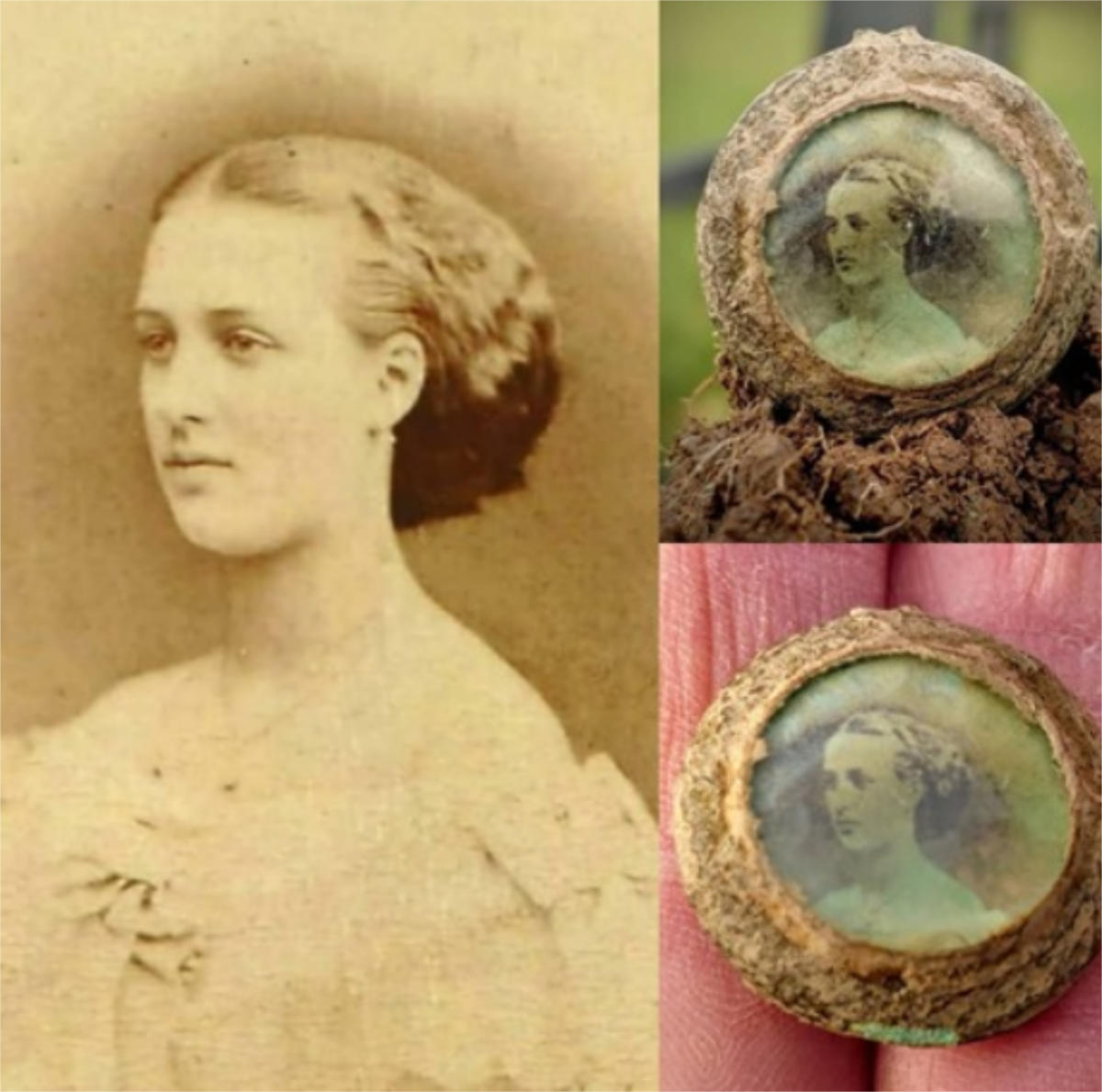
Victorian photo broach discovered in a field near Oswestry, UK

Toronto. You may think metal detectors and photography have little in common but sometimes they do! When I was young, I saw pictures of people using war surplus metal detectors to find “buried treasure” – usually a few coins and lots of junk.

Today, in the UK it is a hobby. So called “detectorists” search local fields for signs of lost civilizations. There is even a TV show (a comedy) on the art and its discoveries. Last fall, a hobbyist discovered an old Victorian broach and enclosed photo buried in a field in Oswestry. He posted an image of his find on social media, and to his delight, found out the name of the lady whose photo graced the broach.

The details are shown here. A big thank you to my friend and fellow PHSC member Celio Barreto. Celio handles our Toronto programme, Instagram account, and coordinates all ZOOM meetings while being a full time instructor at Seneca College in Toronto.

Posted in history | Tagged , , , , | Comments Off on metal detectors and photography