do-si-do and allemande left …

Dos-a-Dos tricycle and family. Image © Lorne Shields

Toronto. .. familiar words to square dancers everywhere, but did you know a special version of a “bicycle” for two in the early days was the dos-a-dos or back-to-back tricycle (photo is c1880).

Member and cycling expert Lorne Shields showed this example photo at the recent ‘ZOOM and Tell Vol. 2‘ held at this month’s online Toronto Meeting of the PHSC. If you need a copy, or have a copy, or want to know more, drop me a line at info@phsc.ca and I will pass your message along.

Posted in history | Tagged , , , | Comments Off on do-si-do and allemande left …

RIC plans for 2021 (COVID-19 considered)

RIC Gallery Plans for 2021

Toronto. The Ryerson Image Centre Gallery announcement for early 2021 (Jan-Feb-Mar) given the current restrictions for COVID-19 has been released. This is the link to details.

Thanks to John Morden, our treasurer and newsletter guru for suggesting this post.


Posted in activities-other | Tagged , , , , | Comments Off on RIC plans for 2021 (COVID-19 considered)

what the heck is an Eholt?

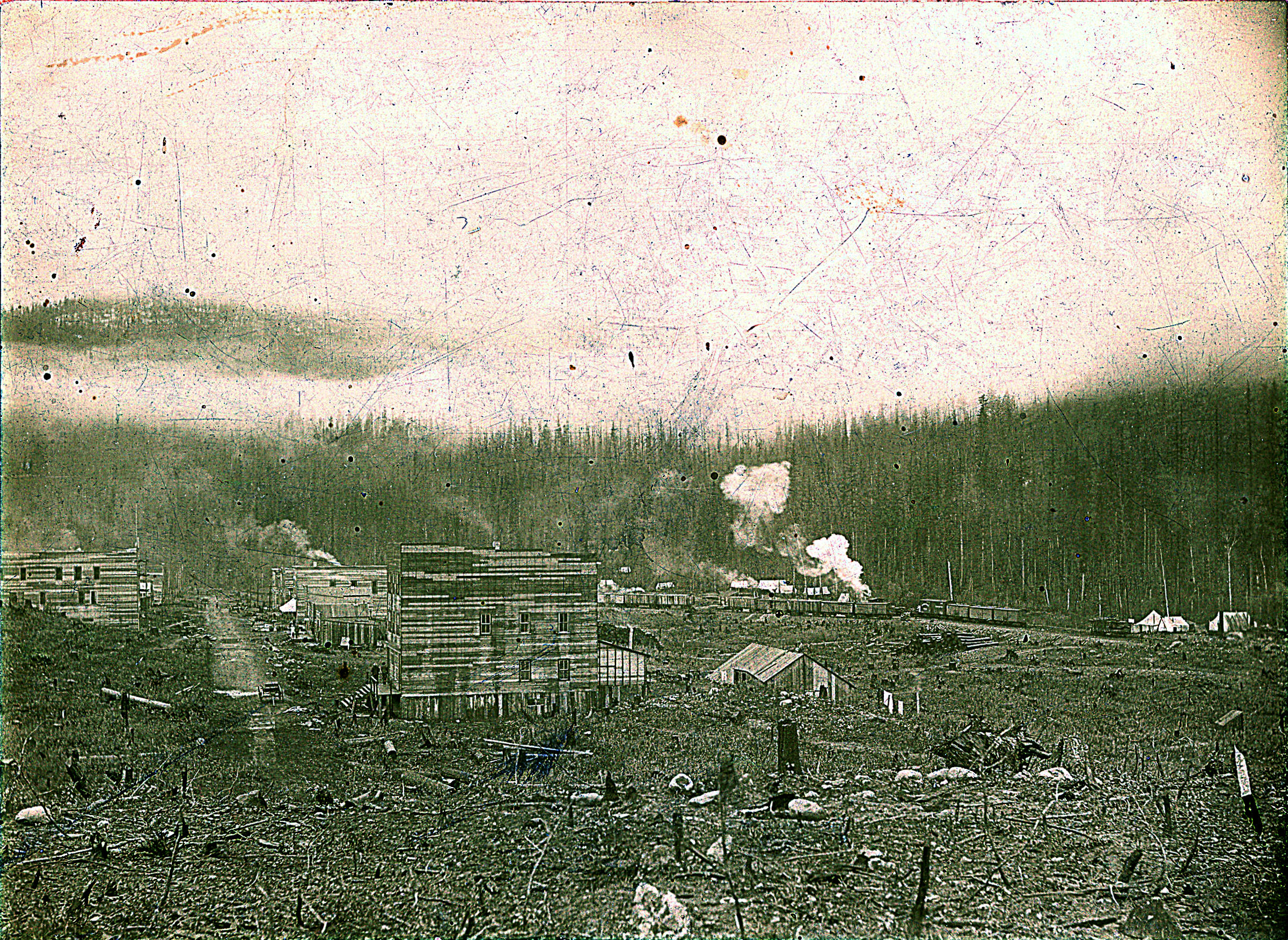
Eholt BC faded photo. Click for corrected version by R. Lansdale

Toronto. Well, as it turns out, Eholt is a ghost town miles east of Vancouver in BC. The little railway town was founded in the late 1800s. It survived until 1948, when the local post office closed, leaving the last 17 residents to their fate. Nothing remains today except a roadside plaque, memories, and the odd faded photograph.

At our Vol. 2 Zoom and Tell this month, Dr Irwin Reichstein in Ottawa, told a tale of finding an old faded print of the tiny town and using Photoshop to increase the contrast and detail showing the buildings, trains, people and even laundry hanging on a line. Our editor, Bob Lansdale used a high resolution scan from Dr Reichstein to adjust the contrast and detail once more using separate levels for the three channels (R, G, B) giving the detail you can see by clicking on the thumbnail at left.

Thanks to both Dr Irwin Reichstein and editor Lansdale for this remarkable photograph and its practical restoration by Photoshop using two different methods.

Posted in photos | Tagged , , , , , | Comments Off on what the heck is an Eholt?

somethin’ flashy

Ad in Jan 1941 Electronics magazine for flash synchronizer insulation materials

Toronto. Did you ever hear of the ‘National Vulcanized Fibre Company’ (NVFC)? Neither did I. However, parts using that company’s products played a key role in the use of flash in photography.

A number of companies in the early 1940s through 1950s sold specialized gizmos that synchronized the shutter release and flash triggering. These gizmos used the special insulation products provided in bulk to factories by companies like NVFC.

The camera maker usually sold flash guns (also made with these special insulation products) as accessories, while lens makers added built-in leaf shutters that included a flash trigger and connector. Remember, this was in the era of discrete components (usually big enough for all to see and hand hold).

This ad on page 48 of the January 1941 Issue of Electronics magazine was sent to me by my good friend George Dunbar who discovered it while perusing old magazines for photographically historic material.

Posted in history | Tagged , , , , , , , | Comments Off on somethin’ flashy

computational photography

Computational Photography by How-to-Geek

Toronto. Photography is a continuously evolving technology. Have you ever wondered how those smartphones could even begin to compete with digital cameras? These tiny marvels are a computer in your pocket just bursting with apps and technology. A phone and a camera are but two features.

The blog “How to Geek” sets out to tell you how smartphone cameras use computational photography to revolutionize the art of the photo. In the article “What Is Computational Photography?“, dated January 19, 2021, author Vann Vincenti gives you the basics. Have a read! This technology is a long way past Daguerreotypes, plates, films, etc. of yesteryear – a mind boggling way!

Posted in processes | Tagged , , | Comments Off on computational photography

a festival of their own

iPhone 12 Camera Lenses courtesy of Apple.com

Toronto. From time to time,  my posts have mentioned the trend for smartphones to become the camera of choice for amateurs. These pocket sized marvels of technology have replaced the digital point and shoot cameras and are making inroads as video cameras too.

Back in 2012, the first “Toronto Smartphone Film Festival” (TSFF) was held. Initially the festival was for Korean film makers and held here in Toronto. Since then, the festival here has grown to become the largest in the country. The festival will go ahead this year with its 9th festival. Currently there is a call for film submissions on its web site. As a nod to the nasty COVID-19 virus, the festival dates are pending at present, but in past have fallen in the June time-frame.

Note. The title of this post is a riff on the 1992 movie “A League of Their Own” about a women’s professional league during the 2nd World War.

Posted in history | Tagged , , , , , , | Comments Off on a festival of their own

Amalgamated Photo History Newsletters

Amalgamated Newsletters Vol 2-1 January 20221

Toronto. As we enter this new year with COVID-19 raging outside, editor Bob Lansdale has put together the first amalgamation of 2021 – Vol 2-1. All members with a an email address on file at the PHSC received this pdf version today. It is an amalgamation of selected newsletters from our exchange members who gave their blessing for inclusion in this venture. This issue wraps up with a couple of photo history related articles discovered by our good friend George Dunbar.

I noted last year that these packages were coming for members, ” … we elected to compile other material in pdf files ready to send to members IF they supplied an email address AND had a fast enough internet connection to receive the 2 – 10 mb or so pdf files. …”.

Well, the Volume 2-1 file (9.8 MB) went out. If you didn’t get it but you do get our newsletters, drop me a note (news@phsc.ca). I will verify you are a 2020/2021 member and send off a copy. If you are a current member and didn’t see a copy, please check your junk folder. This and all other specials will only be sent to paid members. Not one yet? No big deal – pull your plastic and use the PayPal set up at the top right of this web page. Note: We will continue to send our excellent newsletter ‘PHSC News‘ to all who are on our MailChimp list – PHSC member or not.

Posted in journal | Tagged , , , , , | Comments Off on Amalgamated Photo History Newsletters

the long and the short of it

My two 9cm Elmars made c1939 taken with an iPod Touch

Toronto. In the 1930s, Leitz sold a special short mount coded as COOED for the ELANG 9 cm f/4 Elmar lens head. This strange focusing mount and lens head were intended for use on the rotating focusing stage coded OORES and shown here as it appears in the green pocket size Hove Leica Accessory Guide (March 1984) on page 54.

From what I can tell, the COOED compensated for the rather thick lens mount plate of the OORES allowing the lens to focus to infinity making it possible to take landscape photos using the bigger ground glass and 5x magnifier of the tripod mounted stage to frame and focus each shot.  At the time, the Leica had only a tiny squinty 5 cm viewer although other viewers could be bought and mounted on the top of the camera in its accessory shoe.

The title of this post comes from an old expression of the same name.

Posted in history | Tagged , , , , , , | Comments Off on the long and the short of it

hey, hey, hey, it’s fat Elmar

Fat Elmar made 1931-2. Photo courtesy of Ritzcam.com

Toronto. In 1930, Leitz began marketing the tiny Leica with an interchangeable lens mount. According to Dennis Laney in his “Leica Collectors Guide” of September 1992, The medium telephoto 9 cm Elmar was one of the first three lenses added to the fold. The version in 1931-2 used the same lens head as future ‘thin’ versions but with a fatter lens mount similar to that on a 73mm Hektor lens.

Less than about 3,000 of these truly odd lens were ever made (the earliest were not rangefinder coupled apparently). I never picked up one although I did see a few offered at PHSC events in the early years of the society. Mine were all the ‘thin’ version – aesthetically more pleasing to me.  The image at left is courtesy of Ritz Cam and appears on this website.

The post title is a riff on the now vilified, but great comedian, Bill Cosby’s childhood character Fat Albert and the signature saying, “Hey, Hey, Hey.It’s Fat Albert“.

Posted in history | Tagged , , , , , | Comments Off on hey, hey, hey, it’s fat Elmar

ah! movies and cars- how great was that?

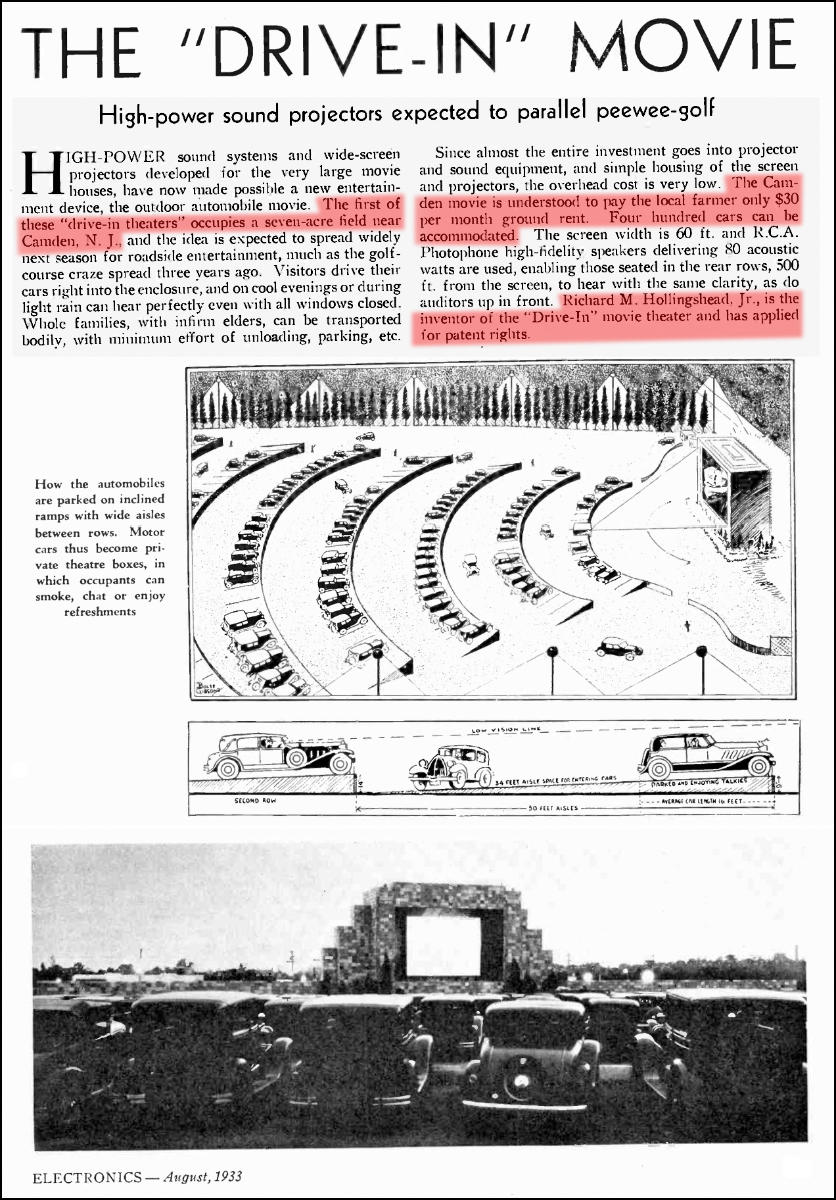
A 1933 idea captures two favourite pastimes: cars and movies (and saving money in the bargain)

Toronto. In the 1950s, I remember clambering in our car or a friend’s car and trundling off to the local drive-in to watch a movie outdoors and listen to a tiny tinny speaker hung on the widow. Sadly up here drive-ins were too cold and snowy in winter and started very late at night in the summer when it was finally dark out.

They proved to be a disappearing fad, but did you ever wonder about them, or their history? According to the August 1933 issue of Electronics, the drive-in first appeared in a seven acre farmer’s field outside Camden NJ. It was said to be invented by Dick Hollingworth Jr. who applied for patent rights. Electronics magazine was interested in the massive high fidelity sound system that provided every car with “80 watts of acoustical power” Impressive, since most so called high fidelity systems of two decades later used a fraction of that acoustical power for home filling stereo sound (there were systems far more powerful, of course).

The premise seemed to combine two favorite pastimes, cars and movies, for a low cost family outing. The closer to the equator you lived, the sooner darkness descended and the less likely you would have snow and freezing cold. For the photographer in us all, it was amazing to see a half frame 35mm shot blown up to around 60 feet across from about 3/4 inches. Remarkable!

This post was based n an idea suggested by my good friend George Dunbar who passed along the Electronics article.

Posted in history | Tagged , , , | Comments Off on ah! movies and cars- how great was that?