to crop or not to crop – that is the question

.. in the eye of the beholder …

Toronto. And another apology to Will for this riff on his famous line in act III of Hamlet.

When I first bought a 35mm camera, I soaked up as much then current wisdom as possible. I was told to move myself and/or change lenses so that most of the negative covered my intended framing.  To crop post exposure in the darkroom would lead to poorer resolution and an increased grainy appearance in the print.

Most newspapers of the day cropped every shot to fit the column width and column inches reserved for a photograph and to heck with the photographer’s aesthetics. To allow for this more rigorous cropping, most photographs were from larger cameras.

The odd newspaper, like the New York Times, did not generally crop photographs to fit but cropped if necessary to the taker’s aesthetics instead.

PHSC member, professional photographer/videographer, and good friend, George Dunbar writes, “What are we to learn about the proper cropping of photos when we see a news image such as this from the NYTimes? I suspect there are few other newspapers in North America that would be this creative with an image.

“I’ve always admired the unusual and powerful ways that photographs are displayed in the New York Times. This is a fine example. Readers are expected to pause and study a photo, rather that just dismiss it without any thought. The NYTimes is outstanding in that respect – in my humble opinion.”

Most newspapers used images to convey information; the Times used them to both convey information and to be a kind of art form as the originator intended.
Posted in photos | Tagged , , , | Comments Off on to crop or not to crop – that is the question

I am a Legend

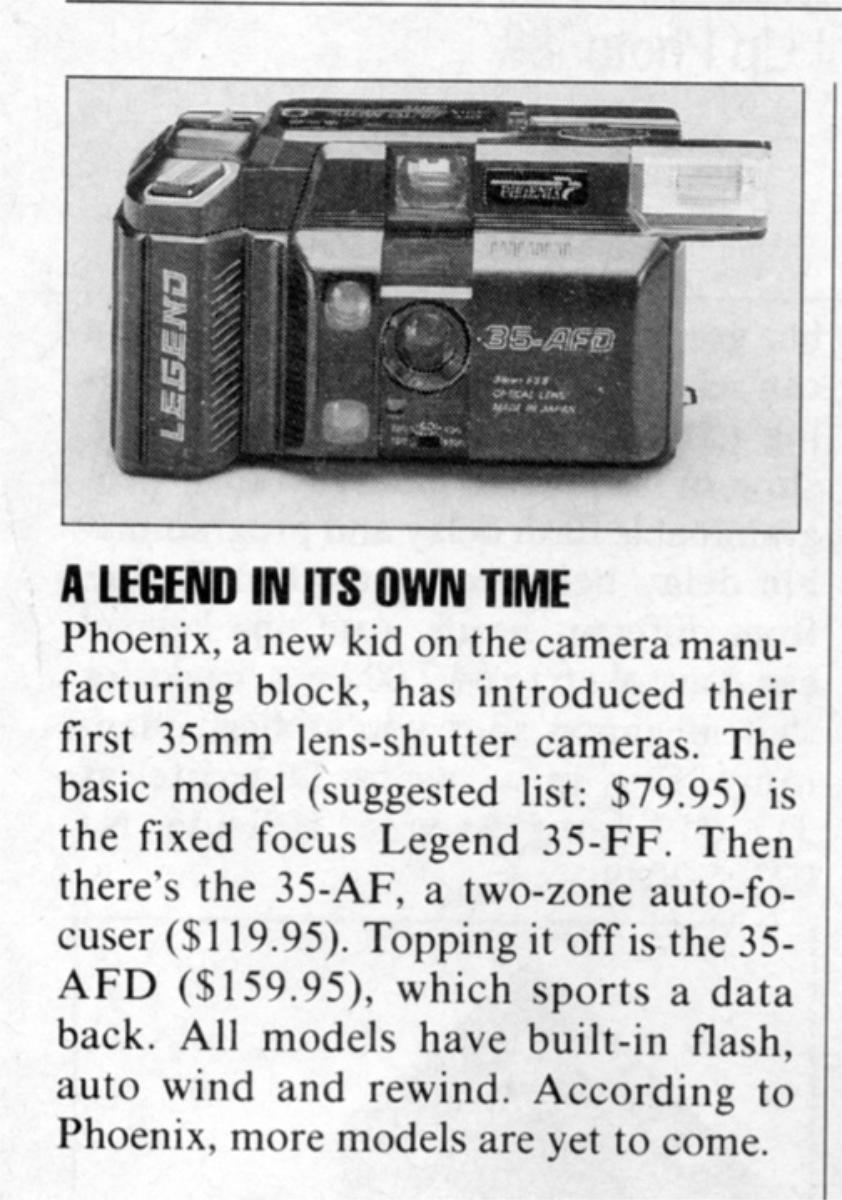
Article on the ill-fated Legend Cameras

Toronto. As of July, 1989, the magazine Modern Photography finally quit publication. It was a long run beginning in 1937 as Minicam Photography to capture the nascent 35mm camera era. In its last year, the magazine posted a small article on a new company called Phoenix and its camera line named ‘Legend‘.

Production was to make three models initially: 35-FF, 35-AF and 35-AFD illustrating the Modern Photography blurb. The camera looks to be crudely made of bakelite with a rather steep retail price given it was basically a box camera at heart. Since neither the internet nor McKeown’s have information on the cameras or the maker, they may never have made it to market or if they did, the cameras bombed.

My thanks to my friend, George Dunbar, for this tiny bit of history at the end of the long run of an influential photography magazine.

The title ‘I am a Legend‘ is that of a 1954 horror novel that spawned a few scary movies. I read the novel when I was a kid and saw at least one of the movies on TV in small bits sandwiched between dopey commercials. The film was ‘thoughtfully’ cut to fit the TV format and schedule.

Posted in history | Tagged , , , , , , | Comments Off on I am a Legend

Reg Holloway, 88

Reg Holloway June 2009 by Robert Lansdale

Toronto. I received sad news yesterday from our president, Clint Hryhorijiw, that member Reg Holloway died at 88. Reg  joined the society in the 1995 membership year and continued membership into April, 2021.

He spoke to us in June, 2009 on his favourite topic – newspaper photography with large cameras. I enjoyed chatting with Reg over the years. When he moved to his farm, he told me the internet connection for him was too slow at the time for pdf files. As part of his talk, he was photographed by our editor, Bob Lansdale with part of his collection.

Reg was a statesman, photographer, author, and collector.


Posted in people | Tagged , , , , | Comments Off on Reg Holloway, 88

we da north

PHSC Supplement 2-2 March 2021

Toronto.  The PHSA’s  Northlight is featured once again as our special members-only supplement. As a member of the PHSC, you received this supplement Friday, the 5th of March.

Vol 2-2 was sent out last Friday afternoon to all current members with an email address. If you did NOT get a copy, please email me at info@phsc.ca and I will send you a copy after verification of your membership. Not YET a member? well, for heaven’s sake! Grab your plastic and register via PayPal on the upper right of this page! And you can donate to the society the same way via PayPal, or go to our Canada Helps entry on the link below the PAY NOW button.

As stated in this supplement, “The NORTHLIGHT was the Journal of the Photographic Historical Society of America, once published quarterly. The Photographic Historical Society of America became a formal organization in November of 1973, and the first issue of their journal came out in the spring of 1974 with John S. Craig as editor. Eaton S. Lothrop Jr, Matthew R. Isenberg and Nathan R. Skipper Jr. functioned as the advisory board. Several other societies were involved in the publication: The Ohio Camera Collectors Society, Midwest Photographic Historical Society, Chesapeake Antiquarian Photographic Society and the Western Camera Collectors Association.

“In their first issue, John Craig stated that NORTHLIGHT was destined to become the magazine of photographic collectors and historians everywhere. As the journal of the Photographic Historical Society of America, it was to report in each issue on the activities of affiliated and participating societies in the PHSA and was to provide a calendar of events for these societies around the country.

“Following in this PDF is the NORTHLIGHT Double Issue Vol. 6 No. 3-4, Fall-Winter 1979-80. At this time, John Dobran was Executive Editor. This appears to be the last issue that was produced.

“The PHSC makes two appearances in the NORTHLIGHT issue. The calendar of events in this issue features a PHSC posting for the 6th annual Camera Fair on June 14-15, 1980 at the Park Plaza Hotel in Toronto. As well, the Photosphere section reports the appointment of the new PHSC directors for the upcoming year (some of those names are still associated with the society).

“In an effort to make this material available to collectors, historians and those interested in the history of photography, this content was digitized by the Photographic Historical Society of Canada (PHSC) and Milan Zahorcak in 2019 and 2020 for distribution to PHSC members. If you have any questions or would like higher resolution scans of any of the images, please contact the PHSC at info@phsc.ca.”

Posted in history | Tagged , , , , , , | Comments Off on we da north

a dirty dozen!

Toronto. We held our 12th ZOOM exec meeting Wednesday evening (its feeling like normal now). Again, Celio deserves a huge thank you for arranging it in spite of his busy teaching schedule at post secondary institutes.

Well, Toronto is still in total lockdown but daily new COVID-19 cases are falling overall. ALL live events are still cancelled. Our monthly meeting venue (North York Memorial Hall) remains closed (even to our archivist). We now use ZOOM and Eventbrite for Toronto meetings and may continue using them combined with in-person sessions at Memorial Hall when it opens again given the stellar success of video registration  and conferencing.

The March issue of our newsletter, ‘PHSC News’,  goes out a week Friday to nearly 1,900  addresses. Sign up at news@phsc.ca for your free pdf copy. Members also get specials plus the journal via pdf. (contact me if you are a member and HAVE NOT seen the pdfs. Some members have unsubscribed to MailChimp; some emails are invalid; and others have no email on file with the society or with MailChimp). Any questions? Just drop me a note at info@phsc.ca.

Our twelfth executive meeting via ZOOM

Coordinator Celio Barreto reported the March meeting via ZOOM, “The Great Bear Rain Forest”, by Dr. Ron Goodlin. Film Screening + Q&A already exceeds 50 seats across North America. Be sure to visit us on Eventbrite and sign up today!

Posted in activities | Tagged , , , , | Comments Off on a dirty dozen!

Glencoe, Glencoe, What Art Thou Glencoe?

camera is badged Glencoe Empire State but is the maker CanCamCo or ROC?

Toronto. With apologies to Bill Shakespeare. When Brian Hudson enquired about his Canadian Camera (& Optical) Company camera, he set off quite a storm which hasn’t settled yet. I had an Empire State camera a few years ago. I added a lens and UNICUM shutter to the empty lens board. But it was definitely a Rochester Optical Company camera according to the plaque on its front.

The image at left is courtesy of the piercevaubel web site. It is similar to the one I had – both are full plate cameras. 

The latest email on Brian’s query came from Dr Irwin Reichstein of Ottawa just a week ago. Irwin writes, “I came across this site which is probably known to you which has many photo catalogues available.  http://www.piercevaubel.com/cam/catalogsall.htm

I looked through catalogues that seemed relevant but the Glencoe was not mentioned in the years I thought relevant.   In the camera section, however, the Glencoe is mentioned.

http://www.piercevaubel.com/cam/misc/canadiancamco-glencoeview.htm

However, it is interesting that in his write-up at the bottom he writes that the years manufactured is 1910.

     This camera is identical to the Rochester Optical Co. Empire State Variation 2., except that the device to make the bed rigid is a thumbscrew, whereas Rochester Optical was using their lever hook for quicker set up and take down.  Some of the hardware is rather distinctive and must have come from Rochester Optical, e.g., the fancy swing hinge, and the triangular ground glass clips.  For this reason, it is very likely that the Canadian Camera & Optical Co. got these cameras already constructed from the Rochester Optical Co., either by contracting with Rochester Optical to purchase cameras for resale, or by buying Rochester Optical’s old stock that didn’t have the lever hook device.

I had come across items about the company dated 1910 and it seems that the company was revived around 1910.  It may be that at this stage they were just importing as opposed to the 1900 time frame when they actually manufactured them.  So is the period of interest still just the early period or should we be looking at the 1910 period as well.

If have more information whether CanCamCo cameras were made, imported, or both by them or if you can confirm the years of operation of the company, please drop me an email at info@phsc.ca and I will pass it along to our editor, Bob Lansdale.

Posted in history | Tagged , , , , , , , , , , | Comments Off on Glencoe, Glencoe, What Art Thou Glencoe?

holy, holy, holy

Photos by Kirk in the Bronx c1960s

Toronto. In Scotland, the word ‘Kirk’ means church. Last century in the Bronx, it meant a very talented Armenian photographer christened Kourken Hovsepian and his Studio.

At the February, 2021 meeting, we saw the finished version of “Photos by Kirk” by Jamie Day Fleck via streaming to ZOOM. This time, Jamie and a panel of three experts fielded queries afterwards. Jamie first gave us a taste of her film on Kirk when we saw a copy at our June, 2015 meeting. Tonight’s presentation was our third meeting organized on Eventbrite and hosted on ZOOM. We owe a thanks to Programme Director Celio Barreto for his co-ordinating acumen. The $9.99 General Admission screening and Panel Discussion tickets included a digital copy of the film. PHSC members were exempt from this fee, unless they wished to purchase a copy of the film.  I counted 46 attendees at one point.

The approximately 25 minute documentary consisted of interviews with family members and clients carefully interspersed with black and white photographs taken mostly by Kourken Hovsepian (Kirk). Note that ‘Kirk’ was the name he used for his studio as his Armenian name was difficult to say in English.

The documentary records some very emotional interviews. It also uses a few home movie clips – each uncorrected for the colour shifts that occurred over time. These clips added some poignancy. Kirk’s photographs recorded not only special events (candids, portraits, weddings) but the history of his neighbourhood in the Bronx (New York City). Like many studio photographers, Kirk used a very big camera in his work.  Continue reading

Posted in program | Tagged , , , , , , | Comments Off on holy, holy, holy

we get letters

Letter to the Canadian Camera Co in Toronto

Toronto. More information on the cameras once made in Montreal and Toronto. Brian Hudson of Edmonton unleashed a tsunami of information with his question on them.

Last Saturday, Dr Irwin Reichstein in Ottawa sent an email to us. He spotted this envelope addressed to the Canadian Camera Company in Toronto. Irwin writes, ” At a stamp collecting site there are two covers (that is addressed envelopes) for the Canadian camera and optical company from Deseronto and Norwood.  It’s neat to see the Queen Victoria stamps on the letters.  Sadly there seems to be no letters inside.” The site Irwin visited is Stamp Community Family, and the link that shows the envelope (courtesy of Irwin) is here.

Posted in camera | Tagged , | Comments Off on we get letters

shooting Arrows

AVRO Arrow drawing by unknown. Original resides in the Library and Archives Canada (LAC)

Toronto. One day as I sat on a runway at Toronto Peason, the pilot announced we could see the Avro Arrow to the side of our aircraft. Summarily scrapped by the Diefenbaker government, issues swirled around the decision – too costly; American influence; specifications insufficient; etc. etc.

Today, Lou Wise keeps the Arrow alive in memory. The Canada’s History site has a wonderful article written by Allan Britnell and posted August 13, 2015. called Shooting Arrows about the team from the AVRO film department.

This is the second post on the famous Canadian aircraft. I did one back on July 18, 2017 called A Broken Arrow and Photography. I owe both to the credit of my friend George Dunbar and his diligent search for photographic history.

Posted in history | Tagged , , , , | Comments Off on shooting Arrows

big yellow taxi

Fotomat, cars, and film

Toronto.  In the days of film, the exposed film was processed and then printed. Prints and the developed film were returned to the owner. In the US, a company called Fotomat was formed. The company’s business plan was simple: Put up tiny one person kiosks in  plaza and strip mall parking lots. Do the processing and printing elsewhere, offer film, flash bulbs and processing dirt cheap – and finished prints within a day.

The concept took off in the States, and before long thousands of kiosks covered the landscape. Internationally, growth expanded into Canada with  about 45 kiosks here in Toronto alone. The owners down south were a litigious lot. Kodak took them to court over their choice of colours and display fonts. Besides, Kodak did not care to be associated with a cheap service.

The business was a mix of company kiosks and franchises which led to more litigation – this time with the franchisees over territory.  The business continued since everyone liked the idea of dropping off exposed film and buying new when visiting a plaza, then getting prints the next day or so. The company didn’t see the storm clouds forming. The development of minilabs meant film processing and printing in one hour, not a day or so. Worse, the kiosks were too small for the minilabs. The need for the Fotomat concept died.

The company was sold off but struggling. Fotomat quietly disappeared as one hour processing took over. To add to the turmoil, one of the owners was found guilty of fraud and fled to parts unknown.

My thanks to good friend George Dunbar for sharing this ad on page 12 in the July 2, 1971 issue of LIFE when the business was going gangbusters!

The title of this post is Joni Mitchell’s epic 1969/70 hit “The Big Yellow Taxi” which has the lines ‘ they paved paradise and put up a parking lot

Posted in history | Tagged , , , , , , | Comments Off on big yellow taxi