feeling liverish?

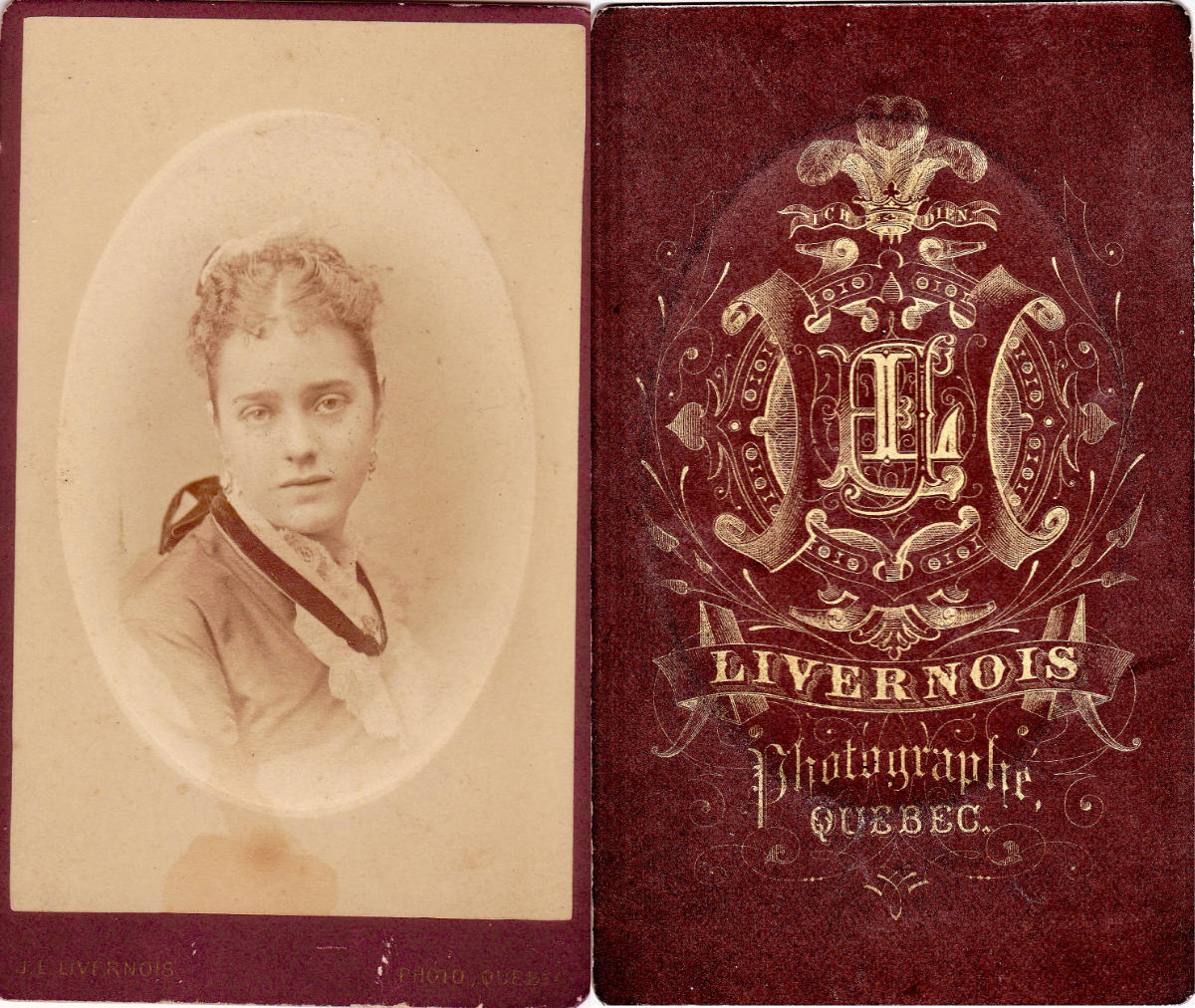
CDV of young lady taken at the Livernois Studio, Quebec City c1890

Toronto. Well, in the late 1800s/early 1900s in Quebec City that likely meant you had an urge to have a likeness taken at the Livernois Studio. Many of the photographs taken by the Livernois family can be found at the  “centre d’archives de Quebec” in the “fonds J E Livernois Ltee”.

Click the archive link above to practice your French and to browse the astonishing number of images. The Livernois studio alone has some 109,000 negatives (on glass, nitrate and acetate), and  prints!

The likeness of the young lady in the CDV portrait at left was captured in the late 1800s when J E Livernois ran the family business. Click on the above studio link to read the family history and see some example photos from the fonds. The samples include the Livernois studio c1900 (also online in the fonds). The family opened a pharmacy on the ground floor of the studio building …

Posted in history | Tagged , , , , | Comments Off on feeling liverish?

after one and a quarter …

Toronto. Hard to imagine, but the PHSC executive held its fifteenth monthly meeting by ZOOM! We cannot get into our North York Memorial Hall venue before September. All events are in abeyance just now but there is real hope on the horizon. Read the image file below and our PHSC News newsletter for program information. I will post all auction, fair, trunk, and image show details as soon as they are released.

Posted in activities | Tagged , , , , , , , | Comments Off on after one and a quarter …

brave new world again

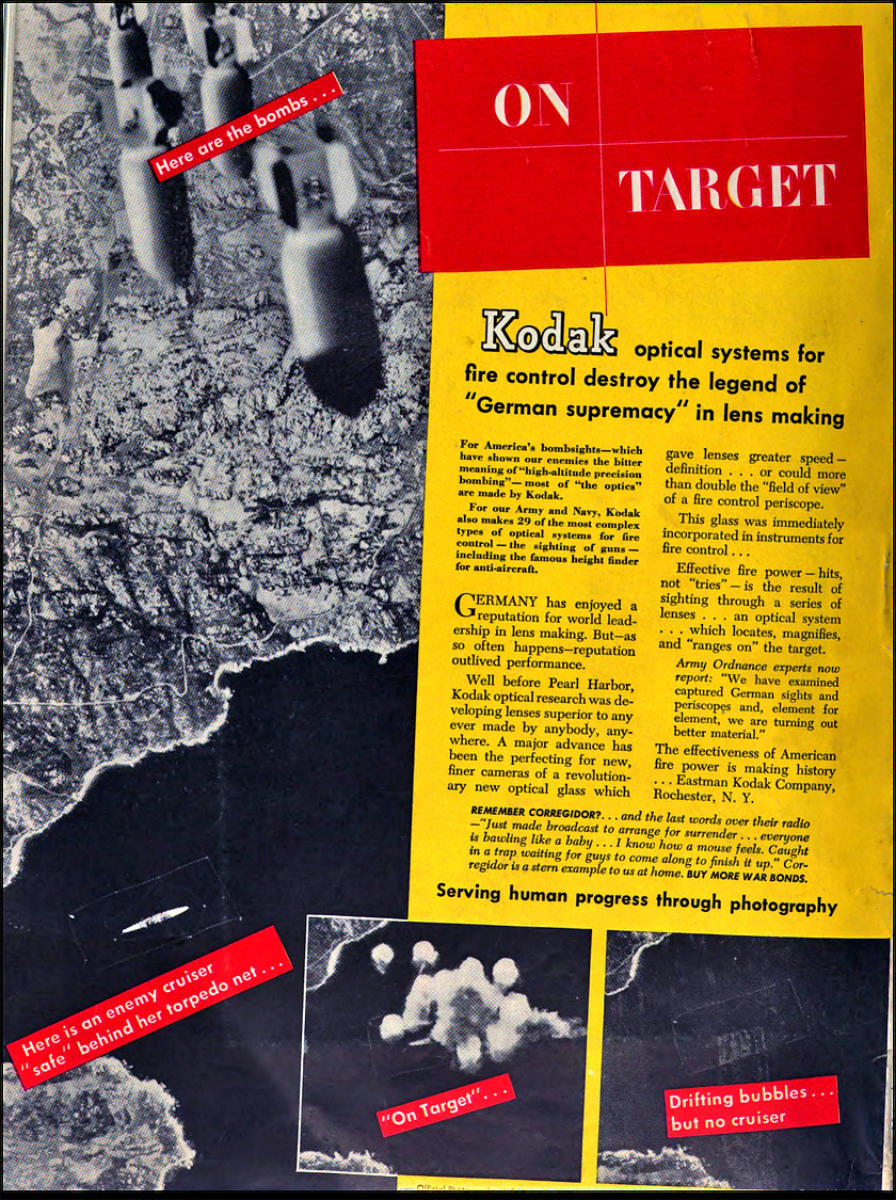
Kodak ad in January 1944 issue of Popular Photography magazine

Toronto. Well into WW2, Kodak took this ad out in the January 1944 issue of Popular Photography showing how research by their labs resulted in lens technology that out performed the German industry and led to superior fire power when American airplanes bombed the Axis ships.

This ad was found by my good friend George Dunbar who has kindly shared it here. As history shows, Kodak did make many fine lenses mid last century, but post war, the Germans regained their lead and were later matched, not by Kodak, but by Japan.

Later last century, Japan and Japanese optical firms routed most of the German optical industry. Today, in the era of the smart phone, most people no longer care who makes the lens or camera that is built into their mobile device.

Note: British writer Aldous Huxley published his novel, “Brave New World” in 1931. I used the same title for this post. I must have been very impressed by the title since it is the FOURTH time I used it in a post title.

Posted in history | Tagged , , , , , | Comments Off on brave new world again

Kalart saves the day

The Kalart synchronizer for Graflex – 1944 ad

Toronto. When I was a kid, I saw small ads in the American photography magazines of the day for a Kalart rangefinder to bolt on to a press camera. The strange name caught my eye.

This particular ad is for a Kalart flash bulb synchronizer gadget that custom-attaches to a Graflex to permit use of shutter  speeds above 1/500th (up to?) second with bulbs. George Dunbar came across this novel war time ad in the March 1944 issue of Popular Photography.

The arrangement uses the focal plane shutter and must be factory installed.  As far as I know, the only bulbs that worked with focal plane shutters at all speeds were the FP bulbs.

Posted in history | Tagged , , , , , | Comments Off on Kalart saves the day

Kodak shows its mettle

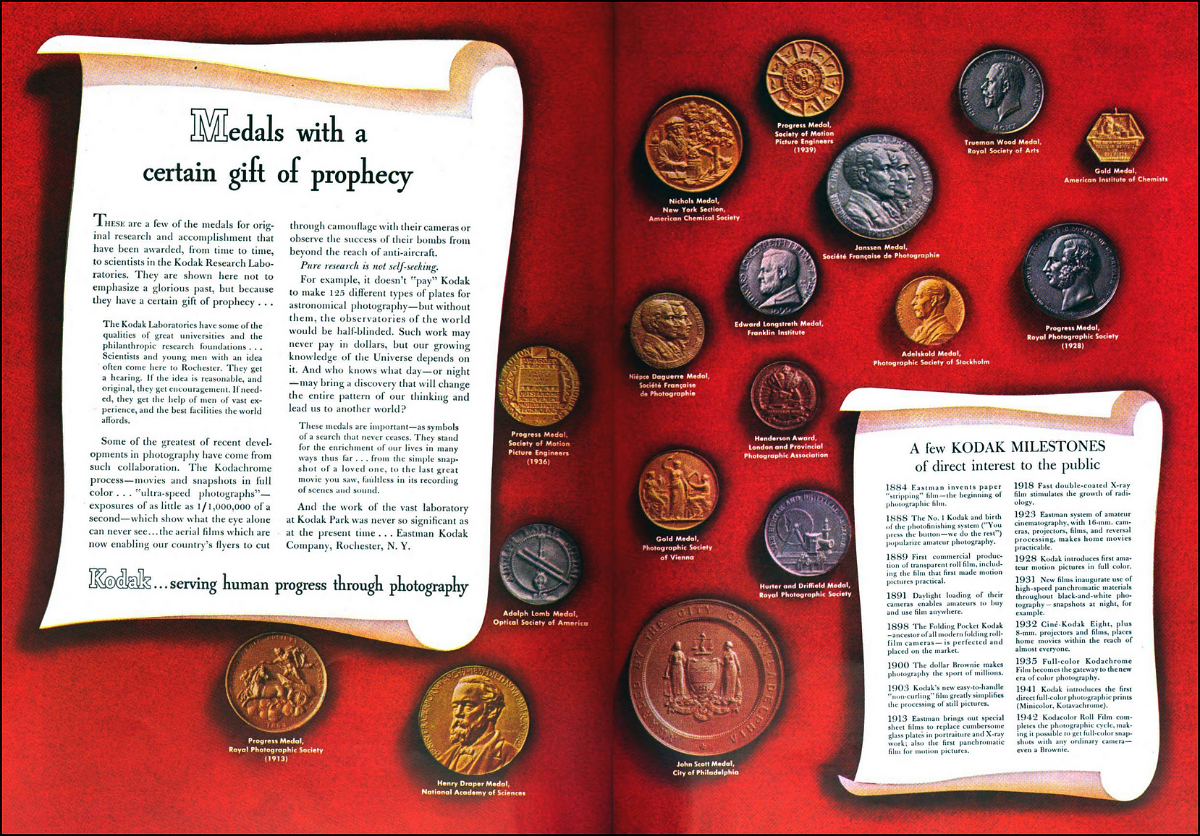
October 1942 ad for Kodak and its achievements in photography

Toronto. I often make derogatory sounding comments about Kodak, but the company was a force in the industry and for many decades a true leader. Few others had the support and customer base to create new film sizes. In fact the very popular single use 35mm film cassette was created by August Nagel at Kodak in Europe and adopted world-wide.

Kodak became synonymous with films and inexpensive cameras. The cameras helped sell Kodak films and other disposable photographic products that added significantly to the company’s bottom line. The above ad from the October, 1942 issue of Popular Photography lists many of the significant contributions the company made to photography and the many, many medals received by its laboratories for front line research of topics related to the future of our art.

This ad is just one of the many contributions to photographic history uncovered by my good friend George Dunbar. Well done, George!

Posted in history | Tagged , , , , , , | Comments Off on Kodak shows its mettle

a positive spin on WW2

Wartime ad for ILEX optical products in Popular Photography

Toronto. Ilex of Rochester NY ran this ad in the February 1944 issue of Popular Photography. The company bravely said, “When war clouds clear **look to Ilex”. The Ilex Optical Company in Rochester made “lenses, shutters, gunsights, and other precision optical equipment” for the American war effort “on many battlefronts”.

According to Kingslake, Ilex was formed in 1910/11/12 as a spin off from Bausch & Lomb and stayed active at least to the publication of  a brochure “The Rochester Camera and Lens Companies” by the then tiny but important TPHS of Rochester in 1974.

Sadly, Ilex seems to have faded away post war in the face of better known brands. One source suggests it was gone by the mid 1980s … We seldom see Ilex products at our fairsor auctions.

We owe a big thanks to fellow PHSC member, George Dunbar, for sharing this ad and its nostalgia regarding one of the old continental European emigrant based optical firms of Rochester, NY.

Posted in history | Tagged , , , , , , | Comments Off on a positive spin on WW2

Leica in Peace and War

Sep 1943 Popular Photography ad for E. Leitz, Inc. NY

Toronto. Before and for awhile after the second world war, the Leica was the most popular high-end 35mm camera sold. As many readers know, before WW2, the German camera industry was the undisputed world leader. During WW2, German technology was no longer exported to the west. Dresden, the city central to Zeiss-Ikon was flattened by Allied bombs. Worse, post war, Jena and the famous Zeiss works fell in East Germany, a part of the Soviet Union. Fortunately, Leitz in Wetzlar was not bombed, and was assigned to the western part of Germany.

During America’s participation in the war, foreign European branches were removed from their parent organizations and operated under the US government. Leitz was no different. They survived by repairing Leicas, selling American made Wollensak lenses that mimicked their German counter parts – except the long focus 135mm became a long focus 127 mm. And made and sold popular accessories like viewfinders, extension tubes, and the ‘Sliding, Focusing, Copying Attachment’ shown in this ad in the September, 1943 issue of Popular Photography. And of course Leitz NY sold the famous Leica Manual published by Morgan & Morgan too.

A huge thanks to good friend and fellow PHSC member (and photographic historian), George Dunbar for sharing his findings.

Note: The post title is a riff on a then famous American radio show, ‘The FBI in Peace and War“. Ironically to me, the theme of the program was Prokofiev’s march from, “The Love for Three Oranges“. Prokofiev was Russian …

Posted in history | Tagged , , , , , , , | Comments Off on Leica in Peace and War

one camera’s wide angle …

Berthiot Angulor 28mm for Leica. Made in Paris FR

Toronto. … is another camera’s telephoto. Did you ever wonder why the tiny smart phone camera has an equivalent 35mm camera size? For example my iPod Touch camera has a 3.3mm, f/2.8 lens but images it takes are considered to be equivalent to those taken with a 35mm lens on a 35mm camera – same angle of view.

As a general rule, a lens focal length about equal to the sensitive media diagonal is called a normal lens. A focal length of less than the diagonal constitutes a wide-angle lens for that camera/media while a focal length greater than the media’s diagonal size is said to be a telephoto or long focus lens. For example, most of us consider a 50mm lens as a normal lens for a 35mm camera. The film frame diagonal is about 43mm so the traditional normal lens is slightly ‘telephoto’. The smaller the sensitive media, the shorter the focal length of a normal lens and by extension both wide angle and telephoto lenses.

If you crop a wide-angle shot, the result can be the same angle of view as a normal lens or a telephoto – only the grainier look and lower resolution might give it away.  Because the majority of film photographs were taken with a 35mm camera, it became popular to show the tinier sensored digital camera as if it had a 35mm camera lens. Of course the un-cropped image from a shorter focal length lens gained a greater depth of field (think of the Minox subminiature). This made computerized images popular since the camera image could be changed to look as if a lower (wider) f/stop had been used with its narrower depth of field.

Attempting to use a lens designed for one size of media with another larger media may result in vignetting as the image’s illumination falls off before the edges of the media are reached. This was an issue in the days when camera bodies, plate holders, and lenses were all purchased separately; not specifically designed as a unit.

Posted in history | Tagged , , , , , , , , | Comments Off on one camera’s wide angle …

what’s in a name

Zeiss Protar V lens from c1900

Toronto. In the early days of photographic lens design there was no established standard for the data recorded on the lens. Early lenses usually had the patent number and/or date shown, but what else was needed? The coverage of the sensitive media depended on the choice of f/stop. The smaller the aperture opening, the greater the coverage.

Who made the lens was also deemed important. And its name, of course, but focal length, widest aperture, or angle of view were not considered important.

Consider the lens show here above (click image for a larger view). Made by Bausch & Lomb (in Rochester NY); licensed design by Zeiss; name of lens is PROTAR; series V (you have to look up the series in a catalogue or text book to know this lens is a wide-angle lens with a maximum aperture of f/18); Pat. Jan 13 ’91 (patented in January 13, 1891, likely in Germany); No 1648682 (serial number) 6 1/2 X 8 1/2 (coverage in inches at widest opening, full plate, larger cameras cannot use the widest aperture. A catalogue or text book will show the maximum usable aperture for larger plates).

On the body of the lens is an index and marks to show smaller aperture settings (if you have young eyes…), and the clearly marked word BACK so the photographer doesn’t mount the lens backwards and then complain about its quality.

The Protar series V wide-angle lenses were sold into the 1930s. They were originally called Anastigmat lenses, but Zeiss lost the court challenge on the name. The other Anastigmat/Protar series fell by the way side much earlier as better glass and better designs made the lenses redundant.

Posted in history | Tagged , , , , | Comments Off on what’s in a name

some thoughts on contrast

Digital HDR for contrast in 2013

Toronto. The other day as I watched a 1938 movie with Boyer and Lamarr, I got to thinking about contrast. The movie I watched was a dark, contrasty,  flick called ‘Algiers’. Some scenes had inky black shadows, others nearly washed-out highlights.

In the 19th century, most efforts on photography went into increasing the media’s sensitivity and trying to capture colour. Tripods, steady subjects (or sturdy supports) and lots of  sunshine were key ingredients for the day.

In the 20th century, the goals for film were: greater sensitivity, softer contrast, higher definition, and full colour. In general, the lower the sensitivity (ASA or as we know it, ISO), the higher the resolution, and the greater the contrast. One solution was using physically large cameras to expose glass plates or film. In the early days of experimentation with minicams, the 35mm cine film traded resolution for speed and hence softer contrast.

By the late 1930s, when the minicam revolution was in full swing, 35mm movie film had changed to low sensitivity and high resolution making scenes very contrasty. The mid 20th century was spent devising developers touted as reducing grain, softening contrast and offering ‘push’ processing to increase the sensitivity of the film by a stop or so.

Meantime, manufactures researched ways to capture colour, reduce grain, soften contrast and increase sensitivity in the off the shelf films. On my last outing to BC using film, in the summer of 2002, full colour negative film with an astonishing ISO 800 rating was available everywhere. The film’s colour accuracy, gentle contrast, fine grain, and sensitivity   made it the go-to choice for my Leica.

A decade later, digital HDR for contrast was in full swing. On-board computing power allowed the camera to combine rapid shots to give the typical look to HDR images such as the tree above which I took late at night by available light (and a tripod) at ISO 400. The trip to BC in 2002 was the last time I used film.

Posted in history | Tagged , , , , , , , | Comments Off on some thoughts on contrast