lousy timing

Agfa-Ansco factory in Binghamton NY went online in the summer of 1929.

Toronto. Ansco and its predecessors and future companies tried hard as number two to be better than Kodak in films, papers, cameras etc. In the 1920s, known as Agfa-Ansco, the company built a massive factory which went into production the summer of 1929 in NY state.

A few months later, the worst stock crash in history hit America followed by a decade of the worst world-wide depression ever. Nevertheless, Agfa-Ansco products expanded rapidly world-wide. The ‘dirty thirties’ depression finally ended with world war 2. The British Empire (including Canada), America (reluctantly), Russia, etc. took on the aggressor, Germany, and its supporters, Italy, and Japan.

The Agfa part of the company was German so in 1941, Agfa-Ansco was seized by the American government as an alien business. Post war, its secrets and formulae became public domain. Ansco lived on a few decades into the 1980s under various names like GAF before disappearing forever as a photographic power.

In the late 1950s, I used Ansco colour slide products since they were faster (film), cheaper, and an amateur could develop the slides. Unfortunately larger colour coupler molecules were used limiting the colour dye choices resulting in the loss of colour, especially yellows, over a few decades. The result was the common purplish, faded image. On the other hand, the far more complex Kodachrome used much smaller colour couplers allowing a wider range of dyes and far better stability over time but was slow and contrasty. It had to be mailed back to a factory for processing.

Years later (late 1960s, early 1970s), I used Agfa-Gevaert products. As a gift in late 1970, my father bought me the 4th edition of Heinz Berger’s excellent opus, “Agfacolor”  which I still have. The tipped in colour enlargement of a photo by the author on Agfacolor paper is slowly fading now, but it’s still reasonably clear and colourful.

My thanks to my good friend, George Dunbar, for sharing this advertisement. The ad/article appeared in the July, 1929 issue of The INTERNATIONAL PHOTOGRAPHER magazine. Seeing it brought back memories of my venture into the world of Ansco and Agfa.


Posted in history | Tagged , , , , , | Comments Off on lousy timing

a 10A century studio camera

A 10A Century Studio Camera by Folmer Graflex from an Ottawa studio

Toronto. Graflex has had a long and storied history beginning in 1887 when it was established  in NYC as Folmer & Schwing, a maker of bicycles. The company expanded and began making Graflex cameras in 1898. Kodak bought the company in 1905.

It remained a Kodak division until the mid 1920s when the government stepped in to break up parts of Kodak. From 1926 through 1945 it was called Folmer Graflex (the period when this camera was made). This seems to be its golden age when almost every North American professional, especially news hawks, used a Graflex or Speed Graphic camera.

In 1945, the company became Graflex, Inc.. It struggled to compete in the amateur market using imported and rebranded cameras. In 1966 the company was sold to Singer and quietly disappeared in 1973.

Note that the dates for the names used by the company vary a bit depending on the source. The early to mid 1900s Graflex cameras even have their own journal and web site. The journal is currently created by Ken Metcalf in North Carolina and appears here on occasion.

This particular camera once graced the studio of Ottawa photographer, Joseph-Alexandre   Castonguay (1877-1972). Our thanks to Mike Toporowsky in Alberta for the photos and a bit of history.

Posted in history | Tagged , , , , | Comments Off on a 10A century studio camera

a star is born

First colour photo in a newspaper – May 23, 1937 in NYC Sunday Mirror. Taken by George Sheedy on 35mm Kodachrome

Toronto. Today, with modern digital cameras and smartphones, we take colour for granted and convert the results to B&W only for a ‘special effect’. It wasn’t always the case. For many decades various colour processes were tried. Some had good or modest sales; others fizzled and disappeared. The earliest still camera colour processes (like autochrome) were on glass plates.

Two American musicians spent many years perfecting a tri-pack process (layers of material on a single base with three layers each sensitive to one different narrow colour band, plus other layers. Colour couplers were imbedded in each of the three sensitive layers; couplers that had to be factory developed to avoid migration to other layers.

The final stages of research were done at Kodak and a brand name – Kodachrome – previously used for a two colour process, was used for this creative new and complex three colour tri-pack. According to Douglas Collins in his massive coffee-table size book “The Story of Kodak (1990)” this Kodachrome was announced April, 15 1935 and initially sold in 16mm format for home movies but quickly expanded to 35mm still film, movie film and larger cut film sizes for professional use doing illustrations like magazine covers. The image shown here is from Collins’s book on page 213.

My first use of Kodachrome was in the 35mm format. It was a measly ASA (ISO) 10 at the time. I remember photographing peacocks at Springwater Park and getting the odd colourful tail feathers amongst inky black shadows while shooting in bright sunlight!

Sadly, like all films, Kodachrome fell victim to the digital era and even its processing in North America died on December 30, 2010, some 75 years after it was first marketed. Another round of “thank you” to my friend and fellow PHSC member, George Dunbar, for sharing these pages (1, 2 and 3) from the May 1935 issue of the International Photographer on the birth of Kodachrome. Note that this post name was also used for  movie title(s) too.

Posted in history | Tagged , , , , , , , , | Comments Off on a star is born

night moves

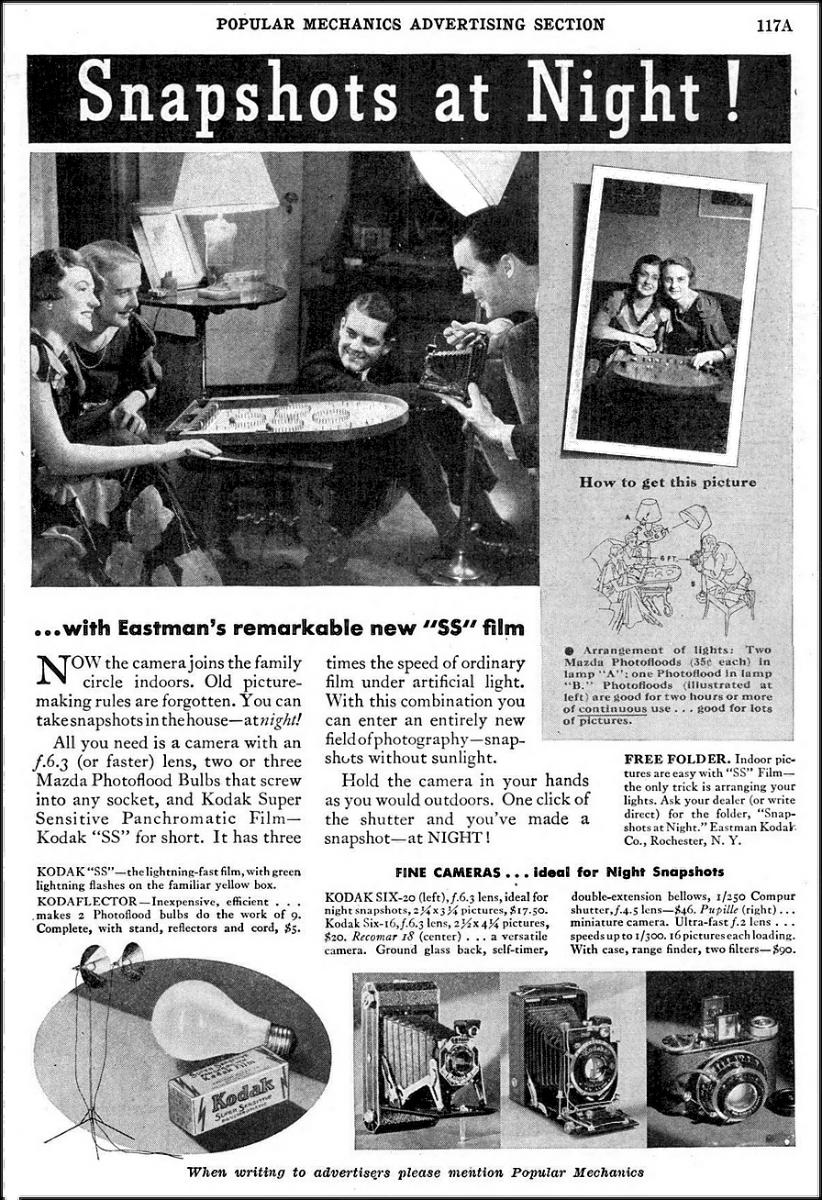
Eastman Kodak ad – February 1934

Toronto. Ahhh, 1934 (before I drew a breath) Kodak was advertising its newest film – Super Sensitive (SS)  Panchromatic – plus a couple of inexpensive cameras and special photoflood bulbs ready to screw into their special reflectors or into ordinary lamps.

The film and cameras where touted as ‘ideal’ for night photography. Sadly both film and camera lenses shown were SO slow that special photofloods had to be used to allow hand held indoor shots (a pdf of old Kodak catalogues is on this site)! (The f/2 lens on the Kodak Pupille camera was fast enough for Tri-X, but not for the SS film.)

A tip of the tuque and a big thanks to good friend and retired cinematographer, George Dunbar for sharing this delightful advertisement from the February, 1934 issue of Popular Mechanics, memorable to me as my dad married my mother that year and bought a  Kodak Six-20 a few years later.

Note, the title of this post is a riff on a song by Suzanne Vega called, “Knight Moves“. This song is on her first CD called “Suzanne Vega” released by A&M in 1985. I first heard her sing the songs on her second (1987) CD, “Solitude Standing”. Her a cappella version of “Tom’s Diner” is haunting.


Posted in history | Tagged , , , , , , | Comments Off on night moves

never heard of Hessercolor – have you?

A colour portrait of Delores del Rio (1936) by Hesser in Hessercolor

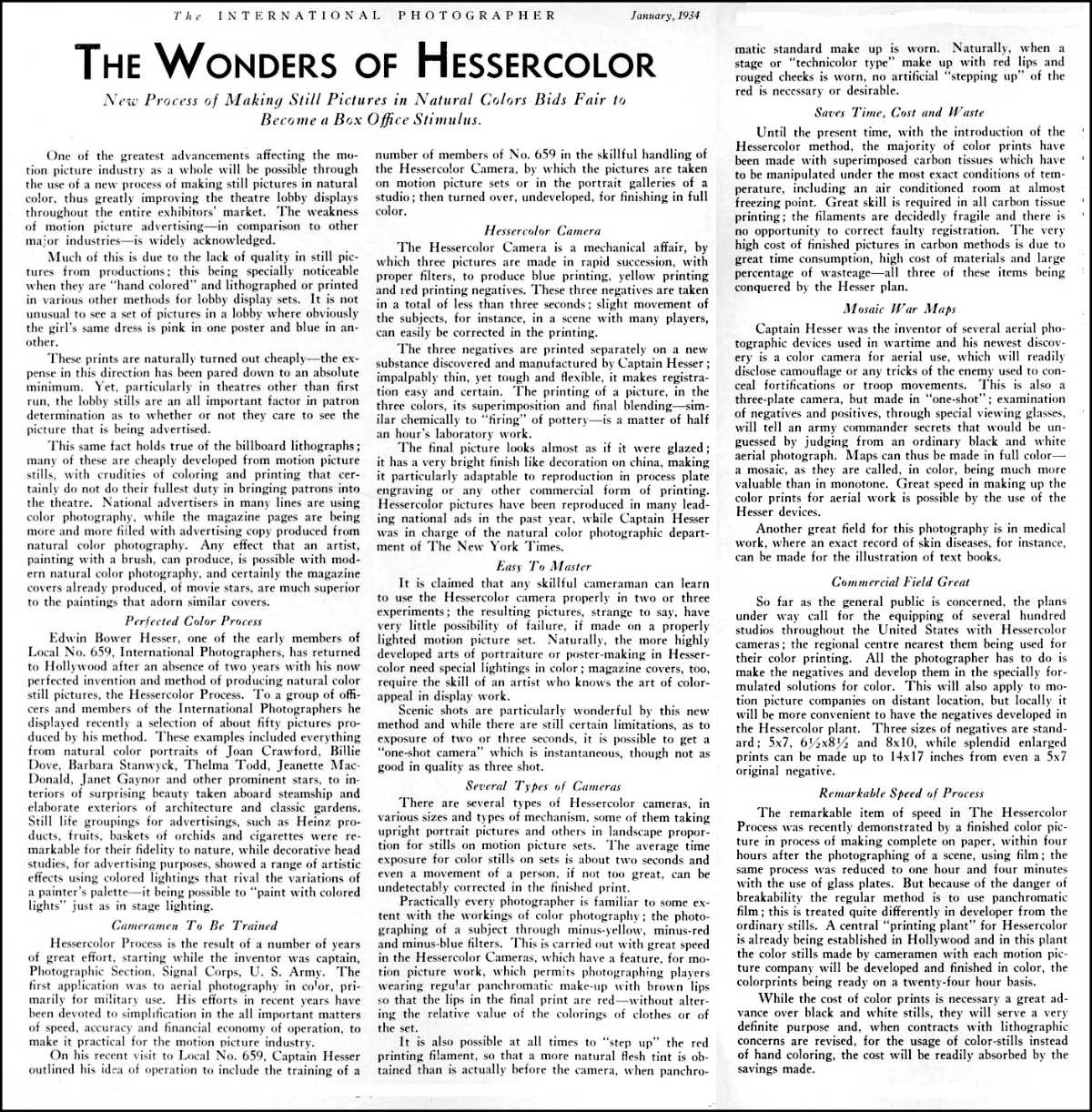
Toronto. George Dunbar sent me a link from the January, 1934 issue of International Photographer. titled, “The Wonders of Hessercolor“.  There is an interesting article on Hesser at “Broadway Photographs“.

Hesser took on Kodak and failed to succeed. He was trained as an artist, moved to Hollywood and took up photography. He became a well known portrait photographer in Hollywood. His process was an effort to improve the colour stills used in theatres to advertise movies.

Hesser designed a camera that used three filters on B&W film negative material – red, yellow, and blue. Each filter was used in very short succession then each negative was enlarged and layered on a special material to create the colour positive. His personal life was messy and he tended to shoot nudes as well as more acceptable portraits.

His process had disappeared by the time I discovered photography and his idea of using three filters in rapid sequence on ONE negative strip never took off.  The photograph used for this post is courtesy of Hollywood Pinups who  sell modern reproductions at reasonable prices.

Posted in history | Tagged , , , , , | Comments Off on never heard of Hessercolor – have you?

black is beautiful

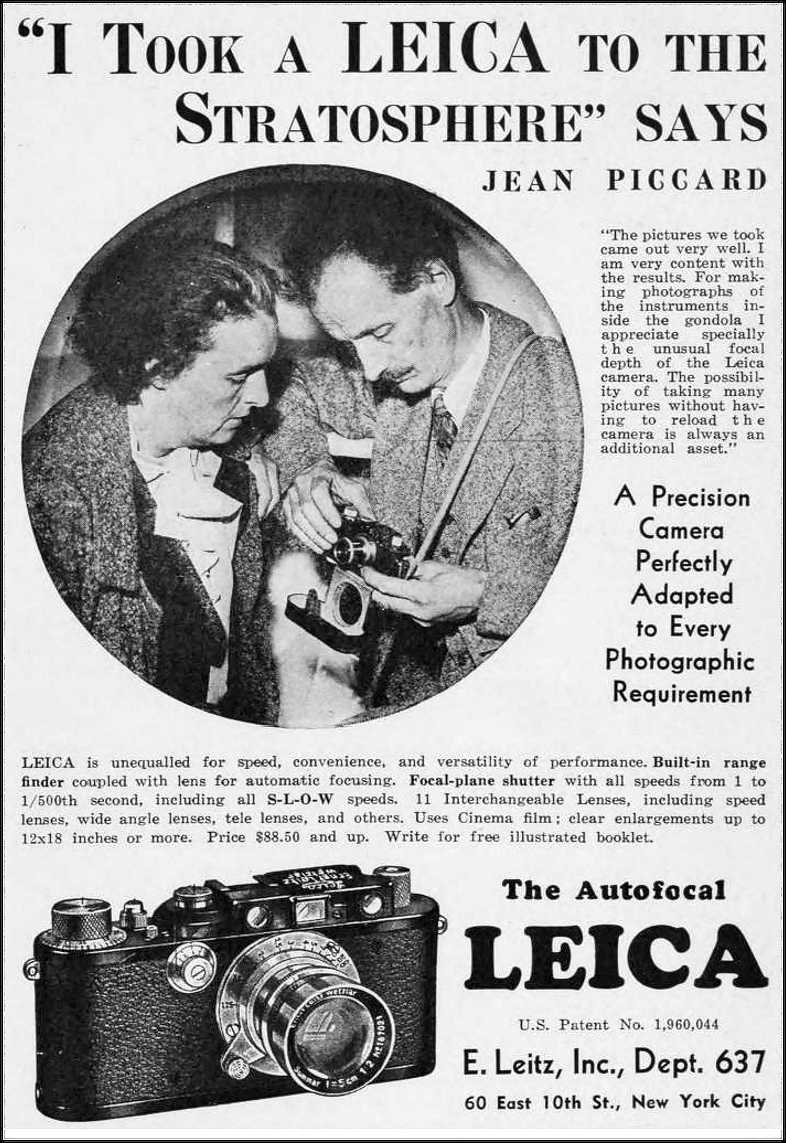
an ad in 1935 showing a black Leica

Toronto. In the 1800s and early 1900s, black enamel was a choice for finishing metal. Sewing machines, microscope bases, lamps, and even the ubiquitous Model T Ford all came in the black enamel finish. When Leica cameras were first sold, black enamel was also the choice of finishes. In later years, Leitz perfected the rub-resistant satin chrome making their cameras satin chrome unless specially ordered in black trim.

This ad from the mid 1930s shows a black Leica and another marketing concept or two: 1. advertisements showing the camera in use by famous explorers or scientists like Jean Piccard and his wife; and 2. emphasis on S-L-O-W shutter speeds via a separate front dial that retarded the release of the second curtain. Any Leica returned to the factory could have the slow speed mechanism added eliminating the need to buy a HEBOO accessory (the ad’s emphasis on slow speeds countered complaints that other cameras had slow speeds earlier) .

My thanks to George Dunbar for sharing this advertisement from page 33 of the January, 1935 issue of the American Cinmatographer .


Posted in history | Tagged , , , , , , | Comments Off on black is beautiful

sparking a revolution

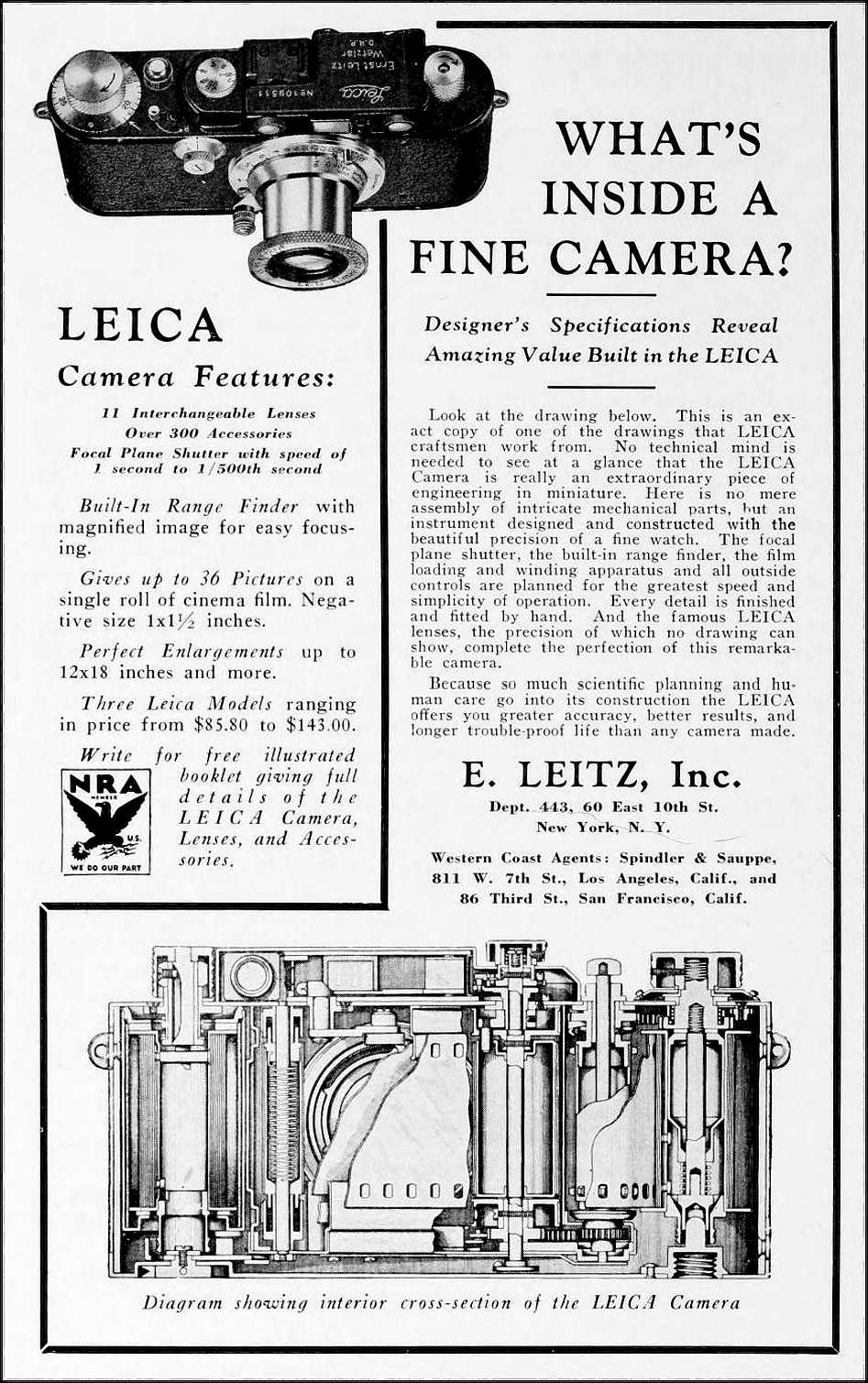
Inside a 1930s Leica

Toronto. While Leica wasn’t the first camera to use 35mm movie film, it was one of the first commercially successful 35mm cameras. The tiny marvel was the brain child of Oscar Barnack. The prototype (UR-Leica) was made by Barnack in 1913. WW1 arrived the following year and the camera was left as a laboratory curiosity, to be slowly improved over time. Post war, Ernst Leitz II struggled to find a product to keep his factory afloat so a decision was made to manufacture the tiny camera which became known as Leica for LEItz CAmera. Leitz himself took street shots with the camera in New York in 1919.

In 1924, commercial manufacture was begun and some cameras were sold. The following year, 1925, the camera was promoted to one and all at the Leipzig Fair. To counter the cameras of the day, Leica was promoted as making a “small negative, big picture”. By the time the great depression settled in, Leica was a system camera intended for professional, scientific and serious amateur photographs. By the mid 1930s the Leica and its competitors sparked the minicam revolution. Production nose-dived during WW2 and a few years after the war the revolutionary M3 arrived on the market world wide.

The ad shown above illustrates how Leitz NY promoted its camera to photographers in 1934. A big thanks is well deserved by my good friend and retired cinematographer, George Dunbar, for finding and sharing this ad from the January, 1934 issue of the International Photographer.

Posted in history | Tagged , , , , , | Comments Off on sparking a revolution

taken with a grain of salt.

A digital camera the size of a grain of salt

Toronto. Science seems to vacillate between analogue and digital concepts. The earliest radio receivers used digital – a “cat’s whisker” and a speck of solid state material.

Significant improvement occurred when technology shifted to analogue – vacuum tubes – then later last century back to digital again.

Similarly but on a much longer time scale, photography was initially analogue (films, glass plates, tintypes, daguerreotypes, salted paper) and then late last century and early this century, digital – with sensors getting smaller and denser raising both sensitivity and resolution.

The earliest photographic lenses too were analogue creating a very tight bundle of light. Multiple lens elements of different glass types and curves corrected distortion and created a flatness of field. Microscope objectives used tiny lenses – the diameter falling as the magnification increased and the NA – numeric aperture – decreased. But always with a great many elements – even more than in a photographic lens, especially as objective magnification and NA both increased.

Now (Monday, Nov 29, 2021) the Scientist Study web site reports results by researchers at Princeton University and the University of Washington that demonstrates a camera and lens the size of a grain of salt. The key to the design was creating a lens that reacted to light in a digital fashion! The result infers much higher resolution and smaller physical size than earlier devices offered.

The last colonoscopy I had, my surgeon offered a tiny camera in a pill capable of spotting a polyp about 5mm in size. Learning that the same pre-procedure cleansing process was used and any polyp discovered would need a colonoscopy anyway to remove it, I declined the pill since the cleansing was always the most onerous part of the procedure. Now a grain of salt size camera with higher resolution makes it time to reconsider ,,,,

My thanks to my friend Russ Forfar, deep in the wilds of southwestern Ontario, for suggesting this post and offering the above links.

Posted in camera | Tagged , , , | Comments Off on taken with a grain of salt.

Wet Plate Social to be held here December 20th

Come to this year’s Wet Plate Social at Horst Hergel’s studio

Toronto. You may recall our previous program co-ordinator, Yvette Bessels did wet plate photography. One of her contacts here in Toronto, Horst Herget, is holding a WET PLATE SOCIAL  this month in the east end of the city (Leaside).

Horst writes, “I wanted to reach out to you about an event I am planning for those interested in wet plate photography, details of which are below. If you have question, please do not hesitate to let me know.

“Best Regards,
Horst”

These are the details, courtesy of Horst –

“This month’s WET PLATE SOCIAL – WPS – is on Monday December 20th between 7-9pm at studio, @daylight_studio_toronto, in Leaside. For this get together we will be doing a Print Exchange. Please bring an 8×10” print of your work or cookies, chocolate, or something else altogether, totally up to you. Also, Horst will be photographing a few wet plate portraits. Tis the season for merriment so feel free to bring a beverage too.

“ABOUT: Wet Plate Social is a get together to talk, ask questions and share all things wet plate photography. From first timers to old timers, the event is open to all that are interested in the beautiful and humbling art. This event is hosted by Horst Herget @horst.herget, www.horsth.ca.

“WHEN: December 20th, from 7 to 9pm.

“LOCATION: Daylight Studio in Toronto: 28 Industrial Street off Laird, (off Laird, south of Eglinton), unit 222; @daylight_studio_toronto.

TO ATTEND: please RSVP to @horst.herget or tintype@horstherget.comDOUBLE vaccinated attendees only, please.

“CORRESPONDENCE AND UPDATES: please contact @horst.herget or tintype@horstherget.com

“FUTURE MEET-UPS: will continue to be held on the third Monday of the month forward into 2022.”

Posted in activities-other | Tagged , , , , , | Comments Off on Wet Plate Social to be held here December 20th

celebrating 100 years of Bergenland as part of Austria

Rust, farmer with harvested Burgundy beets, 1931 by Franz Swoboda

Toronto. Our friends in Westlicht, are mounting an exhibit originally planned for a November start but now beginning December 14, 2021 celebrating a century of Bergenland photographs, titled “BORDERLAND IN FOCUS. 100 YEARS BURGENLAND“. The exhibition was delayed by COVID. The famous auction house needs the help of us all to promote this event.

Westlicht explains, “As you know, we had to start the exhibition GRENZLAND IN FOKUS. 100 YEARS BURGENLAND postponed due to lockdown. 

“But now we want to be there again for our visitors. We are showing the remarkable exhibition from December 14th and would be delighted if you could support us with an announcement during this difficult time for all cultural establishments.

“The exhibition was created in cooperation with the Burgenland Cultural Companies and the Burgenland Provincial Archives and offers an exciting photographic journey through the history of the youngest Austrian federal state.”

Feel free to copy this material. Browse the exhibit news on line via Google or your favourite search engine (eg. use the search words: GRENZLAND IN FOKUS. 100 YEARS BURGENLAND) .

Posted in activities-other | Tagged , , , , , | Comments Off on celebrating 100 years of Bergenland as part of Austria